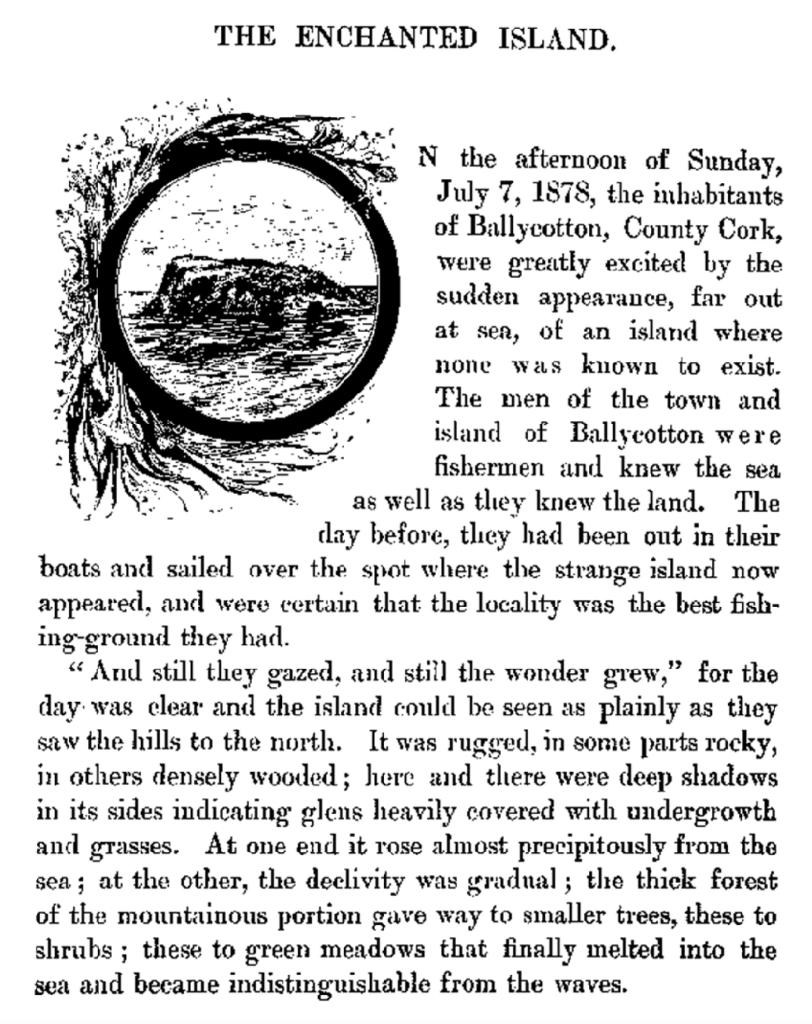
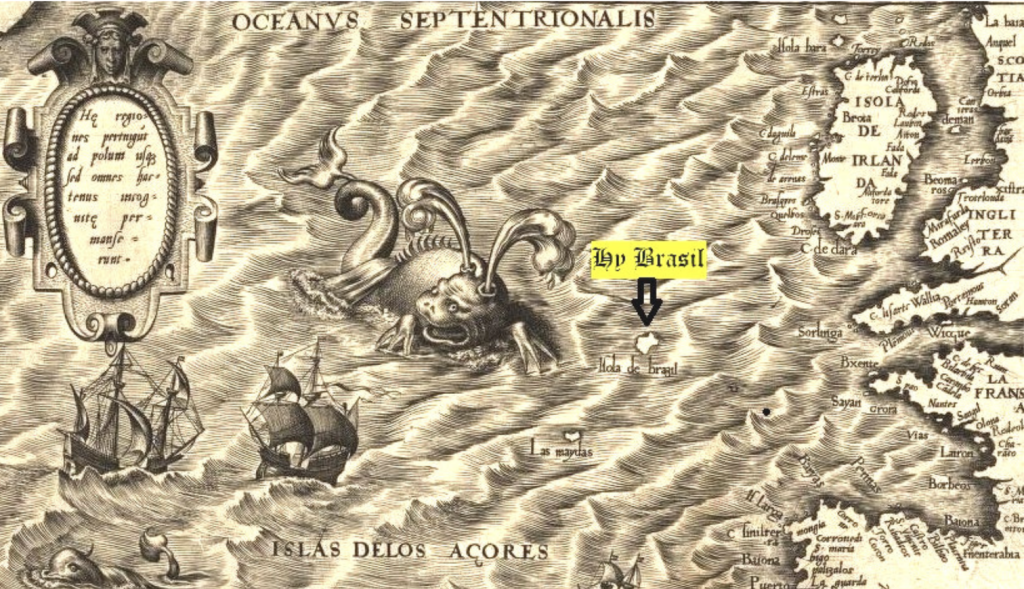
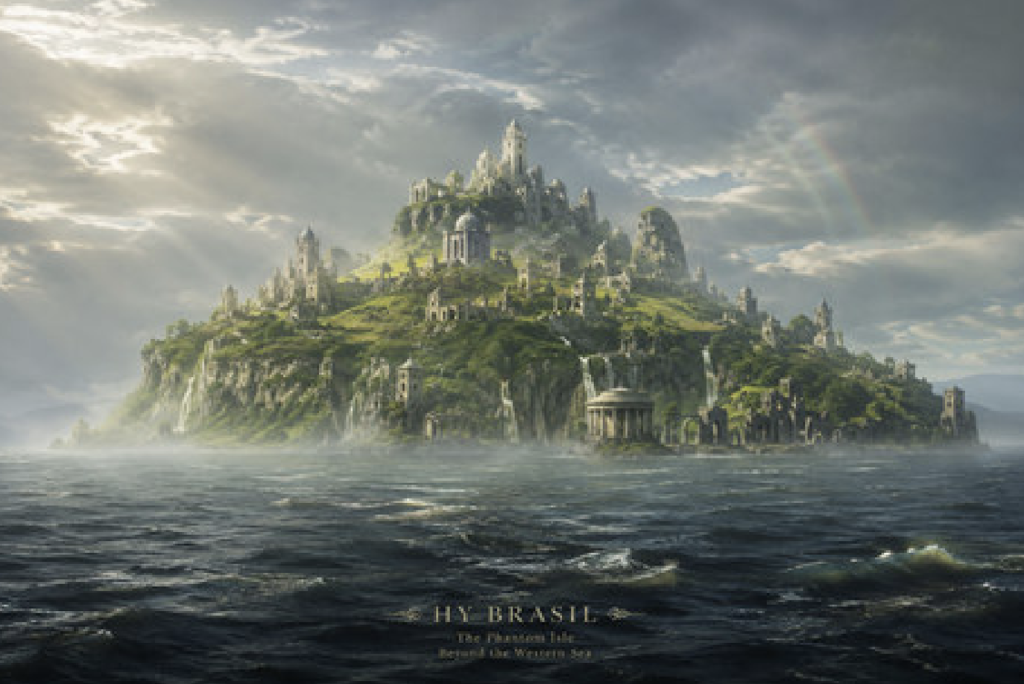
Stories of a distant and strange island located far off the west coast of Connemara have haunted and intrigued people from earliest times. According to legend, the mystical island of Hy Brasil lies somewhere off the west coast of Ireland. People believed it was a happy realm of light and enchantment; a place they said, ‘free from the pitiless touch of age, decay and sorrow and they called it by beautiful names: Hy-Brasil – Isle of the Blessed – Tír na nÓg – Land of Youth’. There are stories of heroes and bards being enticed away by beautiful maidens and taken to this golden land. All who love old Celtic legends are familiar with Oisin, the warrior poet of the Fianna, who fell in love with Niamh of the Golden hair. They left Ireland together and crossed the ocean to Tír na nÓg on an magical white horse. An old story-teller once said there were times while watching the sun go down on Galway Bay it wasn’t difficult to imagine how these tales had arisen. Some said, ‘Hy-Brasil was a land kept hidden by special ordinance of God as the terrestrial paradise’. An old scribe wrote:
Men thought it a region of sunshine and rest,
And they called it Hy-Brasil the Isle of the Blest,
The golden clouds curtained the deep where it lay,
And it looked like an Eden, away, far away.
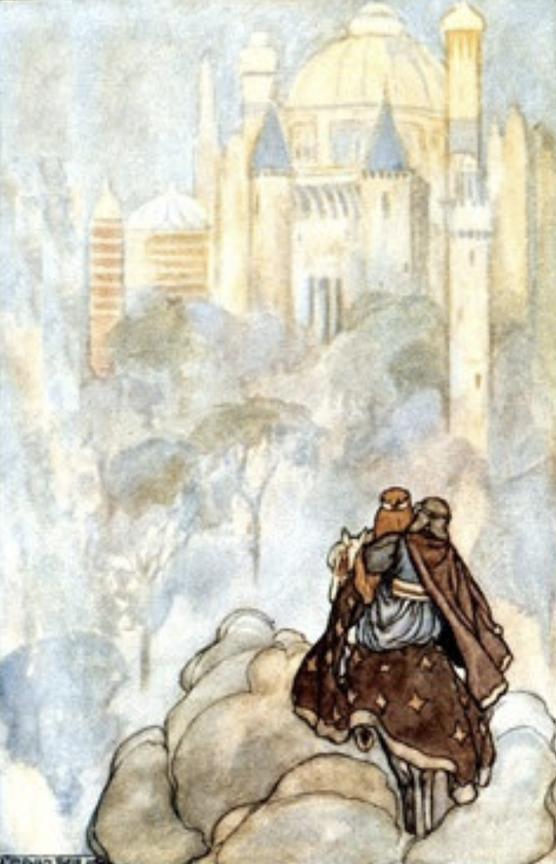
Others believe that Hy-Brasil derived its name from a Firbolg chieftain named Breasal who lived in the Galway area in ancient times. His daughter, Galvia, was drowned in the River Corrib many centuries ago and according to legend it was from her that the city derived its name. The island is shrouded in myth and legend, and there are many stories surrounding this, ‘Isle of the Blest’. There is an old legend of sailors going in search of the island, but no matter how fast they sailed, the island seemed to continually move away from them making it impossible to reach its enchanted shore. They sailed for months over a troubled ocean and eventually the island faded away. The story ends with these sailors discovering a new land, which they named ‘Brazil’ because of their quest.
Hy-Brasil is said to be the most intriguing of all the legendary islands of the Atlantic Ocean. Although named and placed on maritime charts from the fourteenth century its legend goes back much further to pre-Christian times. Celtic people believed in the existence of a wonderful land situated beyond the Atlantic horizon and called it the Blessed Realm (Hy-Brasil). It seems to have first appeared in Irish text during the seventh century. This was in an ancient Irish manuscript known as The Voyage of Bran, which is a combination of poetry and prose. This tells a story of Bran visiting an ‘Other World’ a supernatural realm of everlasting youth, beauty, health and joy.
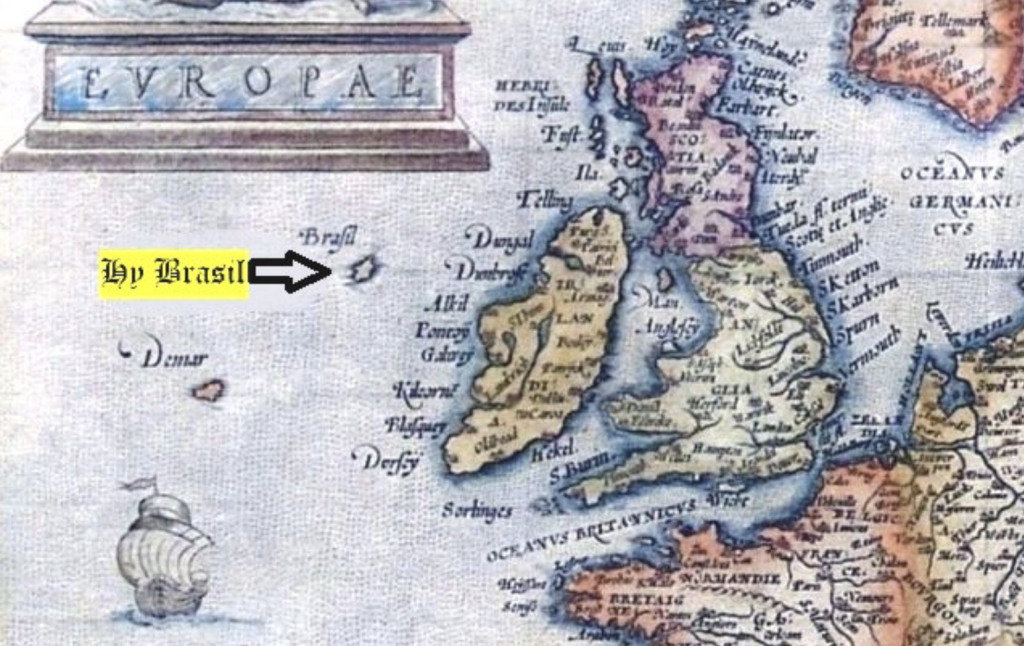
There is also a tradition that Saint Brendan the navigator landed on Hy-Brasil during his famous sixth century voyage. It seems that the old stories awoke Brendan’s imagination. He believed that the island lay far beyond the setting sun and decided to place his trust in God and set out in search of this charmed land. After fasting for forty days and nights, Brendan chose fourteen monks to accompany him on his voyage. He sailed first to the Aran Islands where he met with Saint Enda. According to the story, Enda was able to give him valuable advice before leaving, as Hy-Brasil could sometimes be seen from Aran. It was recorded that the monks set sail with ‘faith and caught winds that softly blew them westward on their course’. During his seven-year voyage, Brendan supposedly landed on a number of other islands also and the stories mention some amazing experiences. He is also believed to have reached America. Following his return to Ireland he apparently shared his experiences with Saint Enda. He referred to the island as the ‘Promised Land’, a blessed land of saints. There was a ninth century biography written about Saint Brendan called, Navigatio Sancti Brendani, which contained a description of the island. This account indicated that it was circular in shape, but shrouded in mist. There was a river running across the centre of the island, which can be seen on some later maps. The manuscript also mentioned that the island was only visible for one day every seven years and cannot always be reached. Its exact location has never really been verified as the island seems to be sited in different places on various maps.
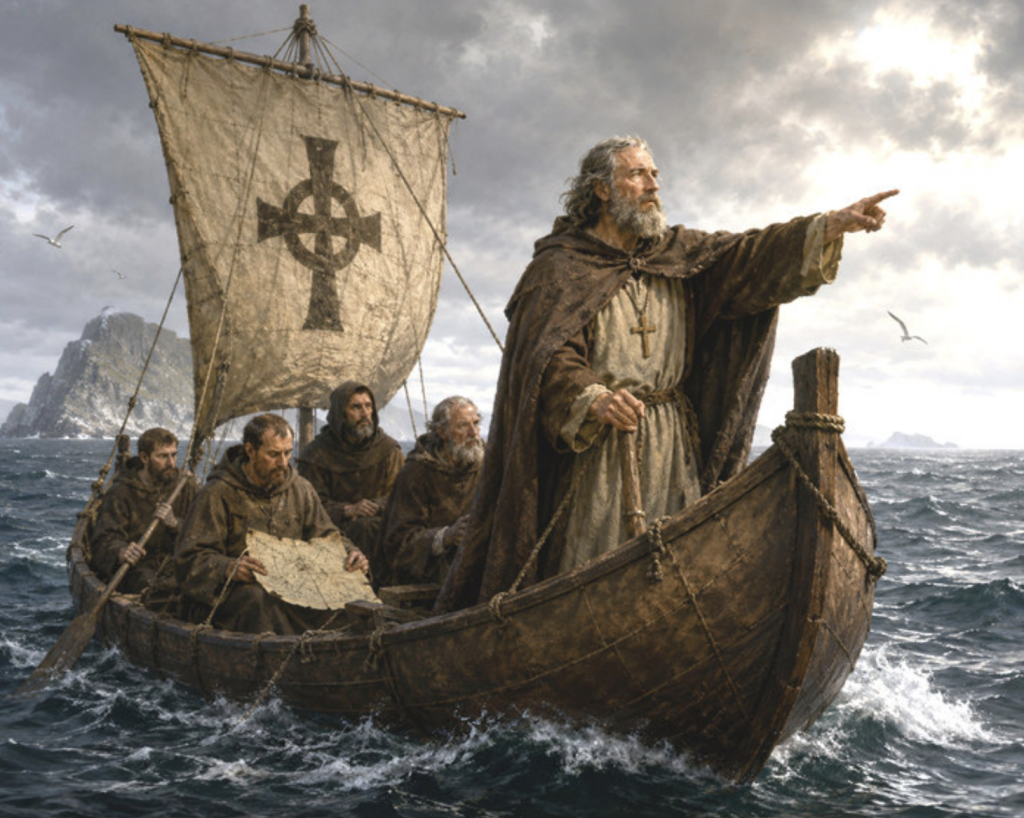
There are several, but similar descriptions recorded of the Brendan voyage. The story of Brendan and his Atlantic pilgrimage spread across Ireland. Some sources say that by the eighth century, there was a need to create an ‘imagery’ perfect replica of the ‘Paradise Land’ mentioned by Brendan. However, people were not prepared to travel for seven years over an unknown ocean in search of this island and so the legend grew. In order to make the story more realistic they had the island appear every seven years the same length of time as the Brendan voyage.
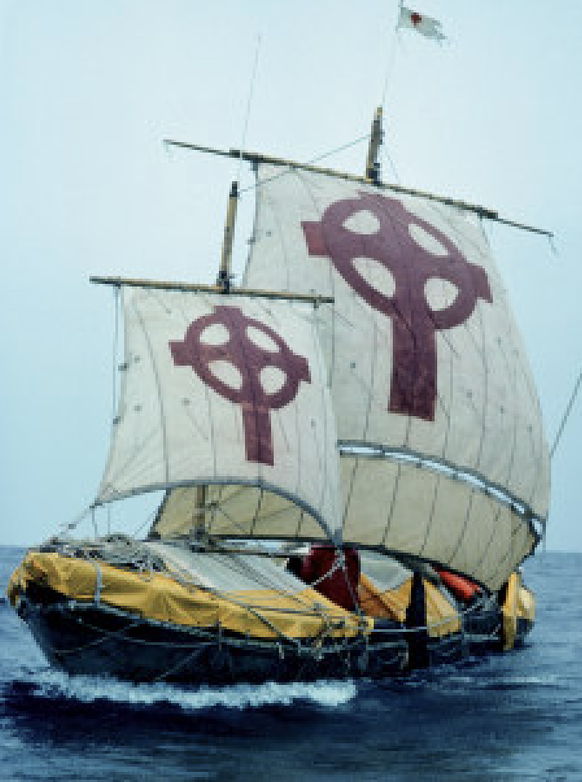
The entire legendary ‘Brendan Voyage’ is hugely intriguing and extremely interesting, but this is another story. Although dating from a later period, a description of the boat building technique used for the Brendan voyage survived. In 1977, Tim Severin (writer and explorer) built a replica boat and set off with his crew from the West of Ireland. They sailed up through the Hebrides and Faroe islands, past Iceland and reached Greenland. From there they crossed the Davis Strait to Newfoundland, proving that Brendan and his monks could have voyaged as far as America.
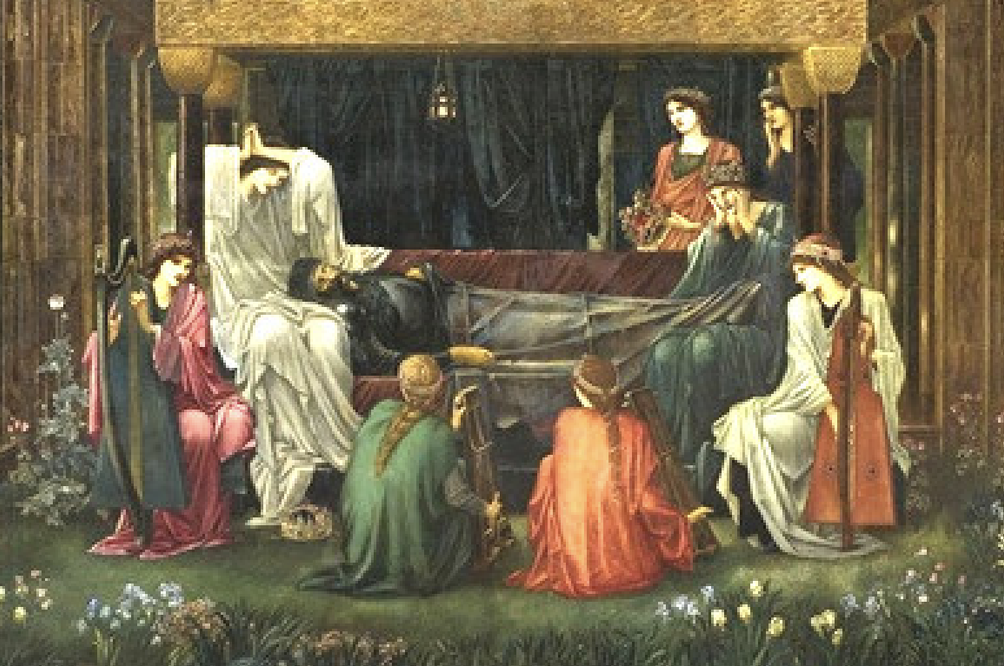
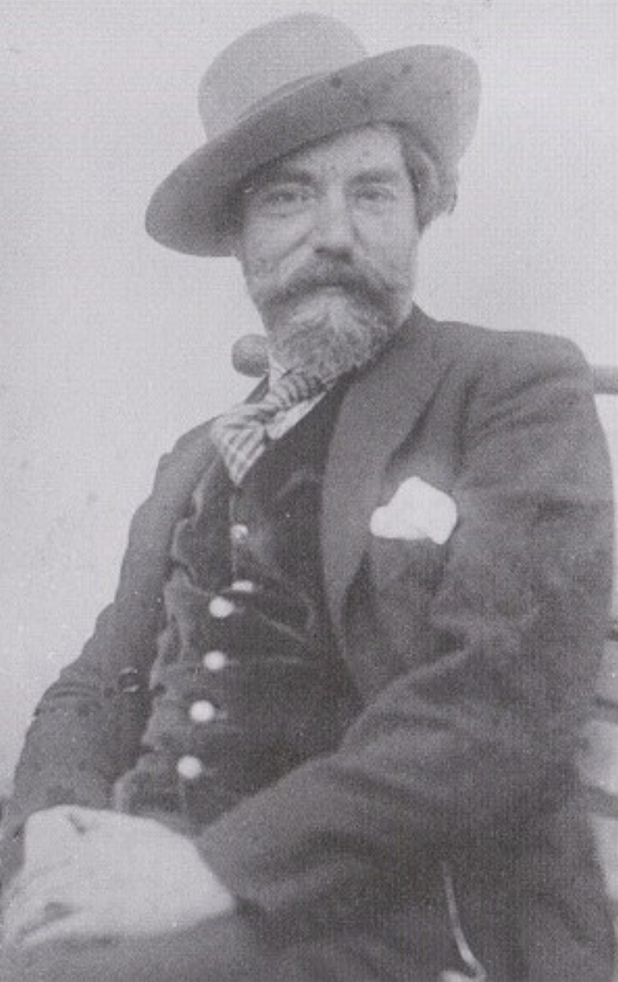
There was also a strong belief of Hy-Brasil in England during the middle ages and the island appears on several British admiralty maps. While Glastonbury is the legendry burial place of the renowned King Arthur of Camelot, there was another tradition indicating that he was laid to rest on Hy-Brasil. According to the story, Morgana, the sorceress, had him buried on the island and then cast a spell of enchantment so that no mortal would be able to find Hy-Brasil. Morgana was supposedly granted her powers by the famous wizard, Merlin. The noted Welsh artist, Augustus John, claimed he saw the phantom island as a child while walking with his father along a sea shore near his home. John called to his father and pointed to the island, but the man merely muttered something and quickened his pace. As John looked back towards the island again it vanished. He later wrote that he believed that it was Tír na nÓg, the mythical land of the young.
According to the proceedings of the Celtic-Nordic-Baltic symposium held in 1996, the celebrated island of Hy -rasil was well-established by the late Middle Ages. Oral traditions mentioned that it could be seen rising above the water at sunrise on May morning every seven years. On one occasion a number of men set out in a boat in a bid to reach the island. They brought ‘red embers’ from a fire which they believed that by throwing them onto the shore it would break the magical spell and the island would then remain on the surface forever. As they came close to the island, they saw a girl sitting down knitting under a tree. She threw the knitting spool into the boat attaching it to the island. The boat began to shake violently and the island started to sink beneath the sea. One of the men placed a red ember on the spool and split the connection; this saved the boat from going down. There was a similar story dating from 1636 that describes the island as having a lush green landscape with delightful hills and wooded areas. In this account, the island could also be disenchanted if a red-hot coal was thrown onto the shore.
There are many more tales and eyewitness accounts of this ‘mythical’ land where ‘bells tolled over an old sea’, but the island vanished every time sailors attempted to land there. There have been many reports of Hy-Brasil being seen from the Aran Island and Connemara, where some people called it ‘Beag Árainn’ (small Arann).