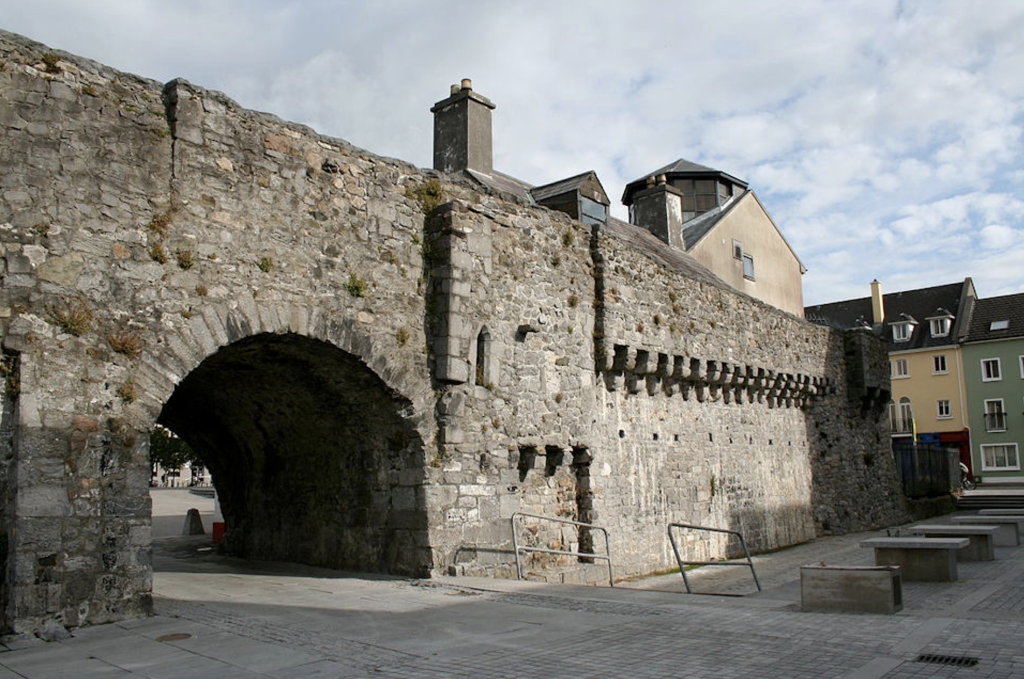
By the beginning of the 16th Century, Galway had become widely recognised as a prosperous city. The 1651 Pictorial Map of Galway shows the fortified City walls with fourteen towers and fourteen main streets and includes many luxury homes owned by wealthy merchant families. Foreign trade drove their success, and Medieval Galway became an important international port of commerce. Prosperity largely derived from trade with countries such as Spain, which gave Galway strong Spanish influence in its culture and fashion. Spanish galleons frequently docked in Galway’s port, exchanging goods like wine, spices, and textiles for Irish wool, fish, and hides. This lively trade fostered strong ties between the two regions, and Galway people were regarded as educated and sophisticated in manners and style. Indeed, many Galway families made pilgrimages to the Shrine of St James in the Galician capital throughout this period. But a darker episode in Galway’s connections with Spain unfolded in September 1588.
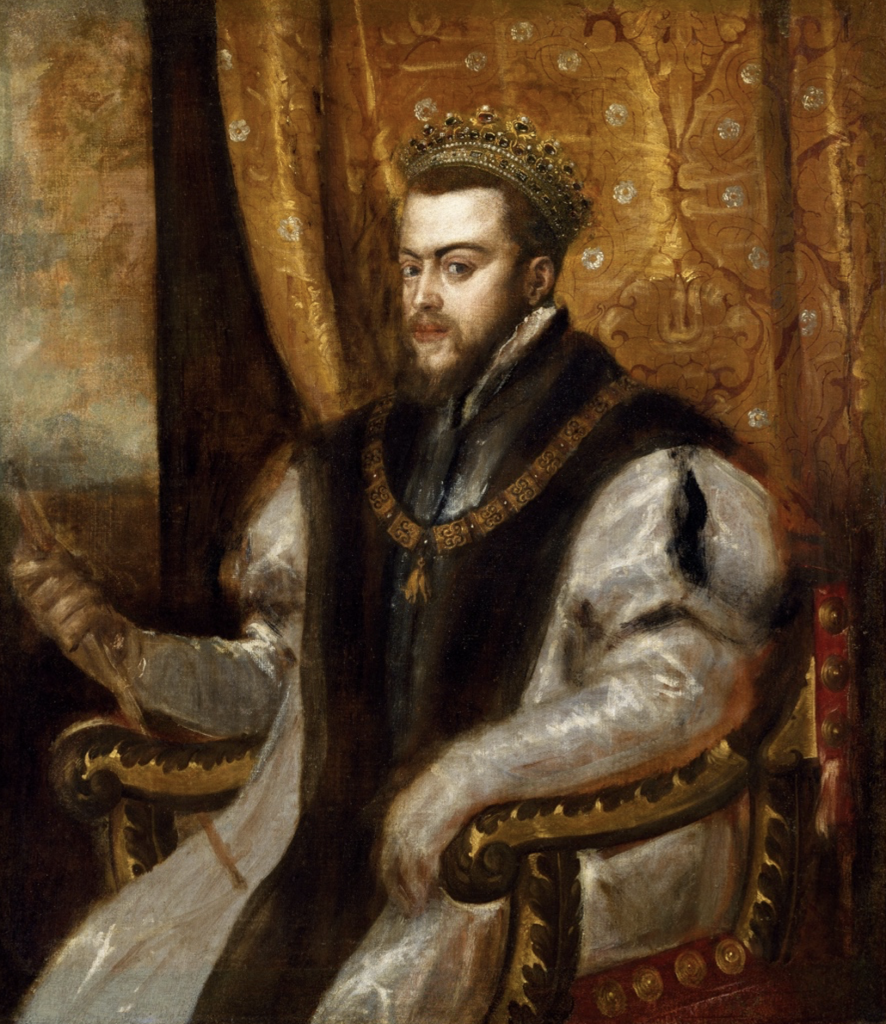
King Philip II of Spain had long considered invading England and restoring the Roman Catholic faith, and English piracy against Spanish trade and possessions only added to the provocation. From around 1585, Sir Francis Drake had carried out a series of damaging raids against Spanish commerce in the Caribbean, and this finally convinced Philip that a direct offensive against England was necessary. He decided to use troops from the veteran and battle-hardened army of the Spanish regent of the Netherlands, under the command of the formidable Alexander Farnese, Duke of Parma, as the main invasion force. To escort an army from Flanders to invade England, he needed to send enough naval strength from Spain to carry these troops and defeat or deter the English fleet. After two years of preparation and some damaging delays, the Spanish Armada set sail from Lisbon in May 1588 under the command of the Duke of Medins-Sidonia. The fleet consisted of 130 ships, about 8,000 seamen, and close to 19,000 soldiers, making it a formidable seaborne force.
Shortly after setting sail, gales briefly forced the Armada to return to port and refit at A Coruña, with the fleet finally setting sail for England in July. Towards the end of July, the first at-sea skirmishes between the Armada and the English fleet took place off the south coast of England. The Armada reached the Strait of Dover on the 6th of August and anchored in an exposed location off Calais in France. Under cover of darkness the following night, the English, under Admiral Howard, in an attempt to prevent it from reaching its rendezvous with the Army of Flanders, launched fire-ships – vessels set alight with pitch and tar- into the Spanish fleet lines, resulting in the breaking of the Armada formation. In what became known as the Battle of Gravelines, the English fleet attacked the disorganised Spanish fleet, which sustained significant damage and casualties, driving them northward towards the east Scottish coast. The Spanish fleet was still noteworthy in size, with some 110 ships, but many were now damaged by gunfire, and supplies were low. Medina-Sidonia set a course to clear the Scottish coast to the north at a distance of some 160km and head into the open Atlantic; the fleet was then to steer along the west coast of Ireland, giving it a clear run to the northern Spanish coast. However, the Armada failed to keep its course around Scotland, and violent Atlantic storms drove up to 33 ships off course and onto the west coast of Ireland.
The Falcon Blanco Mediano ran aground on reefs in Ballynakill Bay near Clifden with much loss of life, and on the night of the 25th of September 1588, in the midst of a severe Atlantic gale, the carrack Concepción de Juan del Cano – a ship of the Biscay Squadron of the Spanish Armada with 255 men and 18 guns onboard – while seeking a safe haven from the storm, was lured onto a shingle beach called to this day Duirling na Spáinneach, the Pebble Beach of the Spaniards, at Carna just east of Mace Head. This was reported to have been done by Tadgh na Buile Ó’Flatharta, known as Tadgh of the Blows or the Ferocious O’Flaherty, who lived in Airde Castle, by placing false bonfire beacons on the shoreline. O’Flaherty chiefs had sworn allegiance to the King of England and, by doing so, were able to hold onto their land, part of the ‘submit and re-grant policy’. Another account says the Concepción de Juan del Cano initially tried to enter Galway port itself. However, because some sailors sent ashore to negotiate were treated roughly, and guns mounted on what is now known as the Spanish Arch fired at the ship, the captain decided to head back out to sea. In his account in A History of Co Galway, Peadar O Dowd claims that a third ship, anchored off Barna, was involved and had sent up to 70 men into Galway, all of whom were captured and were to suffer a similar fate to the survivors of the grounding of the Concepción de Juan del Cano.
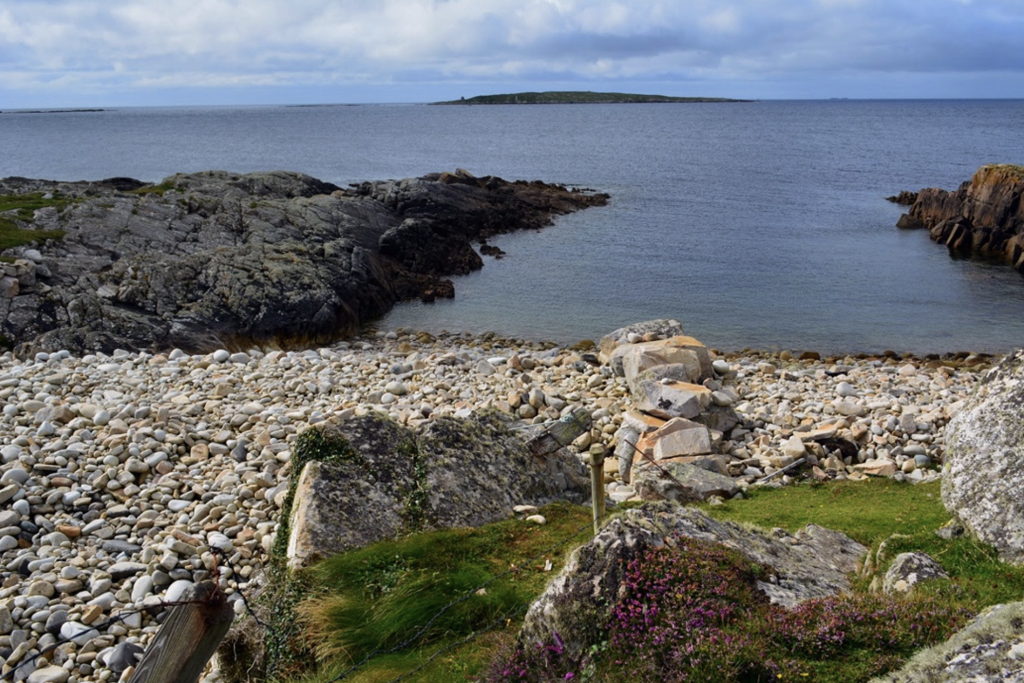
Numerous ships of the Armada had lost their sea-anchors when their hemp ropes had been cut away trying to escape the English fire-ships off Calais. As a result, when driven shoreward by the gales of that September, many did not have the means to anchor at sea. Of the complement of 255 on board the Concepción de Juan del Cano, only 30 men were to survive the landing that day; most drowned or were slaughtered on or near the beach on the orders of Tadhg na Buile, and their bodies buried in the nearby bogs. This atrocity was prompted by the instructions that had been issued in Dublin in early September 1588 because of a paranoid fear of an intact Armada making a concentrated effort to land in Ireland. The Lord Deputy of Ireland, Sir William Fitzwilliam, had issued a proclamation which stated:
‘We authorise you to make enquiry by all good means, both by oaths and otherwise; to take all hulls of ships, stores, treasures etc. into your hands; and to apprehend and execute all Spaniards found there, of whatever quality soever. Torture may be used in prosecuting this enquiry.’
Dublin was not to know that Philip of Spain had issued specific orders to the fleet admirals telling them to avoid landing in Ireland at all costs. The survivors of that fatal morning were then summarily transported into the city of Galway by the O’Flahertys.
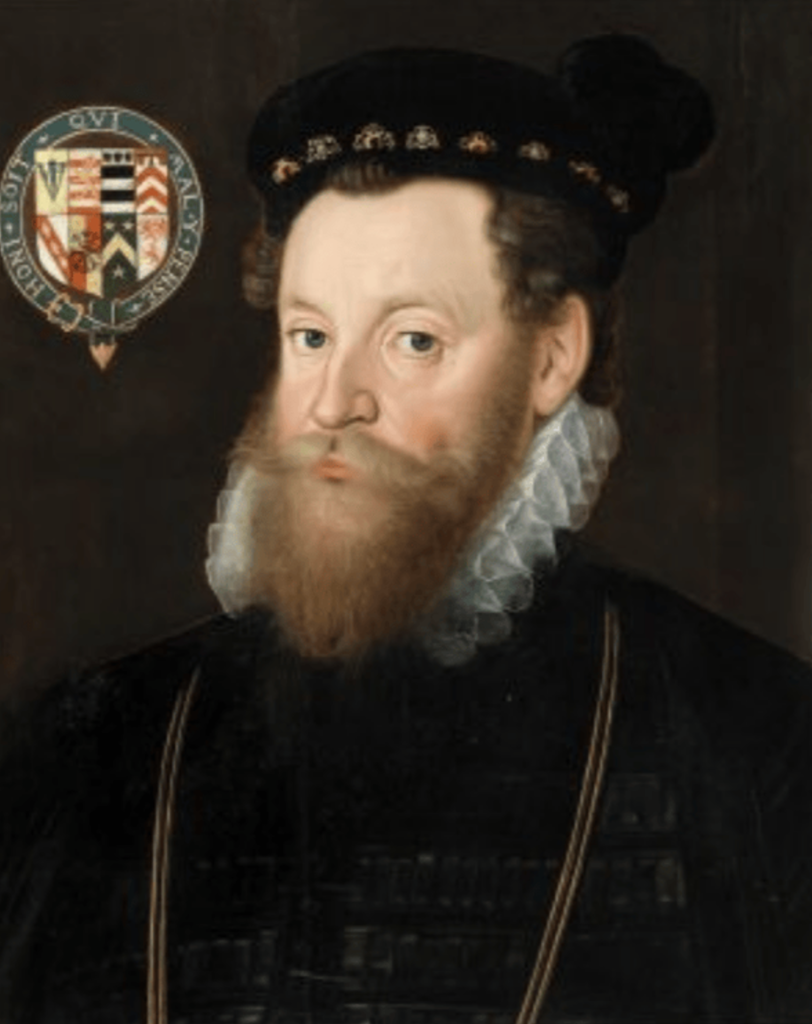
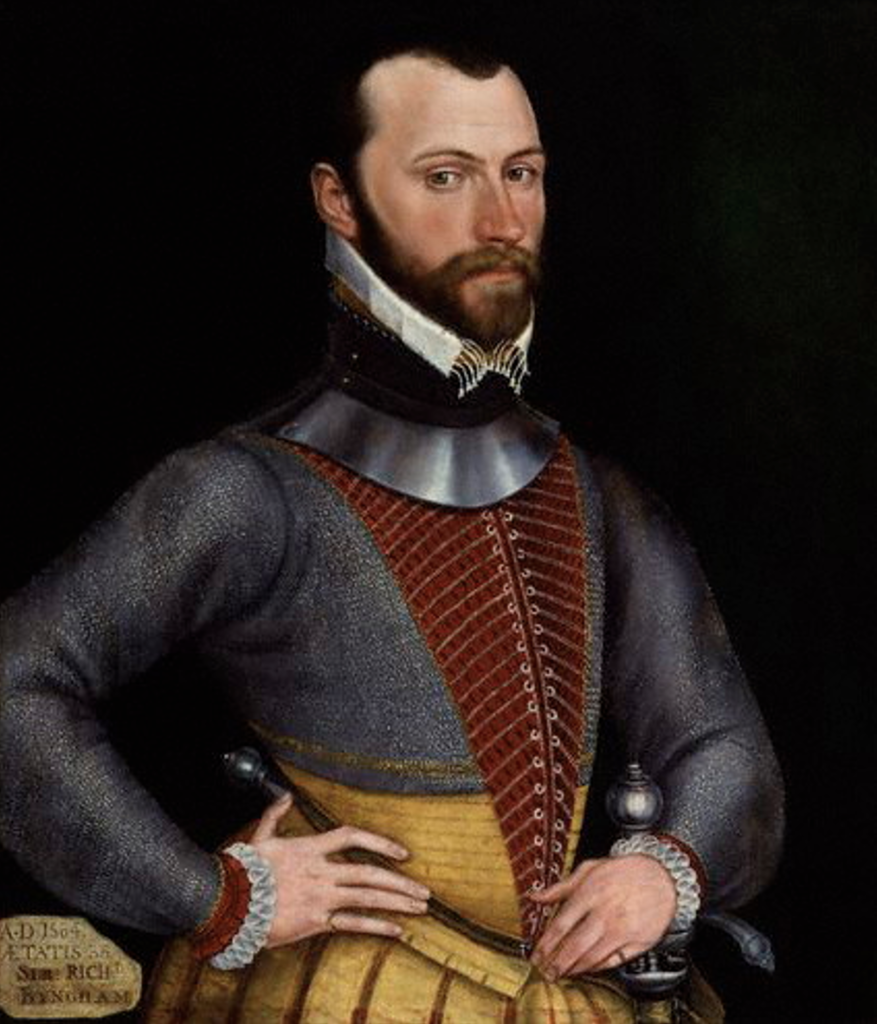
The surviving sailors from the Concepción de Juan del Cano were imprisoned in Galway with approximately 300 other Spanish sailors from other Armada shipwrecks up and down the west coast of Ireland. On the orders of Sir Richard Bingham, Lord President of Connaught, all but 40 were swiftly executed by beheading by citizen executioners and buried on the graveyard hill of the Augustinian Abbey, otherwise known as Forthill Cemetery. Those spared were presumed of high ransom value, and six young Dutch boys. Bingham wrote in the aftermath to Fitzwilliam, professing that ‘having made a clean despatch of them’ that ‘he rested all day Sunday giving praise to and thanks to God ‘. Bingham also wrote directly to the Queen asking that he be allowed to override his superiors’ ‘execute-all’ orders and spare the remainder of the captives. On reaching Galway, Lord Deputy Fitzwilliam was furious and ordered George Bingham, Sir Richard Bingham’s brother and aide-de-camp responsible for the custody of the Spanish prisoners of high worth and the Dutch boys, to execute everyone. The order was duly carried out, but two ordinary Spaniards, hidden by the people of Galway, later made their way home to Spain. In addition, two noblemen, Don Luis de Cordoba and his nephew Gonzalo, were ransomed. The people of the town took pity and laid all who had perished to rest in Forthill.
In late September of 1588, the Privy Council in England, reacting to news of the atrocities, issued a directive instructing Fitzwilliam to desist, which stated:
‘Their Lordship’s pleasure (the Privy Council) is that great care be had of their safe custodie (the Spanish prisoners) and keeping in some convenient place that hereafter they may be forthcoming, where their Lordship shall require them at his hands.’
By the time the Privy Council order was relayed to Fitzwilliam, nearly 1500 Spanish sailors and soldiers of the Armada had been executed on his orders. In addition, a further 3,750 men were reputed to have drowned when the Armada floundered along the west coast.
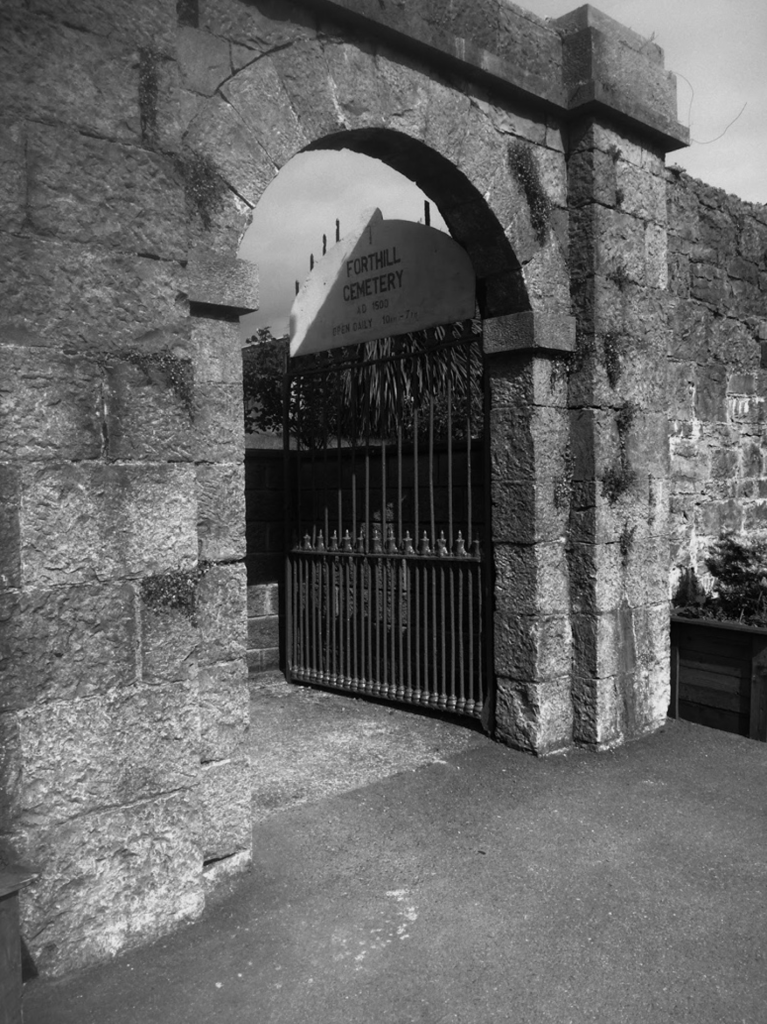
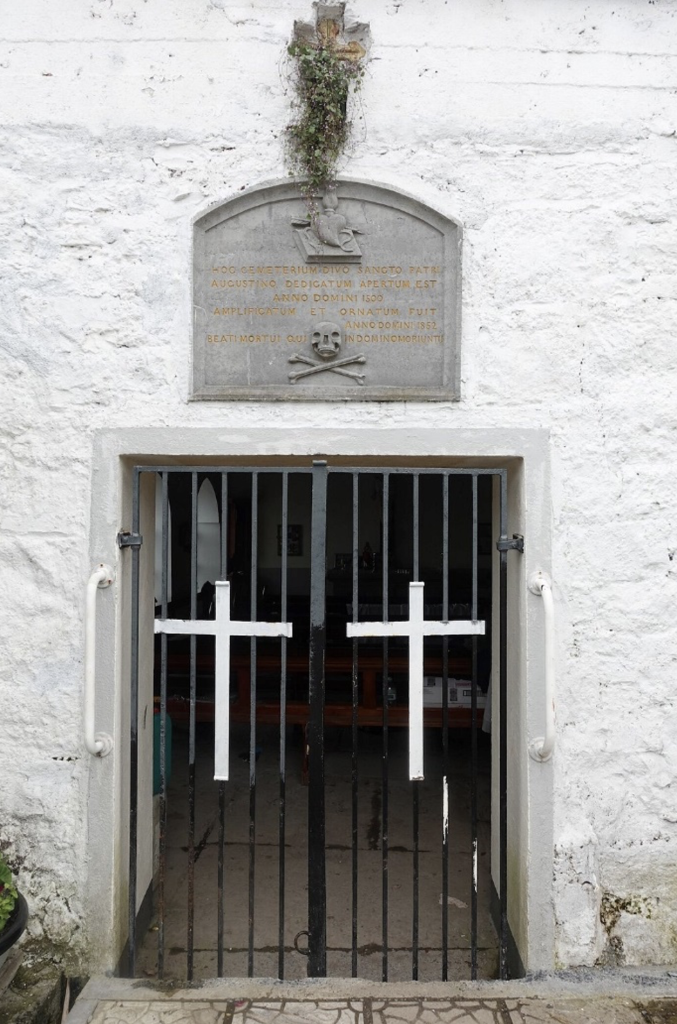
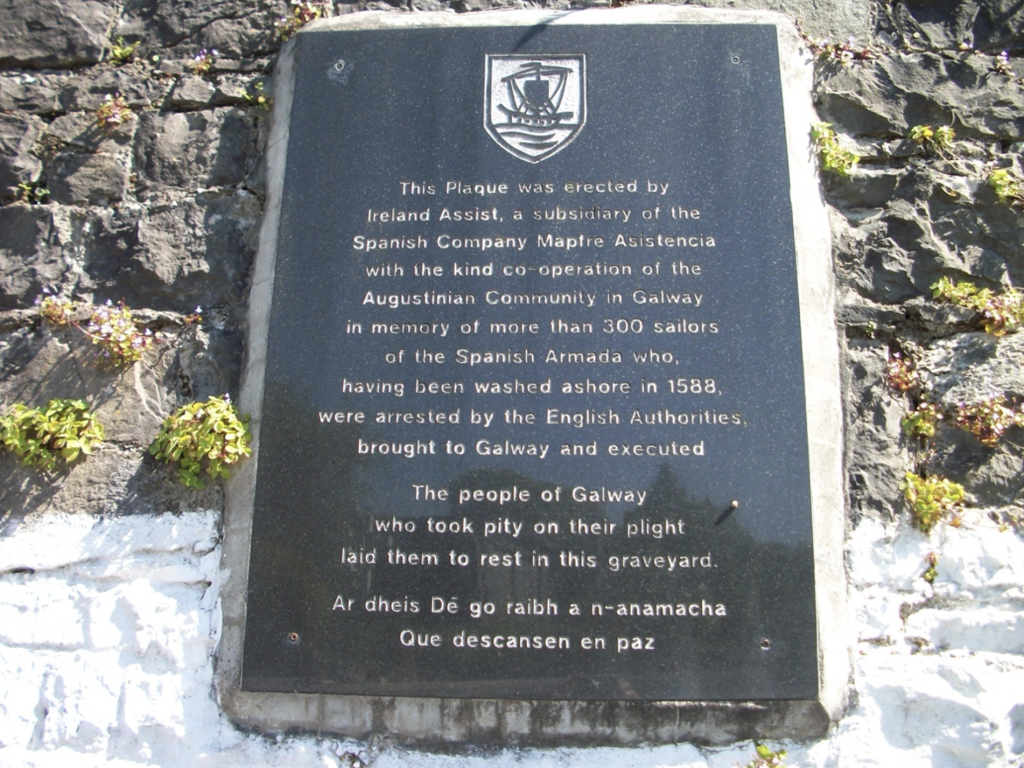
Native Irish treatment of the Spanish survivors was varied, with many Irish Lords siding with the British crown. Others attacked the Spanish for their money, clothes, jewellery, and whatever could be salvaged from ships. But as was evident by the humanity of the ordinary people of Galway, others shielded Spanish sailors and troops, and yet others afforded dignity to the bodies of those executed in 1588. Despite the Armada’s fate in Ireland, the late 16th century saw a strong bond form between Irish Catholics and the Spanish monarchy, through mutual hostility to Protestant England. The atrocities perpetrated against the Spanish sailors of the Armada, brought against their will to Galway in September 1588, have been commemorated in Forthill Cemetery, Galway, the place where they were executed and buried. There are two plaques to the sailors of the Armada who were executed in Galway in Forthill Cemetery. The first is just to the left as you enter the gate, and the second is midway along the east wall.
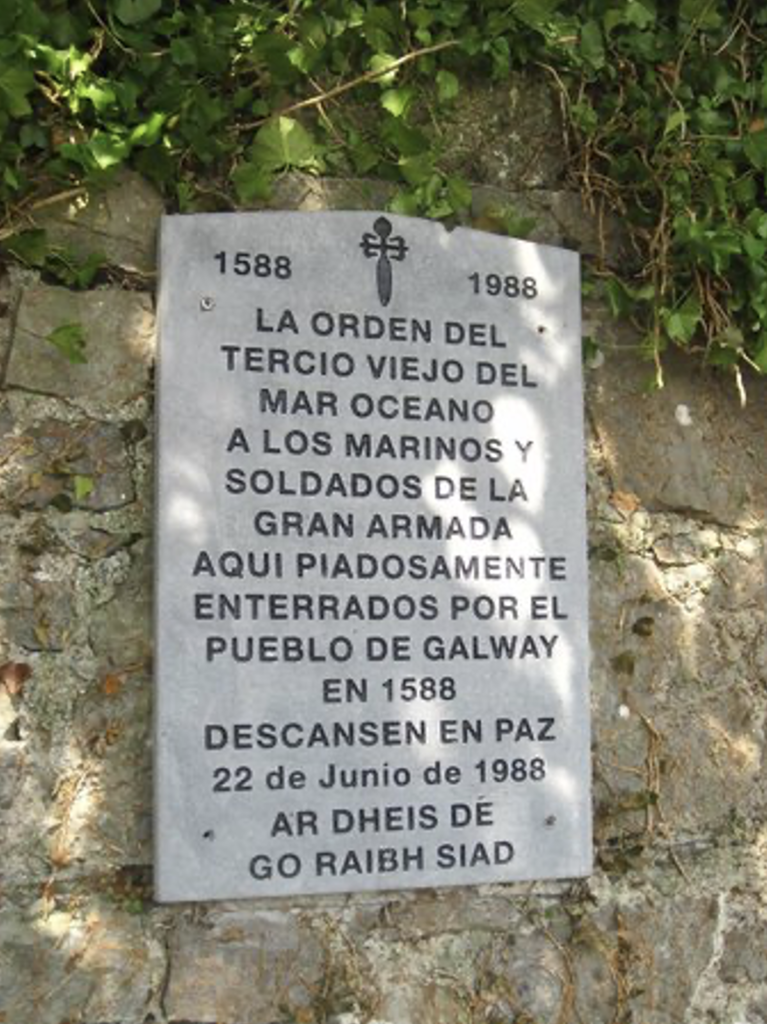
The plaque erected on the east boundary wall of Forthill in 1988 was to commemorate those Spanish sailors killed and buried there in 1589. Members of La Orden Del Tercio Viejo Del Mar Oceano, the world’s oldest marine corps, which traces its origins to the Spanish Armada, installed the plaque alongside the Spanish Ambassador. Peadar O Dowd, in his A History of Co Galway, revealed that on that day in June 1988, the members of the marine corps were decked out in silver helmets and breastplates modelled on those worn in the sixteenth century, and evidence for this is also captured in an RTÉ newsreel of the day.[1] Peadar also told an interesting, connected story about a time he visited Inishbofin Island. Speaking to an elderly local man about the fate of these ships of the Armada, the man referred to the sailors as na fir bhuí (the yellow men). This most likely referred to the yellow uniforms worn by the Armada marine corps, and it stands as testimony to the power of language to retain local history through the ages.
The plaque is written only in Irish and Spanish, as a deliberate snub to English, the language of their executioner, and it endorsed the dignified act of burial of the victims carried out by the ordinary people of Galway, who were subsequently exonerated by papal decree of any blame for what happened in their town on that fateful day. It reads:
La orden del tercio viejo del mar oceano
a los marinos y soldados de la Gran Armada aqui
piadosamente enterrados por el Pueblo de Galway en 1588
Descansen en paz 22 de Junio de 1988
Ar dheis de go raibh siad
English translation
The Order of the Old Third of the Ocean Sea
to the Sailors and Soldiers of the Great Armada,
piously buried here by the People of Galway in 1588
Rest in Peace, June 22, 1988
May they rest at God’s right hand
John Lynch (1599-1677), author of Cambrensis Eversus, in his Vila Kirovani, relates:
The Spaniards cast ashore at Galway were doomed to perish; and the Augustinian friars, who served them as chaplains, exhorted them to meet death bravely when they were led out, south of the city, to Saint Augustin’s Hill, then surmounted by a monastery, where they were beheaded. The matrons of Galway piously prepared winding sheets for the corpses, and we have heard that two of the Spanish sailors escaped death by lurking a long time in Galway, and afterwards getting back to their own country.
Hardiman’s The History of Galway, originally published in 1820, revealed that these summary executions so terrified the remainder of the shipwrecked sailors that:
though sick and half famished, they chose sooner to trust to their shattered barks and the mercy of the waves than to their more merciless enemies, in consequence of which multitudes of them perished.
While staying in Galway in 1912, James Joyce expressed pride in the supposed humanitarian actions of the population of Galway (the home city of his wife Nora) in an article in Italian titled Il Miraggio del Pescatore di Aran. La Valvola dell’ Inghiterra in Caso di Guerra (translated as The Mirage of the Fisherman of Aran. England’s Safety Valve in Case of War). He wrote:
Beneath the waters of this bay [Galway Bay] and along its coast lie the wrecks of a squadron of the unfortunate Spanish Armada. After their defeat in the English Channel, the ships set sail for the North, where the storms and the waves scattered them. The citizens of Galway, remembering the long friendship between Spain and Ireland, hid the fugitives from the vengeance of the English garrison and gave the shipwrecked a decent burial wrapping their bodies in white linen cloth.