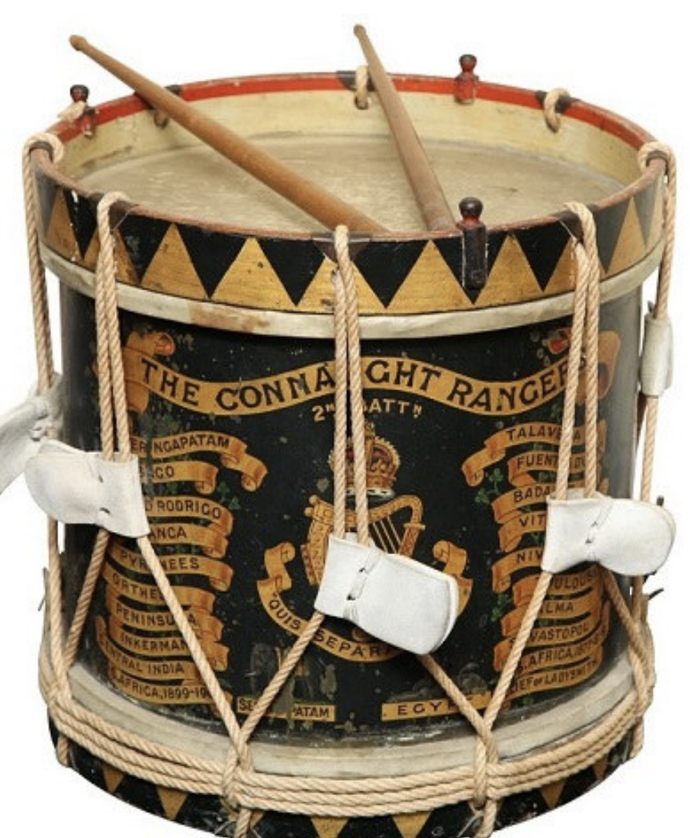
The Peninsular War was fought between 1808 – 1814. The war resulted in the Connaught Rangers being arguably the best single combat regiment in the British army. However, General Picton refused to accept this because of earlier disciplinary issues. The battle honours of the regiment during the war speaks for itself, among them are Bussaco, Fuentes de Oñoro, Ciudad Rodrigo, Badajoz, Salamanca and many more.
The French had little trouble in defeating the Spanish, but they never really destroyed them. The Spanish retreated to the hills where they were re-armed by the British and continued the fight. Another problem for the French army was food, trying to feed some 250,000 troops every day proved an enormous task. To make matters worse, the British and Portuguese armies were also competing for provisions. The French generals pursued a ruthless policy of requisition when it came to supplies, this also included looting from the civilian population. It was this relentless search for food that forced Spaniards of all ages to flee their homes and form guerrilla bands, which brought about additional problems for the French. No mercy was shown from either side.
Upon arriving in Portugal with his expeditionary force, Wellington had initially travelled south to Lisbon. While he had troops in Spain, he had no intention of fighting on the frontiers and instead planned to retreat deep into Portugal, laying the country bare behind him. This would bring the French face to face with the formidable defensive system of the lines of Torres Vedras, which covered the immediate approaches to Lisbon. The French invasion of Portugal began on 24 July 1810, and they continued to follow and harass the British until they reached the lines of Torres Vedras. They were not prepared for an attack on this extensive double line of interlocking fortifications. This left the French starving outside Lisbon throughout a miserable winter; by April 1811 they had lost 25,000 men, most of whom died through the terrible conditions, disease and hunger. The French then withdrew to the Spanish border with the British Portuguese army following them. It was in these areas that much of the conflict took place. There were a number of important battles fought during this campaign; one of them in particular was near the Portuguese town of Bussaco.
The Connaught Rangers played a crucial part in the battle of Bussaco, which took place on 27 September 1810. Prior to combat, Wellington occupied the heights of Bussaco, which consists of high ridge some ten miles in length. He had 50,000 men, almost evenly split between British and Portuguese troops. Wellington was also under political pressure to gain a victory and quell unrest in England about the cost of the war in Spain. His battle position was a formidable one and all should have been well. However, because of the length of the ridge the British and Portuguese soldiers were thinly stretched in certain sections. Advancing towards Wellington’s army were some 65,000 French troops. Among the French senior officers was the famous Marshal Michel Ney who led the assaults on Wellington’s positions.
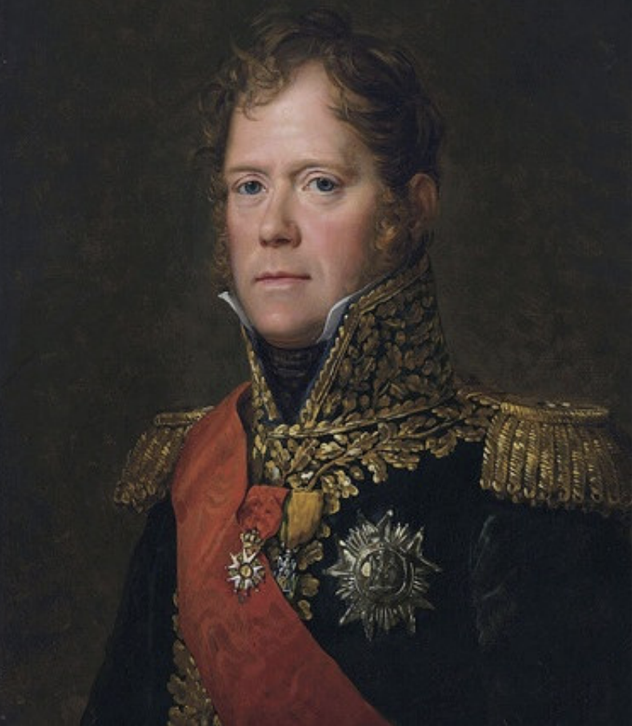
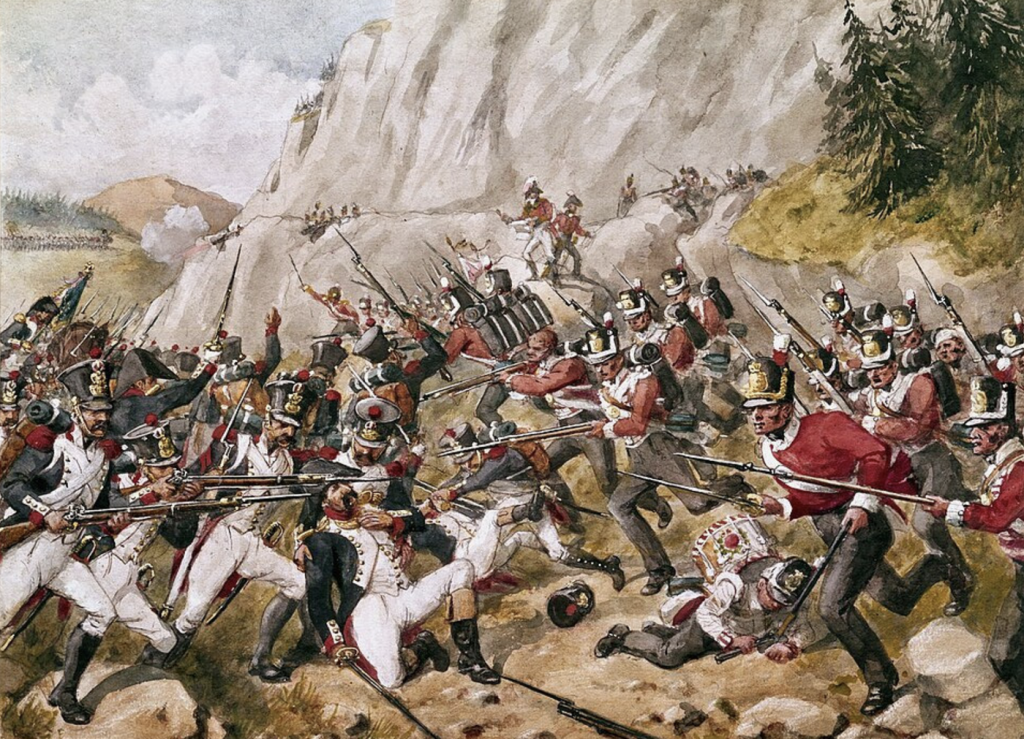
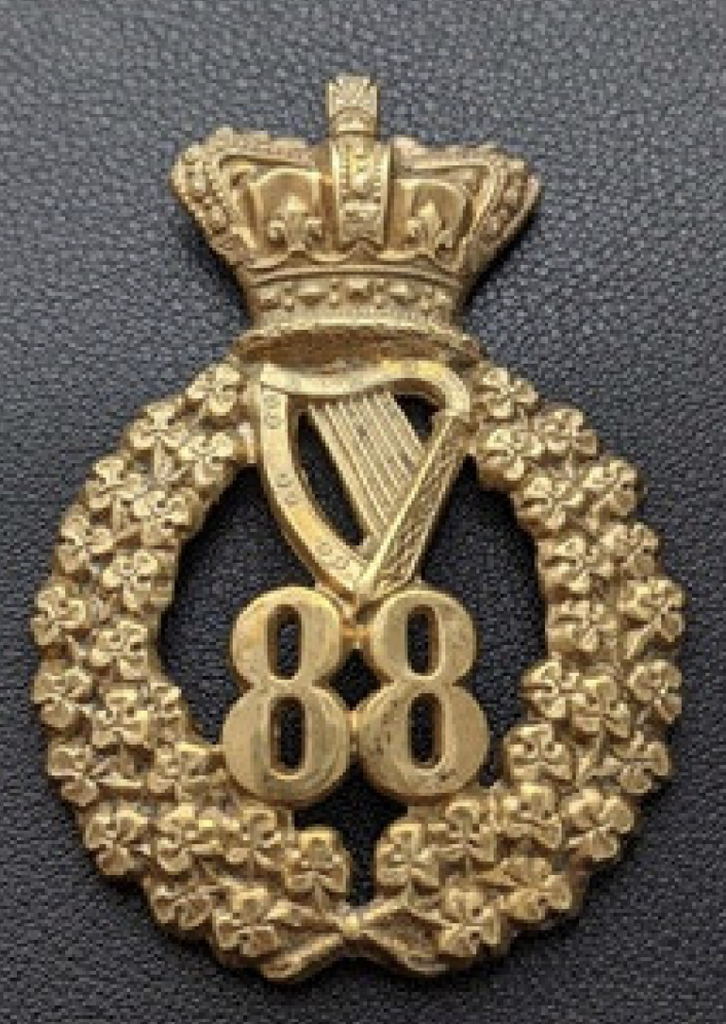
There was a heavy mist on the morning of the battle and a French column inadvertently found themselves before a weak point in the British lines close to the summit of the hill. In the ensuing battle, Wellington’s line was breached by a number of French regiments and they found themselves in a perilous situation. The battle was almost lost when the Rangers, under Colonel Alexander Wallace, launched a fierce counter-attack which forced a hasty French retreat. They were supported by four companies of the Nottinghamshire Regiment, but the courage and ability displayed by the Rangers was unmistakable and stood-out to all present. Their bravery was such that following the battle, Wellington rode towards Wallace, calling out to him, ‘Upon my word, I have never witnessed a more gallant charge than that just made by your regiment’. General Picton, who had arrived on the scene just before the charge, also gave all the credit to Wallace and his men. The courage of the Rangers was also noted by the eminent Napoleonic military historian, Arthur Bryant, when summing up events of the day, he said, ‘They saved the situation’. The French defeat at Bussaco had a direct impact on the remainder of the campaign and gave confidence to the British. After the battle Wellington personally thanked Colonel Alexander Wallace and the 88th Connaught Rangers for their heroic valour. The following words were later composed to commemorate the Connaught Rangers action:
And the fierce sons of Erin
are there in their might,
And invincible Wellington
marshals the fight,
For the Rangers now burst on
the fugitive throng,
And sweep like an avalanche,
restless along,
And the conflict has ceased
with the fast waning day,
The wild-routed masses
through deep ilex shade,
Fly, and toss from their grasp
the encumbering blade.
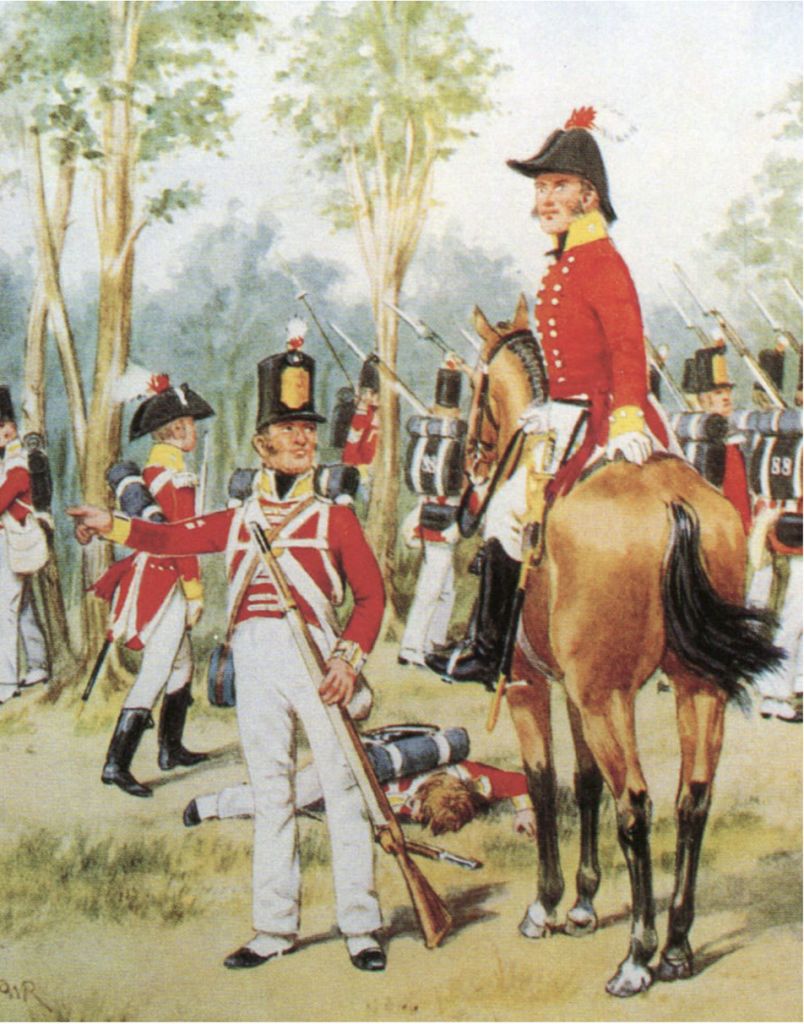
Wellington witnessed an equally gallant charge by the Rangers at the battle of Feuntes de Onoro the following year. Fuentes de Oñoro is a border village in the Province of Salamanca in western Spain and is part of the autonomous community of Castile-Leon. The British, Portuguese and Spaniards numbered some 37,000 and were facing an opposing French army of 48,000 men. Wellington’s right flank included holding the village of Fuentes, occupied by two Scottish Regiments, and was proving extremely difficult position to hold.
Hostilities began here on 3 May 1811 with the French attacking across the Don Casas and storming into Fuentes de Oñoro. Ground was gained and lost throughout the day, but as night fell the attackers were finally pushed back and the village remained in British hands. There was no fighting the following day. However, on 5 May, the French launched a series of powerful attacks on the village which lasted throughout the day. Eventually, after hours of hard combat the French managed to force the Scots out and captured the village.
Colonel Wallace had been observing the battle, and despite his commander’s doubts of securing the position, he insisted that his men could re-take the village. Once he received permission to attack, he placed the Rangers in front, with a Scottish and English regiments behind in support of the attack. He then ordered the Rangers to fix bayonets after which they surged forward and astonishingly swept the French columns before them re-taking the village within fifteen minutes. The Ranger lost three officers and sixty-five soldiers were killed or wounded, but they had saved the day for Wellington.