When ancient conflicts are mentioned in regard to Athenry many people immediately think of the brutal battle of 1316. However, there was an earlier battle fought between the native and Norman forces. There was continual warfare between both sides throughout the thirteenth century making a bloody climax inevitable. According to the seventeenth century historian Roderic O’Flaherty the first battle of Athenry was fought on 15 August 1249. This was, and still is an important date in the Catholic calendar as it is the Feast of the Assumption of Our Blessed Lady into Heaven. The Irish were led by Turlough and Hugh O’Connor, grandsons of Cathal Crovderg an early King of Connacht.
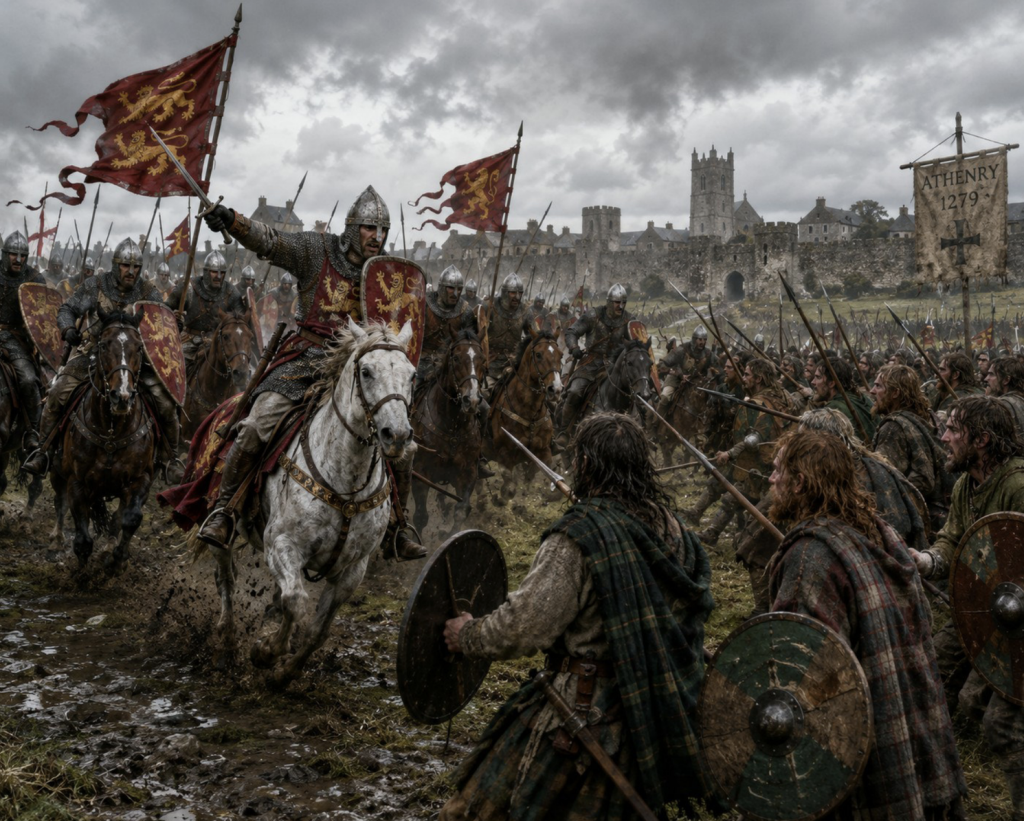
They made their way the Norman settlement at Athenry with the intention of plundering and burning the town. Jordan de Exeter was Sheriff of Connacht at the time. He married Basilia de Bermingham, daughter of Meiler de Bermingham, Lord of Athenry. De Exeter was an experienced soldier having taken part in the conquest of Connacht with Richard de Burgo over fifteen years earlier. He was granted land in Connacht because of his support during the campaign. Once he became aware of the Irish plans, he marched his army to Athenry. He entered Athenry before the Irish arrived and occupied the town. When the Irish arrived, de Exeter requested a truce in honour of the Feast of the Assumption. Turlough O’Connor accepted, but he was over-ruled by several other Irish chiefs. After hearing that the offer was rejected, de Exeter led his forces outside the defences. The Irish were lined up in battle formation outside the town. The Normans were heavily armed and clad in iron mail. De Exeter led and rallied his men forward and soon the charge gathered momentum.
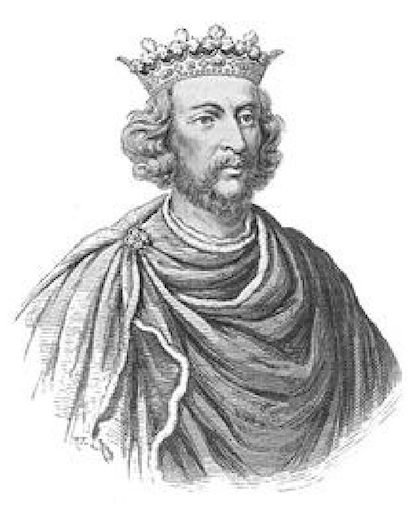
It was said that many young Irish men were seized with fear upon seeing the battle array organized by de Exeter. Leading the cavalry charge at Athenry was the highlight of his long military career. The Irish soon felt the powerful force of the heavy Norman cavalry. They cut into the Irish lines with doubled edged swords causing havoc among the ranks. It was a disaster for the Irish with huge losses, and they were soon forced to retreat. Many were cut down as they fled the battlefield. The Irish lost many Gaelic princes and lords killed that day. In 1250, de Exeter was granted an annual fee by King Henry III as a reward for his services. He was killed while pursuing pirates in 1258.

The following description of the battle was translated from the Annals of Clonmacnois, preserved in Trinity College Library, Dublin. It was published by Roderic O’Flaherty in West or H-Iar Connaught in 1684:
A.D. 1249. The Irish nobility of Connaught went to Athenry to prey and spoil the town, on the day of our Lady the blessed Virgin Mary, in the middest of harvest. There was a great army, with Terlaugh mac Hugh. The sheriff of Connaught with many Englishmen were in the said town before them. The sheriff and Englishmen desired them, in honour of the Blessed Virgin Mary, whose day then was, to forebeare with them that day, which they said Irish nobility refused to give any respect, either in honour of the Blessed Virgin…
… They assaulted the town against the will of the said Terlaugh, which Jordan de Exetra the sheriff and Englishmen seeing, they rushed forth to meet the said Irishmen, where the Virgin Mary wrought miraculously against the said nobility. When the Irish nobility saw the Englishmen, and horsemen well appointed with harness, arms and shirts of mail, make towards them, they were daunted and affrighted at their sight, and presently discomfitted.
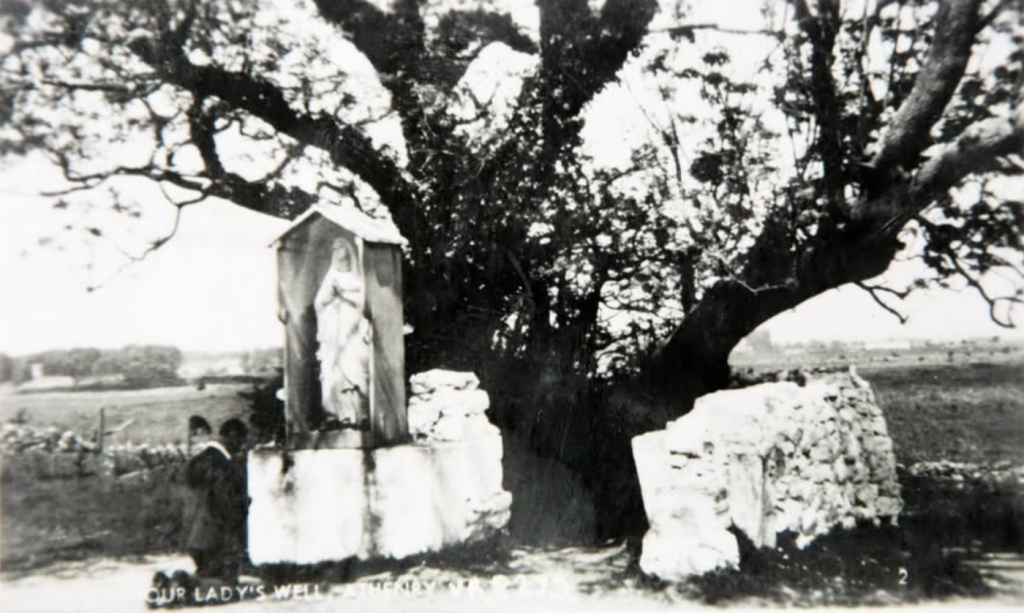
While the Normans were better armed, they considered their victory was through divine intervention because the Irish didn’t respect the sanctity of Our Lady or the Crucifixion. The crushing defeat of the Irish inspired the inhabitants of Athenry with new hope and confidence. The town attracted more settlers and accordingly grew in strength and numbers. It has been said that the battle was the first historical reference to the town. There is a holy well located near Athenry, known as Lady’s Well. It is a place of annual pilgrimage and some believe it has associations with the battle.