The so-called ‘paisley pattern’, with its characteristic curved teardrop or pinecone motif, is often seen on bandanas, pyjamas, ties and pocket squares, but two centuries ago the paisley-patterned shawl was an Indian-inspired, European fashion craze that kept skilled Scottish weavers busy. When that fad passed, Scottish weavers began to produce what became known in Ireland as the ‘Galway shawl’.
The Kashmir Shawl: Traditionally worn by Indian noblemen, the Kashmir shawl was made from the fine underbelly hair of the Himalayan Mountain Goat. The shawl was much prized for its softness, warmth, light weight, and characteristic design, called buta (meaning ‘flower’) and the curved teardrop or pinecone motif, which has a long history stretching back to ancient Persia and Babylon. There is much myth and legend concerning the origin of the motif, but the popular consensus is that it represents the growing shoot of the date palm, the ‘tree of life’ of the ancient Babylonians. These richly decorated, handmade shawls took two men as long as eighteen months to make, so they were a luxury item for the wealthy. In the late 1700s, British and French officials, military officers and merchants were gifted or otherwise acquired Kashmir shawls in India, which they brought or sent back to Europe. As British men did not normally wear shawls, they often gifted them to the important women in their lives. The exotic shawls soon became fashionable, desirable, and a symbol of status. They were, however, prohibitively expensive, and out of the reach of most European women. Nonetheless, in October 1819, 611 Kashmir shawls were shipped from Calcutta to London for the British market.
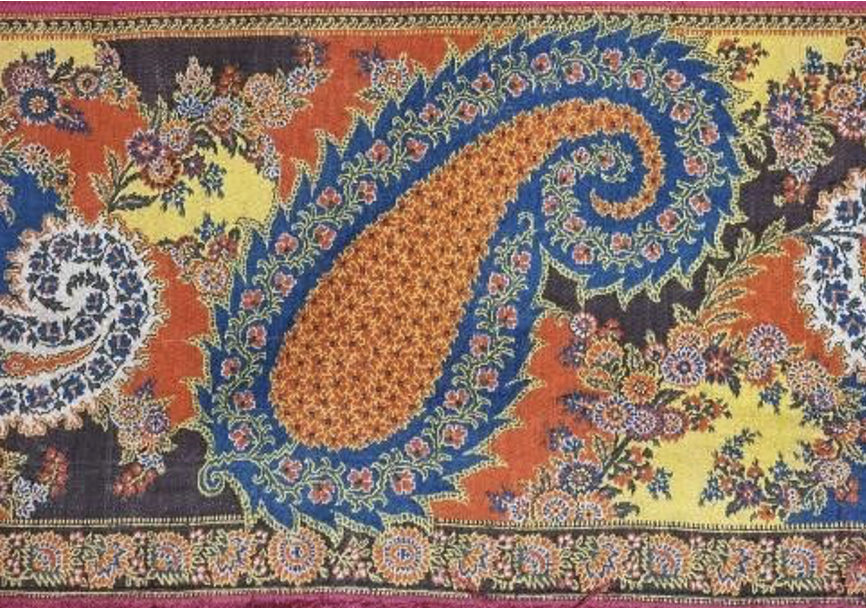
By the late 1700s, to satisfy the growing demand for Kashmir shawls, manufacturers in Norwich in England and Edinburgh in Scotland saw an opportunity and began producing their own versions of the shawl – ‘made in imitation of the Indian’. The buta motif remained the essential, characteristic element of the design, which was known by several names, including ‘cone’, ‘pinecone’, and ‘mango’. Using silk, cotton and fine wool in place of goat hair, the imitation shawls could be produced on looms more quickly and cheaply than the Kashmir originals, thus making them more accessible for fashionconscious, upper-middle-class consumers.
The Paisley Shawl: Though Edinburgh pioneered the shawl industry in Britain, the weaving town of Paisley, west of Glasgow, soon eclipsed the Scottish capital, so much so that the very pattern, as it was locally designed, became known as ‘paisley’. Shawl production began in Paisley in 1805. By the 1810s, when genuine Kashmir shawls each cost between £70 and £100 (about €5,500 to €7,800 in today’s money), the Paisleymade imitations each cost £12 (about €950). There were as many as 7,000 weavers employed in the manufacture of these imitationIndian shawls in the town by the 1830s. They were first made on a drawloom by a weaver, assisted by a drawboy or drawgirl, and, later, on the French-invented Jacquard loom, the first programmable power loom, which eliminated the need for an assistant and resulted in more complex patterns. The adoption of the large and expensive Jacquard loom, from about 1840 onwards, also resulted in the shawl industry moving out of the cottage and into the factory.
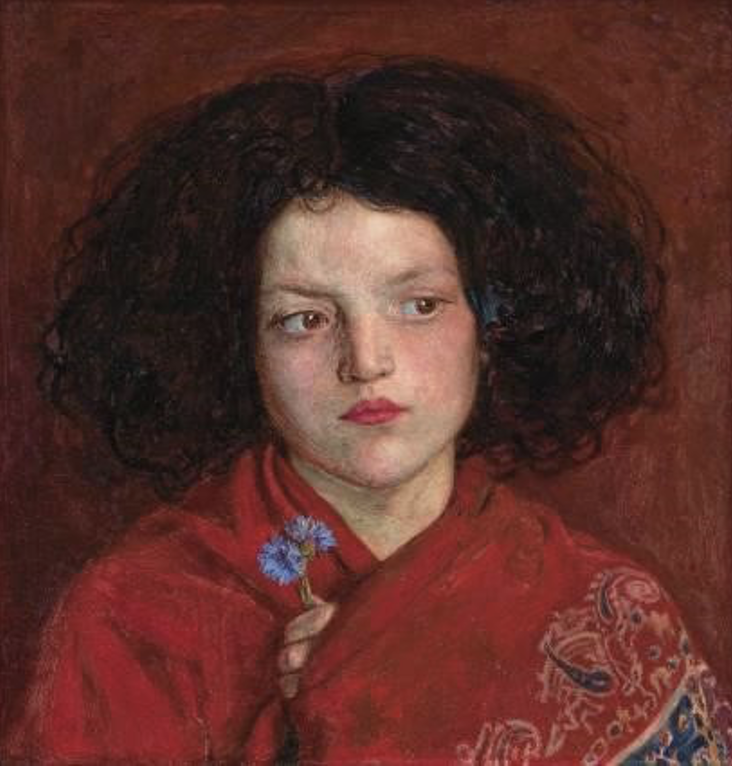
In 1842, Queen Victoria bought seventeen such shawls from Paisley, which gave the by-then lagging industry a timely boost, and the following two decades was the heyday for the Paisley shawl. Soon, the shawls began to appear in artwork. The British artist Ford Madox Brown (1821–1893), for instance, painted ‘The Irish Girl’ in 1860, which depicted a young but wise-looking girl wearing a fashionable red Paisley shawl and holding blue cornflowers. By the late 1860s, however, the Paisley shawl was beginning to fall out of fashion and the industry rapidly declined over the following decade.
The Paisley Shawl in Ireland: The Paisley shawl eventually made its way to Ireland, where, as elsewhere, it was worn as a fashion item. From the late 1830s onwards, drapery shops in Tuam in north Co. Galway were advertising the sale of ‘Edinburgh and Paisley Shawls’ (see, for example, William Paton of Bishop Street in the Tuam Herald, 29 December 1838). They were sometimes gifted by husbands to their new brides, and often became heirlooms, passed on from mother to daughter. As elsewhere, the Paisley shawl had fallen out of general favour in Galway by the 1870s. In 1883, the Galway Observer reporting on ‘Fashions for May’ noted: ‘Paisley shawls which have long been laid aside as unwearable are now brought out and arranged as mantles, dolmans, and dress trimming’.
Writing at the turn of the twentieth century, Matthew Blair wrote: ‘Notwithstanding that the shawl, and more particularly the Paisley Shawl, has long disappeared from Central Europe, it still lingers on the outskirts, in countries not given much to change’. And this seems to have been the case in the west of Ireland.
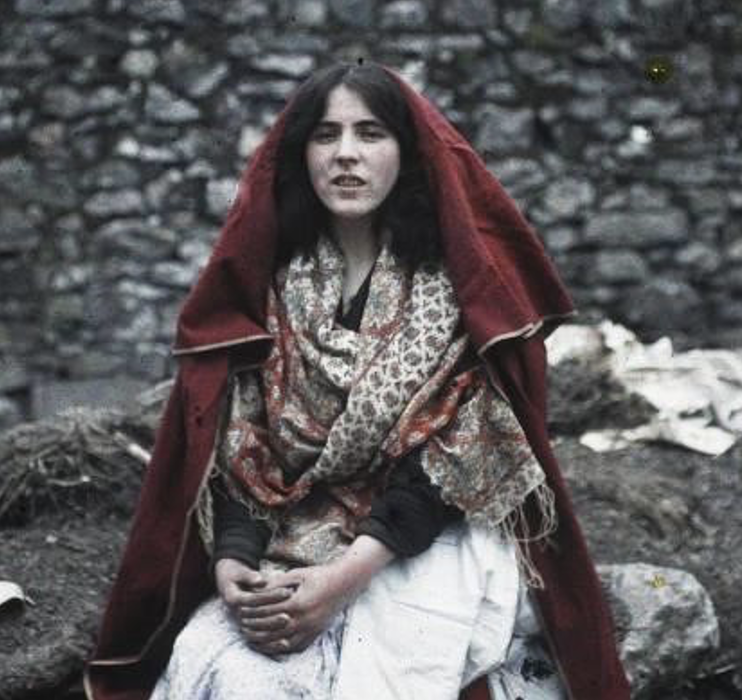
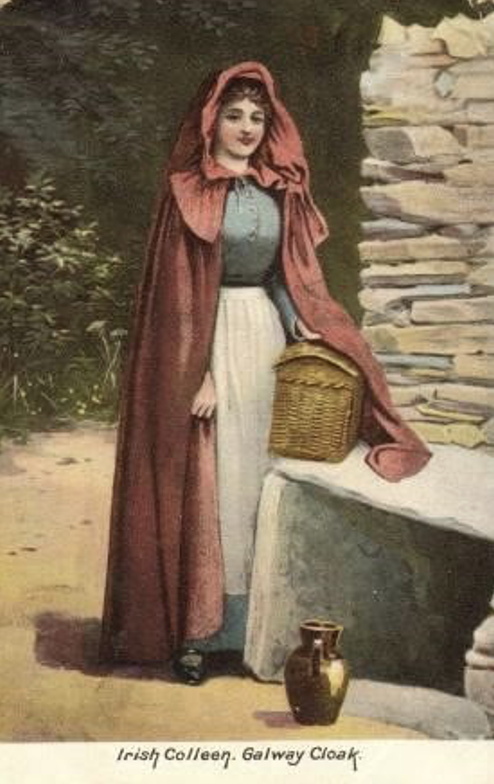
In May 1913, two French women – Marguerite Mespoulet and Madeleine Mignon – visited county Galway as part of Albert Kahn’s ambitious Archives of the Planet project and took what are believed to be the first colour photographs in Ireland. Mespoulet took autochrome photographs of women wearing paisley-patterned shawls or scarves in Cois Fharraige, west of Galway, and the Claddagh. One of those photographed at the Claddagh was thirteen-year-old Mary Anne ‘Mian’ Toole (later Kelly), the daughter of Michael and Anne ‘Nan’ Toole, who was described as ‘very typical of “The Irish Colleen” in Galway.’ She wore a paisley-patterned shawl or scarf about her neck and shoulders, and a crimson blanket with trim over her head in the manner of a traditional Irish cloak. According to Dr Dan Coughlan, curator of textiles at Paisley Museum and Art Gallery, she is wearing a printed shawl, which was lighter and less expensive than a woven version.
In her notes, Mespoulet recorded that this ‘traditional costume of the Claddagh’ was by then out of fashion: ‘We were lucky to find a unique example of this traditional costume style which has not been worn for many years. Women abandoned such dress style for the current national costume – the fringed shawl – and want nothing more of the old style.’
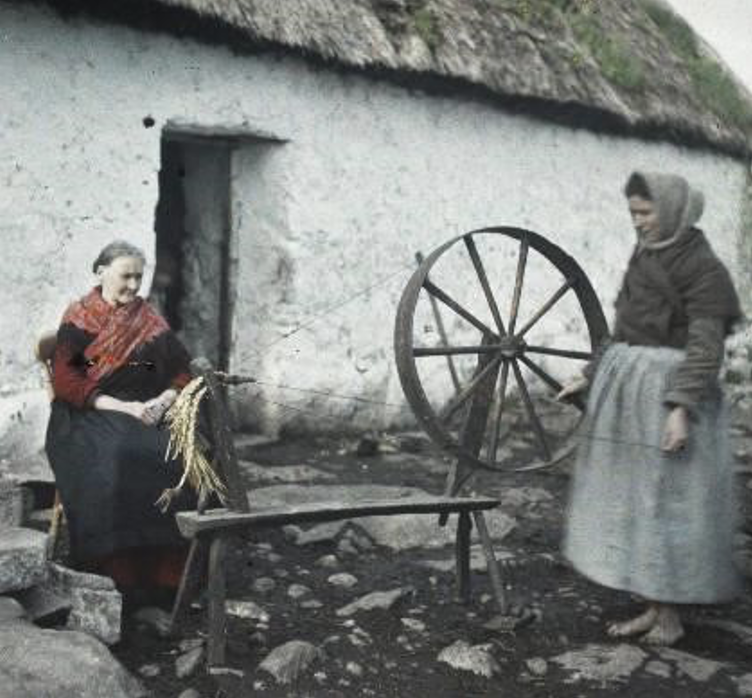
Photographs taken in the 1920s on the Aran Islands by Frank Stephens (1884–1948), nephew of John Millington Synge (1871– 1909), and by Thomas Holmes Mason (1877–1958) show both younger and older women wearing light shawls printed with the paisley-pattern.
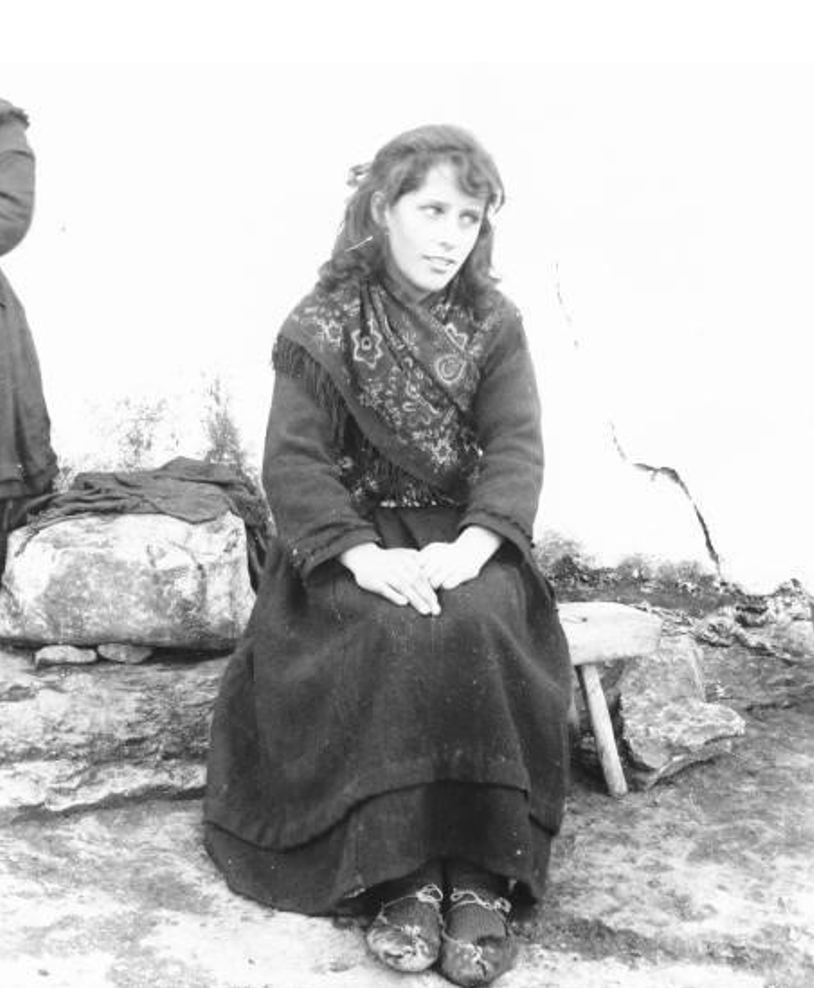
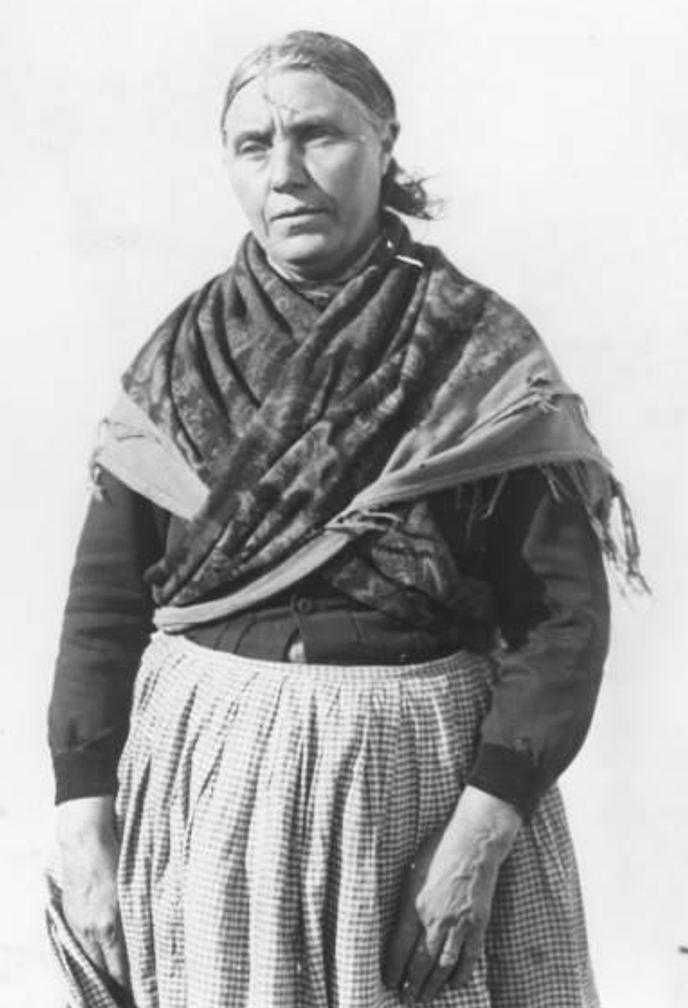
Photos by Frank Stephens and Thomas H. Mason. Courtesy of the Library of Trinity College, Dublin and National Library of Ireland
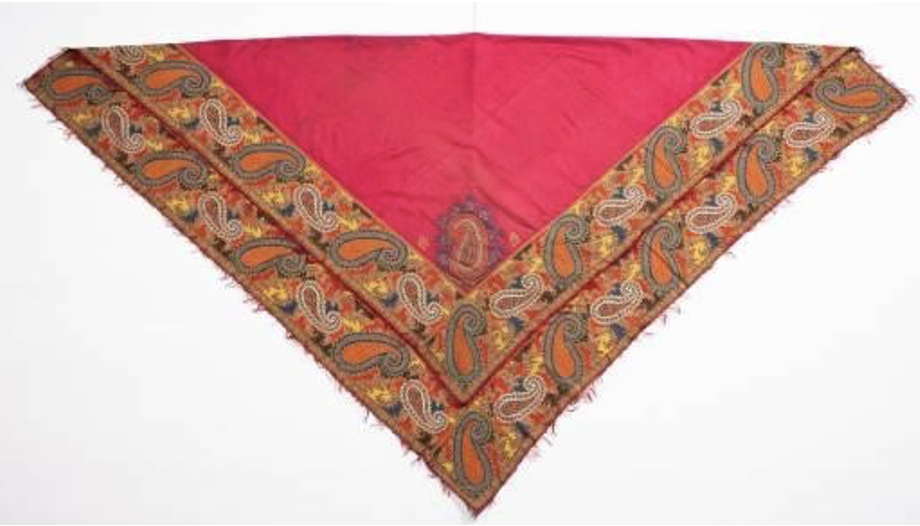
Galway City Museum has a harlequin shawl in its collection, which has a rose-red centre, paisley-patterned border and short fringe. The solid-coloured centrepiece was made of woven silk. The decorative border was made separately – of silk and cotton – and attached to the centrepiece. It formerly belonged to Ellen Kavanagh (née Mulally, 1864–1940) of Fairhill Road in Galway. According to Dr Dan Coughlan, it was likely produced in Paisley in the 1820s, when the harlequin shawl was at its most popular. It was also known as a ‘turnover’ shawl, because of how it was designed, folded and worn. When the decorative borders were sewn onto the centrepiece, two borders were attached face-side up and two borders face-side down. When the shawl was folded in triangular fashion and worn over the shoulders all the borders were displayed with the correct side up.
The Galway Shawl: Until the mid-nineteenth century cloaks, such as the so-called Galway or Claddagh cloak, were commonly worn by Irish women, but these gradually came to be replaced by shawls. The word ‘shawl’ is derived from the Persian shāl, which was adopted into Urdu and other Indian languages, and originally referred to a class of woven material rather than a particular article of dress. From India the word found its way into the European languages in similar forms; in Irish, it was rendered seál, which is pronounced the same as in English.
In 1853, Mr and Mrs Samuel Carter Hall noted: “The Irish cloak,” once so famous in song and story, is now becoming rare: it forms, however, a very graceful drapery: – the material falls well and folds well. It is usually large enough to envelope the whole person; and the hood is frequently drawn forward to shield the face of the wearer from sun, rain or wind. It is, however, liable to objection as a sort of “cover-slut” [an outer garment worn to conceal untidy clothes] to hide all dilapidations of dress. It was found in many parts of Ireland – in the north especially – a better and less costly substitute in the tartan or plaid shawl.’
Towards the end of the nineteenth century, factories in Paisley began producing heavy woollen shawls, in brown and fawn with wide patterned borders, on Jacquard looms. It is estimated that once the loom was set up, which was a laborious job, a weaver could produce two shawls per week. As these shawls were made of wool, their patterns weren’t as intricate and detailed as the earlier Paisley shawls, which were made of silk, cotton and fine wool.
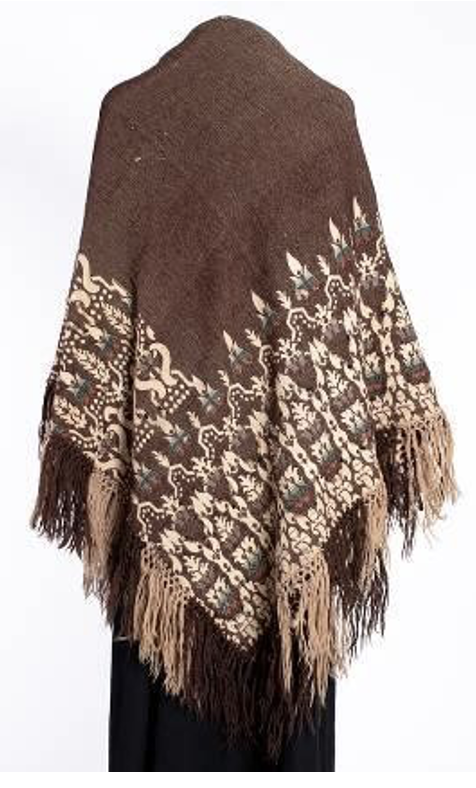
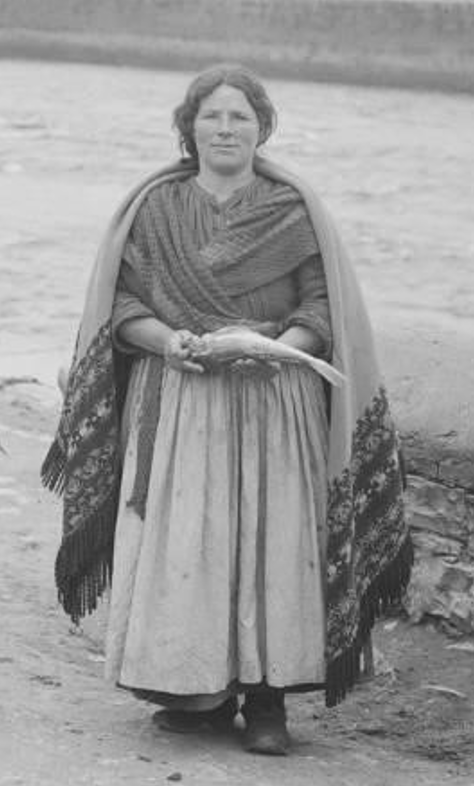
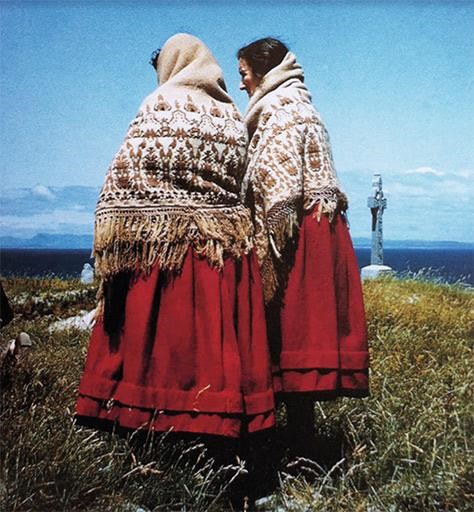
The woollen shawls were known as ‘velvet’ or ‘fur’ shawls because of their napped finish, which gave them a soft, fur-like look and feel. They were shipped to Ireland and further afield and became particularly popular in Galway city and county, so much so that they became widely known as ‘Galway shawls’ in Ireland. Whereas the earlier Paisley shawls were items of fashion, these Galway shawls were utilitarian, affording fishwives and countrywomen, who spent much time outdoors, protection against the elements. The shawls were originally fringed in Paisley but, when they became worn, they were often re-fringed in factories in Paisley or Galway, or at home by the owner, to give them a new lease of life.
American writer Burton Egbert Stevenson (1872–1962) visited the Town of the Tribes in 1913 and in his book, The Charm of Ireland, noted: ‘All the women here in Galway were shawled, and beautiful shawls they were, of a delicate fawn-colour, and very soft and thick.’ In Ireland and Britain, the term ‘shawlies’, came to be used as a dismissive term for working-class wearers of the shawl. In Galway, it was sometimes used to refer to women of the Claddagh.
The last firm in Paisley to produce these shawls ceased trading in 1943. A decade later, Maureen O’Hara, as Mary Kate Danaher, famously wore a Galway shawl in the film, The Quiet Man. The wardrobe department offered £25 to Galwegians who were prepared to part with their shawls for the film’s extras. O’Hara later bemoaned the fact that hundreds were taken back to the United States by the Hollywood cast and crew, which made them scarce in Galway. A book of stunning colour photographs, Island Funeral by Bill Doyle, which documents a funeral on Inis Oírr, shows that some of the older women of the smallest of the Aran Islands were still wearing the Galway shawl as late as 1965.
Although the Galway shawl has since disappeared from the public realm, it has been immortalised in the traditional folksong, ‘The Galway Shawl’: ‘She wore no jewels, nor costly diamonds; No paint nor powder, no none at all; But she wore a bonnet with ribbons on it; And ’round her shoulders was the Galway shawl.’