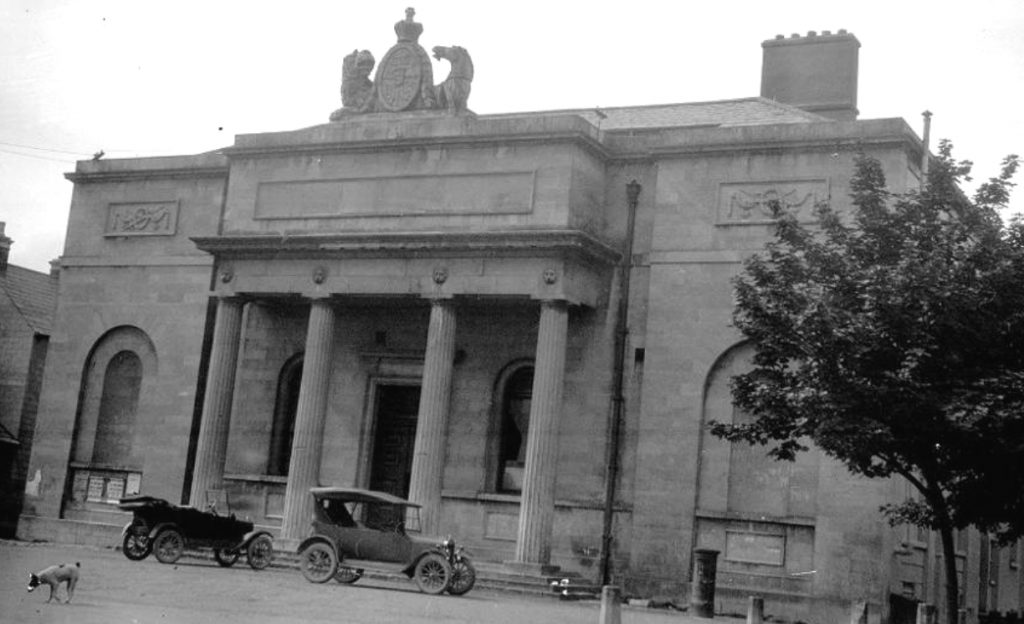
The practice of sending written messages is almost as old as writing itself. Indeed, the ancient Egyptians and Chinese established early postal systems to support their empires. Around 2500 years ago, the Persian Empire – which stretched from present-day Egypt to India – developed a vast network of roads and staging posts, each one a day’s horse ride apart, that allowed horse riders to quickly carry written communications over great distances – an impressive 320 kilometres per day.
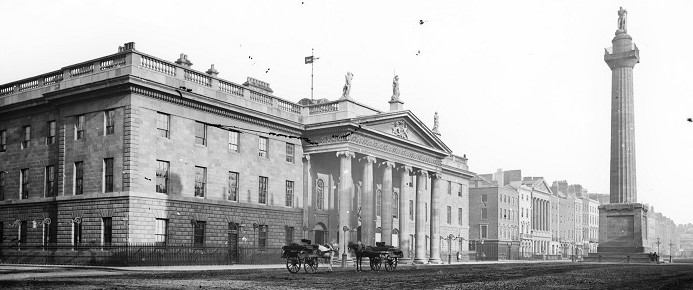
The Irish postal system, by comparison, is only about 400 years old. In its early years, it was an important tool of the British administration of Ireland, facilitating communication between Westminster and Dublin, and between Dublin Castle and its satellite administrative bodies across the island.
The modern postal service in Ireland can be traced to the introduction of cheap, uniform postage in 1840, when a letter could be sent anywhere within the United Kingdom of Great Britain and Ireland for just one penny. Prior to this, postage was charged according to the distance between the sender and the receiver. The introduction of cheap postage coincided with the spread of education and literacy and the development of the railway network in Ireland. Consequently, the number of letters delivered annually rose from 9.25 million in 1839 to 65 million by 1870.
The most conspicuous symbol of the expanding postal service in Britain and Ireland was the post box, particularly the pillar box, a type of free-standing post box. It is thought that post boxes were first used in Paris in 1653, and their use spread from there to the rest of France. These French post boxes inspired Anthony Trollope (1815–1882), a post office official working in the Channel Islands, to propose – in 1851 – a similar system for Britain. Pillar boxes were trialled in Jersey in 1852 and on neighbouring Guernsey in 1853, before being introduced to mainland Britain. The first pillar boxes arrived in Ireland in 1855. One of these early pillar boxes is now on display at the National Museum of Ireland – Decorative Arts and History at Collins’ Barracks, Dublin. Interestingly, the earliest post boxes – in both Ireland and Britain – were painted bronze green. The change to ‘royal red’, so long associated with British post boxes, did not take place until 1874. The reason for the change from bronze green to red was to make post boxes more visible and findable in the streetscape.
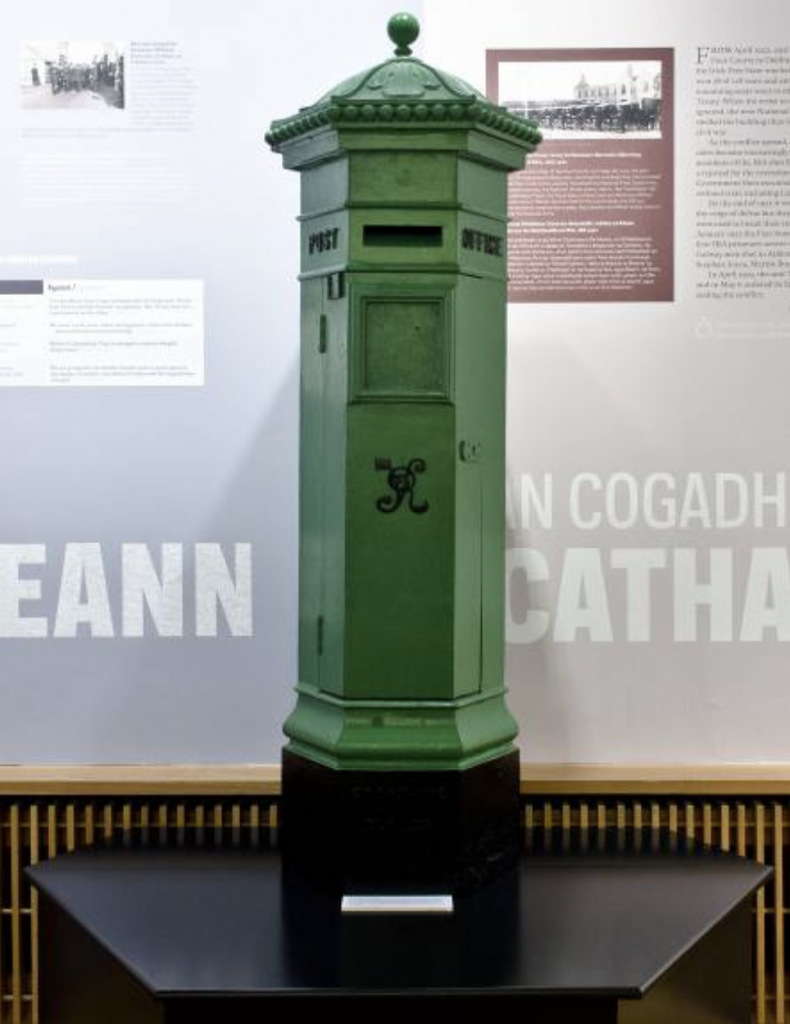
Victorian Penfold Pillar Box: The earliest surviving post box from Galway City is a Victorian pillar box. Now located in Galway City Museum, it formerly stood on Mainguard Street, near the junction with High Street. This particular type of pillar box was designed by English architect John Wornham Penfold (1828–1909), so it is sometimes called a Penfold box. His hexagonal design was inspired by the ancient Tower of the Winds in Athens, though the Greek tower is, in fact, octagonal. It was decorated with beading around the cap and was crowned with acanthus leaves (a popular foliage motif) and an acorn (long-since missing). It bore the British royal crest and cypher (‘VR’ for Victoria Regina, the Latin for Queen Victoria); Victoria was Queen of the United Kingdom of Great Britain and Ireland from 1837 to 1901. This example would have originally been painted bright ‘royal red’ but following Irish independence it was repainted ‘saorstát green’. The British royal crest was removed, though strangely the ‘VR’ was retained.
Penfold post boxes were made at the ironworks factory of Cochrane and Company at Dudley, near Birmingham, in the English West Midlands. Made of cast iron, they were strong, heavy, and durable. Penfold post boxes were produced from 1866 to 1879 and came in three sizes. The design was modified over time to overcome certain problems; for example, a downward-pointing chute was added to prevent letters being stuck in the top of the box. From 1879 onwards, cylindrical pillar boxes replaced hexagonal post boxes. This one was severely damaged by a reversing truck in 2002, and so the An Post decided that it needed to be moved for its own safety.
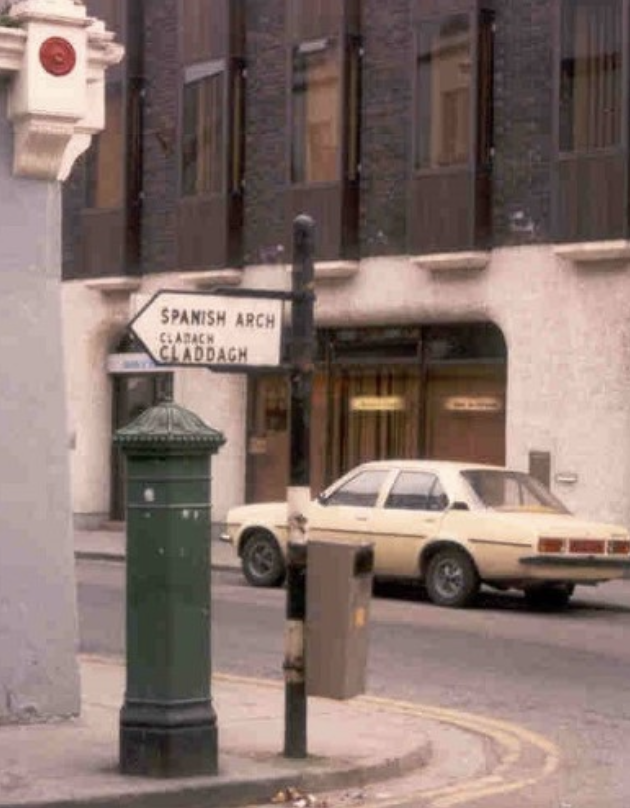
Photographs by Derek Biddulph. Courtesy Galway City Museum
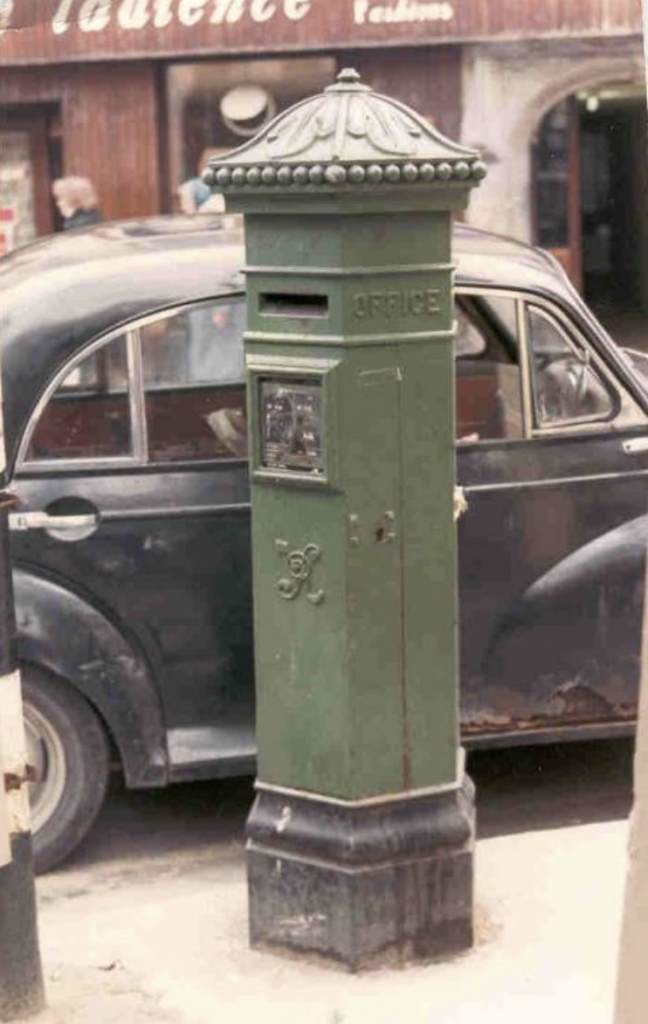
Photographs by Derek Biddulph. Courtesy Galway City Museum
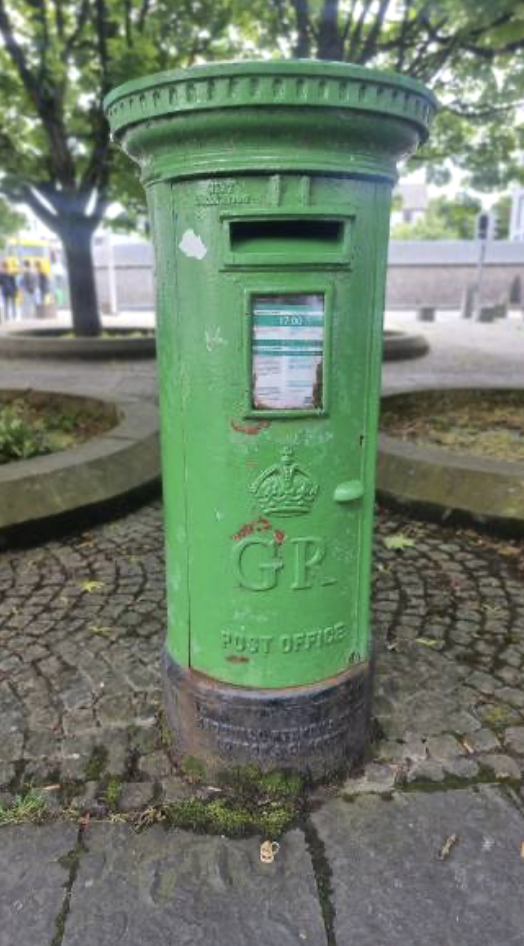
Royal Cyphers: If you look carefully at old post boxes (pillar and wall boxes) you will see that some of them are embossed with a royal cypher – a monogram representing the reigning British monarch. Their presence indicates that the post box was in place while Ireland was still under British Rule – prior to 1922. The monogram combined two letters representing the monarch’s title and name: ‘R’, which stands for ‘Regina’ or ‘Rex’ (Latin for ‘Queen’ or ‘King’), and the first initial of the Monarch: ‘V’ for Victoria; ‘E’ for Edward VII; or ‘G’ for George V. The letters may be standalone, intertwined or overlapping. Some post boxes were also embossed with a crown symbol or the royal crest.
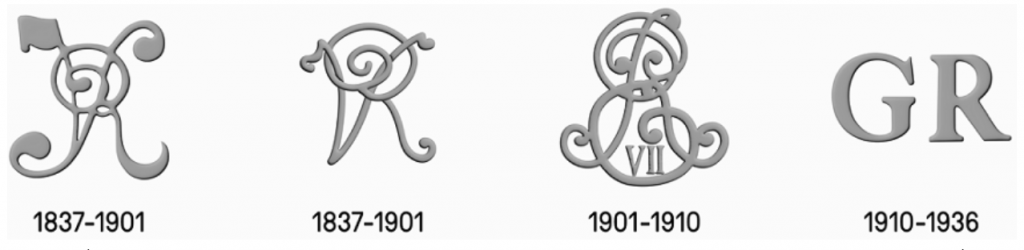
Apart from the Victorian Penfold pillar box in Galway City Museum, there are four post boxes – one pillar and three wall boxes – bearing royal cyphers to be found on the streets of Galway. There is a Victorian wall box on University Road, a Victorian wall box on Taylor’s Hill, and an Edwardian wall box on Upper Salthill Road, opposite the Promenade, and a Georgian pillar box outside the courthouse at Courthouse Square in Newtownsmith. The doors of the wall boxes on Taylor’s Hill and Upper Salthill Road have the letters SÉ (Saorstát Éireann – Irish Free State) and an Irish harp, which were added after independence. How many have you noticed?
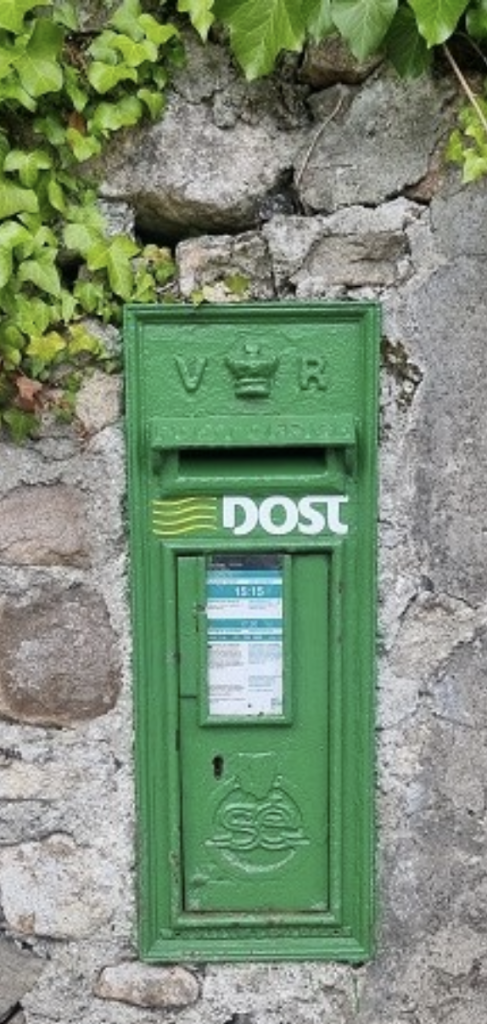
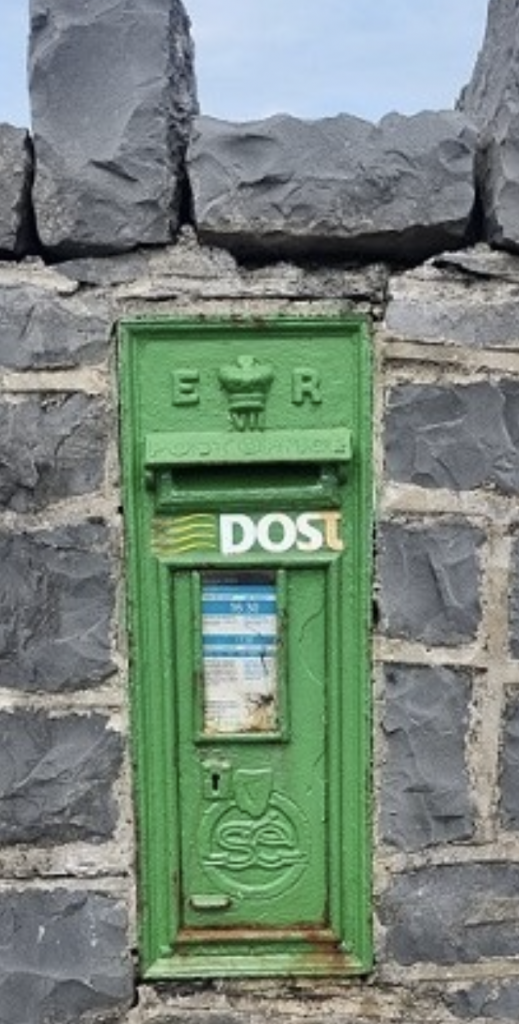
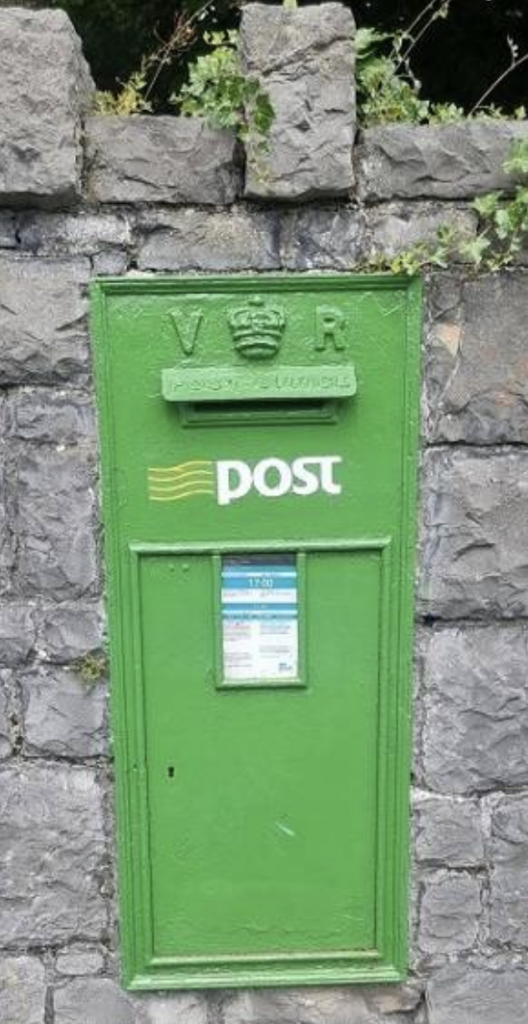
Galway City Museum: Galway’s oldest surviving post box, the Victorian Penfold pillar box can be seen in the Revolution in Galway, 1913–1923 exhibition area at Galway City Museum. It is strategically positioned between the sections of the exhibition dealing with the transition from the Anglo-Irish Treaty to the foundation of the Irish Free State – the change of colour from red to green symbolising Irish independence. The Museum is open from Tuesday to Saturday, 10am to 5pm (galleries close at 4.45pm). For more details of exhibitions and events, visit: www.galwaycitymuseum.ie