Life in Buttermilk Lane during the nineteenth century was never easy. There were many families living in this small area. It was a time when the pawn shop played a crucial role in everyday life for people across the old city. However, among all the poverty, people displayed a sense of humour and character. An amusing incident occurred in November 1884 when two women, both living in Buttermilk Lane, had a disagreement over a shawl. The garment had been left in a pawn shop on Quay Street by Mary Walsh.
The problem occurred because Mary had pledged to retrieve the shawl by a certain date. However, she allowed the pawn ticket to over-run the appointed date, and therefore it was put up for sale. Another woman, Jane Flaherty, also living in the lane, purchased the shawl and this led to a squabble the following Saturday night. That night, Jane Flaherty was making her way home through Buttermilk Lane wearing the shawl. As she was walking up the lane with a half-penny candle in her hand to light her way, she met Mary Walsh. Mary was half drunk and in a foul mood since she became aware that Jane Flaherty was now the proud owner of the shawl. Mary was very abusive and began calling Jane Flaherty dreadful names and waving her fists in a wild and threatening manner. Faced with this very angry and drunken woman, Jane Flaherty offered to sell the shawl back to her for the same price that she had paid for it in the pawn shop.
This seemed to pacify Mary, and she proceeded to pull an old sock from her ‘bosom’ where she kept her money. Having opened the sock, which she was using as a purse, she proceeded to count out the price of the shawl. Mary then handed the money to her neighbour. But the peace settlement was only momentarily, as she was taking the shawl off the woman’s shoulders, Mary’s daughter, Ellen Toole, arrived on the scene. She was also half drunk and picked up a stone and threw it at Jane Flaherty. This sparked a drunken row between the women, and it was soon a ‘free-for-all’ fighting, pulling hair, shouting even more abusive names and foul language being used by all parties. Head Police Constable Wynne of the Royal Irish Constabulary, who was walking along Shop Street, heard the shouting and ran towards Buttermilk Lane. He arrived on the scene, but even the presence of the chief policeman didn’t stop the women from brawling. Despite his best efforts, Constable Wynne had his work cut-out for him trying to separate the fighting women. He eventually managed to bring some degree of order, but moments later Mary Walsh and her daughter started fighting again. Lighted candles could be seen in the little dwellings along the lane as people watched out through the windows, deeming it safer to remain indoors. By now, another policeman had arrived in the lane, and they arrested Mary Walsh and her daughter for being drunk and disorderly.

The following week, the drunk and disorderly case was brought against Mary Walsh and her daughter in Galway Courthouse. Drink was the main cause of the disturbance, and it would also play a part during the court proceedings. It was evident in court that the women facing charges were not very fearful of the authorities, and as one might say today, they were both, ‘known to the police’. The Judge asked Mary what she had to say about the charge after it was read out against her, which included that she was ‘half drunk’. Mary replied, saying that first and foremost she was not half drunk, or fully drunk either, ‘for devil a sup had I taken that night.’ She offered a very good reason why she wasn’t drinking. Mary said that she had taken the pledge almost a month earlier because of ‘her foolish husband’. He was drinking every chance he got, and she took the pledge along with him, but did so only to please him. As to the charge of abusing Jane Flaherty, Mary said, ‘I no more spoke to her that night than did any gentlemen sitting on the bench right now’. She then said that it was Jane Flaherty who was abusing her. Mary added that she went into her own house for a bit of peace and shut the door, ‘so as not to have to listen to that Flaherty woman’. While it seemed clear to the police that Jane Flaherty was attacked in a drunken frenzy, Mary Walsh’s evidence brought total confusion to the situation. In a bid to try and bring some sort of clarity to the case, the judge allowed the plaintiff (Jane) and the defendant (Mary) to question each other before the court:
Jane Flaherty V Mary Walsh:
Jane Flaherty asked: – ‘Didn’t you prevent your daughter from striking me with a stone?’
Mary Walsh replied: – ‘I did, and wasn’t that standing up for you instead of abusing you?’
The Judge then asked Constable Wynne: – ‘What character does the defendant bear?’
Wynne replied: – ‘Well, sir, she is only after putting up six weeks in jail.’
Mary Walsh then shouted – ‘And what is that to you?’
Wynne then addressed the Judge: – ‘You should put her under a heavy rule of bail.’ Mary Walsh called out: – ‘For what? Is it because I got six months; that was your fault. I wouldn’t get a day only for you and your auld law.’
The Judge then announced his verdict: – ‘Mary, you are bound to the peace and fined 40 shillings. You are to be of good behaviour and keep the peace with the plaintiff, and if you default on this, you will be sent to jail for seven days.’
Mary Walsh was having none of this and pointing to Jane Flaherty, she said: – ‘Faith, then, I’ll go to jail for 10 years before I’ll make peace with her.’ The Court Clerk then intervened and said to Mary: – ‘Come back here tomorrow with your payment’. To which she replied: – ‘I will in my eye’.
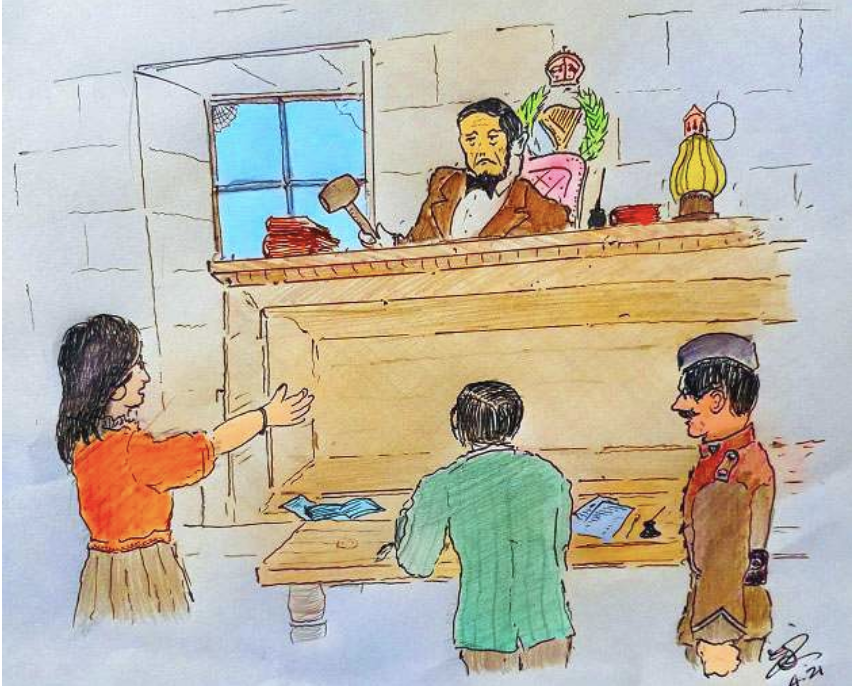
Jane Flaherty V Ellen Toole: The charge against Ellen Toole was similar, with the added dimension of a stone being used in the attack. She couldn’t deny the charge because her mother had already admitted to Ellen using a stone. The Judge listened to the case and then declared that she should also be bound to keep the peace. He asked Wynne if the woman had a husband that might be able to keep some control over her.
Constable Wynne replied: – ‘She has, your worship, but he is a convict and is in prison’.
Ellen Toole then shouted: – ‘How do you know where he is?’ Wynne replied: – ‘I got a letter from the governor about him. He is going on first-rate there’. Ellen Toole then said: – ‘He needn’t thank you for that’, adding, ‘You should mind your own business’.
Wynne seemed to be provoking Ellen, and he could see that she’s showing visible signs that she had been drinking, the woman was, in fact, drunk.
Wynne then said that her husband was better off in prison, where he was well looked after, and the governor was particularly fond of him.
Ellen Toole then shouted: – ‘Go on, You, you have too much to say entirely.’
The Judge then passed his sentence, saying: – ‘You are bound to the peace for 12 months.’
Similar to her mother, Ellen Toole was determined to have the last word and shouted:
‘Begor that’s a bad law, so it is, to say that people can be abused at their own doors and bound to the peace for just listening’.
She was about to continue, but was forcibly removed from the court, very much against her will.