In July 1923, all of one hundred years ago, St Patrick’s Brass and Reed Band played to a large gathering in Galway City. Over five thousand people gathered in Eyre Square to attend an election rally. It was one of the largest crowds to be seen in Galway for many years. The tricolour flew from the stage, and buntings adorned the railings around the park. Ireland was finally at peace following the war of independence and civil war that had raged throughout the country over previous years. The Band was originally founded in 1896 and re-emerged once the Truce between England and Ireland was established in 1921.
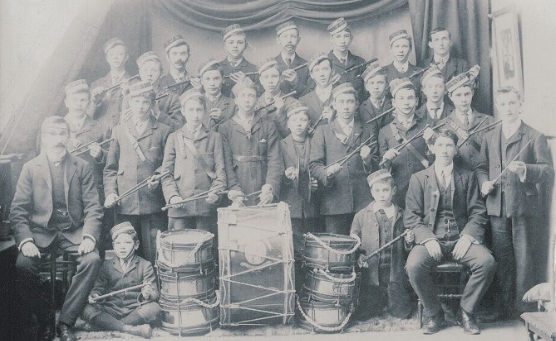
During the War of Independence, Galway experienced its share of violence. The Town Hall was being used as an internment centre by the military and all markets were prohibited within six miles of the city. The courts were dealing with numerous compensation claims for loss of property and damage. In May 1921 there were elections, but there were no contestants and Sinn Fein candidates were returned unopposed. Choral and orchestral sessions continued in Sea Road, but in the centre of town St Patrick’s Band was unable to operate. The Bandroom was closed and had been vandalised. That part of Galway had been through a traumatic period of deaths and destruction of property; in February there was a bomb blast at Mahon’s hotel in Forster Street and there were regular shootings and trouble at the railway station close to the Bandroom.
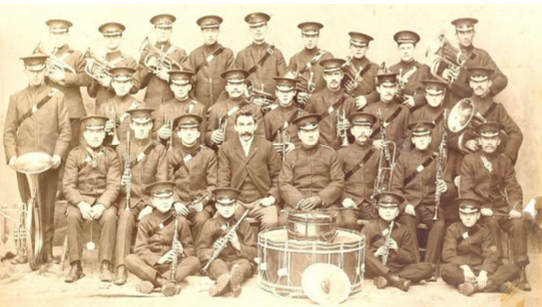
A truce on 11 July 1921 brought an end to hostilities between the British and Irish. Later that year, in November, a meeting took place to revive St Patrick’s Band. The meeting was presided over by Band President William Greene, and it was agreed to reactivate the band and twenty new members joined. Forty of the older members returned and damaged band instruments were sent away for repairs. It was hoped to get the band on the road again by St Stephen’s Day 1921. News of the band’s revival was welcomed locally, and in December a house-to-house collection was undertaken to raise funds for new instruments. Some contemporary newspaper accounts follow.
The Reality of Freedom: On 11 March 1922, The Connacht Tribune reported, ‘The last of the British Crown forces comprising two hundred and sixty men and eight officers of the R.I.C. evacuated Galway yesterday (Thursday) morning (10 March 1922) leaving by special train at eleven a.m. for Dublin. Before disbandment, St Patrick’s Brass and Reed Band paraded Irish forces to the various barracks to replace the Crown forces in Galway. At noon, the Galway battalion of the IRA headed by the band emerged from Lenaboy Castle, so recently occupied by the Auxiliaries. The band played martial music along the route which was lined with people. The scene was such as has never hitherto been witnessed in the capital of the West, and the crowds along the route realised that they were witnessing history in the making. As the band, followed by two hundred men swung into Eglinton Street, a spontaneous cheer went up from the crowd as the tricolour floated from the window of Eglinton Barracks’. The Band had led a force of 200 Irish soldiers into the various barracks in Galway as they replaced departing British forces following Dáil Eireann’s acceptance of the Treaty.
On 1 January 1922 there was a recital in the Bandroom. A crop of new instruments was received by the band and practice continued under Bandmaster Paddy Griffin. At its meeting on 2 March 1922, Galway Urban Council awarded a grant of £15 to the band and with this assistance, they could operate normally again. The Galway Observer reported, ‘On St Patrick’s Day, which was brilliantly fine, the ex-servicemen held a march. St Patrick’s Band and the Industrial School Band played at Eyre Square before and after meetings. There was an election rally at Eyre Square on the Treaty that same day.
On 25 June 1922, (the day before the General Election on the acceptance of the new Free State) the band gave a recital at Eyre Square. Civil War trouble was brewing during the year. In July there was a meeting of citizens calling for a normalisation of trade and the repair and restoration of the railway lines which had been damaged by IRA bomb attacks. In August, the Marconi station in Clifden was burnt down and public houses were ordered shut at 9p.m. Arthur Griffith, President of Dail Eireann died that August and Michael Collins, Chairman of the Irish Government was killed in an ambush in West Cork.
Despite these troubles, St Patrick’s Band had continued to operate and gave recitals during the summer and also performed at the Claddagh Races in August 1922. The Claddagh races took place that year, even though the Galway Races were cancelled due to the troubles. The Band held their annual dance in the Town Hall in December of 1922. There was a select orchestra comprising of seven instruments and the evening was a great success. On 16 December 1922 the Galway Observer reported: ‘The dance given by the St Patrick’s Band Society on Saturday night was a great success, there were over 200 persons present and a most enjoyable time was spent by those present. The orchestra was of course the leading attraction on the night, which consisted of musicians from the Empire and Victoria cinemas and also members of the band. Nothing was left undone by the Committee to make the dance as enjoyable as could be’.
There was no St Patrick’s Day Parade in March of 1923, and the National festival passed off quietly without any untoward incident of any kind. Armed Irish National Army soldiers patrolled the streets of Galway; and did so up to the end of the conflict in May 1923. The Galway Observer of 24 March 1923, recalled subdued events on the day: ‘The St Patrick’s Band marched to the cathedral for the 11 o’clock Mass on Saint Patrick’s Day. Afterwards the band paraded through the town followed by large numbers of people. Later in the day, the National Transport Workers, headed by their banner and fife and drum band also paraded through the principal streets. Every person wore the triple leaf, and other green emblems. During the evening many people attended a hurling match in South Park. While a rugby match was played at the Grammar school grounds in which the local College won the cup … During the day armed soldiers patrolled the streets. On 30 March 1923, the Galway Observer published a programme list of music that was to be performed by the band at Eyre Square, under conductor Paddy Larkin.
With the ending of hostilities in May 1923, the normal discourse of politics resumed, and a General Election was proposed for August in order to establish a new Government. In June, leading politicians, business leaders and clergy attended a meeting at Eyre Square where there was a festive atmosphere. President William T. Cosgrave (Free State) was seeking support for his party; Cumann na nGaedheal. Irish people had control of their own affairs after years of rule from London. The Industrial School Band also played for the meeting and St Patrick’s Band resumed its normal activities.
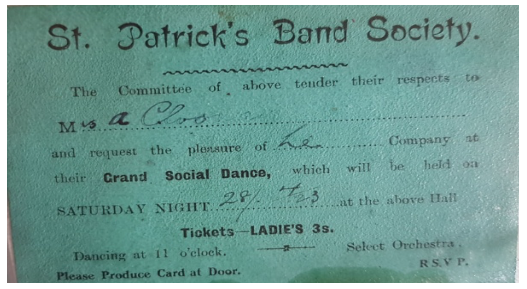
The dances moved back to the Bandroom in 1923 following renovations to the hall. A Dance Committee of officers of the Band including Mick Spelman (Secretary) and P. Rabbitt (Treasurer) and other members ran the dances. There were ‘All Night Dances’ that started at 11pm and lasted into the early morning; Cinderella Dances from 9pm to 2am reverting to 812pm in the winter of 1923. There were also regular practice dances. This committee organised every detail pertaining to the dances, including hiring musicians, food, drink, posters, tickets and also approved the invitation list. Ladies had to receive an invitation to attend dances! Various roles were assigned, including a member to run the bar, a person in charge of minerals, doormen, someone to look after the orchestra / players and an MC for the night. Prices in 1923 were 4 and 5 shillings for the Cinderella dances. The practice dances were held at a reduced fee. The cost of the installation and use of electricity for eight months in 1923 was £9-1s-6d.
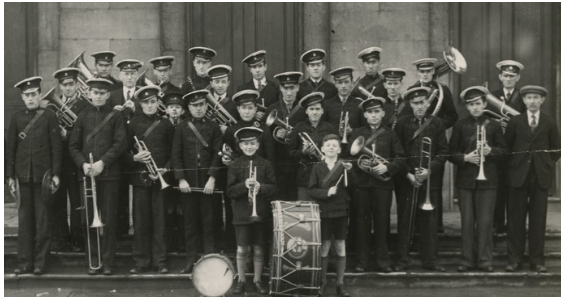
The committee ensured that there were continual improvements to the hall and hired tradesmen to carry out the work, which included repairs to the ladies cloakroom and to roof. The Hall was also hired out to various organisations for dances periodically, such as the Tom Ashe Hurling Club in October 1923. At times it was hired out to other worthy groups including the Irish Transport & General Workers Union in December 1923. Loans were given to musicians by the committee to purchase instruments; for example, £2 to M. Dooley for a violin, which could be paid off weekly. Stings and musical accessories were purchased for the musicians and the dance band-orchestra; and they received six drinks on the night of a dance. The fee for the leader was 10 shillings as was paid to Paddy Larkin in 1923. The overall profit of a dance on 31 October 1923 after expenses were paid was 2s-6d (Half Crown!). The dance committee set itself a target of April 1924 to have the debts cleared and the committee agreed to work hard to promote their dances as there was increasing competition from other organisations.
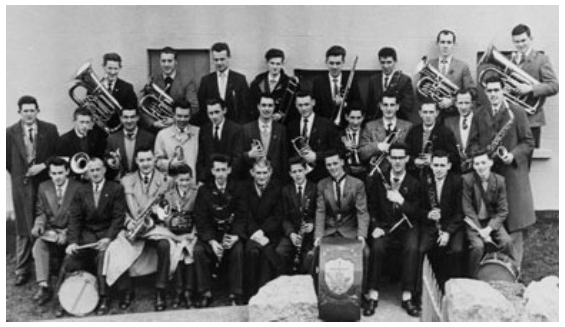
Today, one hundred years on, the Bandroom has survived and continues as a cultural and musical centre in the heart of Galway despite all the developments in the city. Its members successfully resisted repeated attempts to move it from its present location in Frenchville Lane, Forster Street. Other cultural groups such as choirs and dance groups avail of the Bandroom, such as the Galway Baroque Singers, Galway Choral Association and Swing Dance Groups. The Band continues to provide a premises and teachers for musical education for new members.
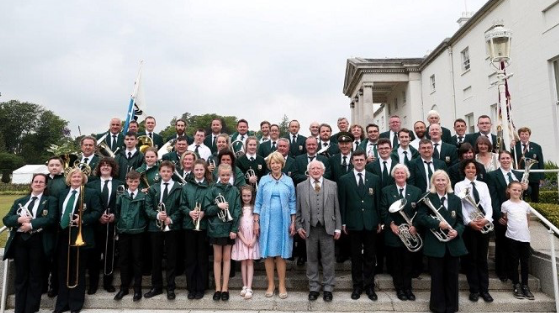
St Patrick’s Band is thriving with a large membership. It played on St Patrick’s Day 2023 as it did in 1903, one hundred and twenty years ago. It continues to organise concerts, recitals for the benefit and enjoyment of the public throughout Galway.