A folly is an ornamental structure which has no useful or practical purpose. They could be costly to construct, both in labour and materials, depending on the size and design. It was a European development. During the eighteenth and early nineteenth century, it became fashionable and a somewhat status symbol for landlords to have an ancient monument located on their land. Where none existed, some landlords had a monument erected to embellish their estate; built primarily to be viewed as part of the scenic garden. Following the rediscovery of Pompeii and other classical sites, travellers would embark on exotic expeditions to places such as Ephesus, Troy, Antioch and Rhodes. At the height of their popularity, these locations attracted poets and artists who would endeavour to capture and preserve the spirit and melancholy beauty of such places. Follies were erected in various classical designs, such as fine decorated stone archways leading ‘nowhere’. Some structures looked like miniature Greek or Roman temples; others were similar to church sites. The most extreme examples were simply ‘conversation pieces’ to excite the Victorian imagination. They had no function at all and were a total invention of the builder’s imagination, which left people to ponder and speculate as to their purpose.
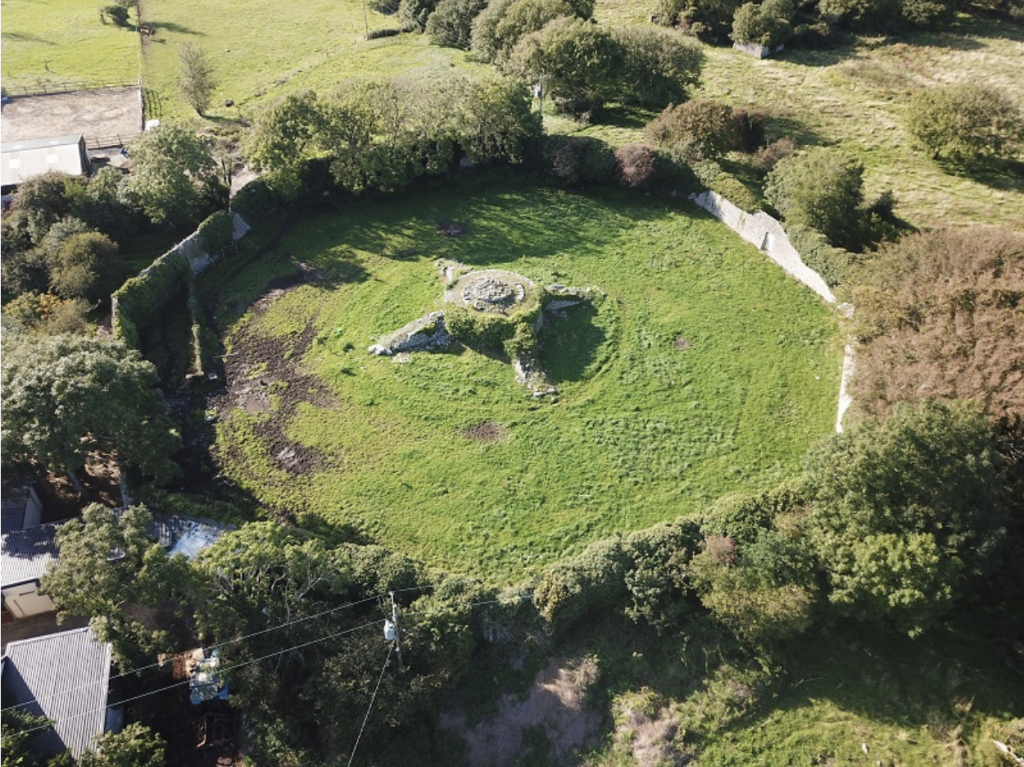
The Roscam Folly could fall into this category, as there is no definite evidence regarding the purpose of this structure. The landowners in this area were the Davenport family. Jane Commins Davenport was the last of the family to live there; she died at the beginning of the 1900s. It is believed that the Davenports had this folly erected sometime during the nineteenth century. It is a circular stone structure and rises in tiers, growing smaller towards the top. There are buttresses located at ground level to support the base of the structure. A number of theories have been put forward regarding its purpose. Some people say it resembles an Aztec sacrificial shrine, while others say it supported some type of lookout post. It was also suggested that it was designed for loading certain types of carts or wagons. It has also been described as a type of lighthouse, where a fire could be lit on top of the structure, as Galway Bay is close-by. The folly is surrounded by a finely built cut-stone wall, which contains recesses that were probably designed to hold beehives. However, like most other follies, it was probably simply a ‘decoration’ and acted as a centrepiece for the walled garden on the Davenport Estate.
I’m currently a student of History of Family in UL – I’m hoping to do a dissertation on the history of the Comyns Davenport family of Rosshill House – my greatgrandfather Thomas Ryan bought the house from The Land Commission probably in 1921, then the house was burnt down by the Crown Forces on 9th December 1921, and he died two weeks later. The house was repaired in 1923 and currently is occupied by my uncle and his wife. Thanks to the full text search facility available on FamilySearch.org I can see that Patrick Comyns (married to Anne Davenport) initially leased land in Roscam with a Hynes man in 1808 where the previous leasee was a deceased Brabazon man, renewed a lease in 1829 before dying in 1843. I have lots of other information which I’m hoping to put into my forthcoming dissertation.