While history is often written by the victor, archaeology in its study of ancient monuments and even smaller artefacts nearly always presents the past as it really was. Galway City is filled with both items, and St Patrick’s Parish is no exception. Take Prospect Hill for example. Just a small section near the top of the hill on the County Building’s side of the road contains five items to whet more than just the archaeological appetite.
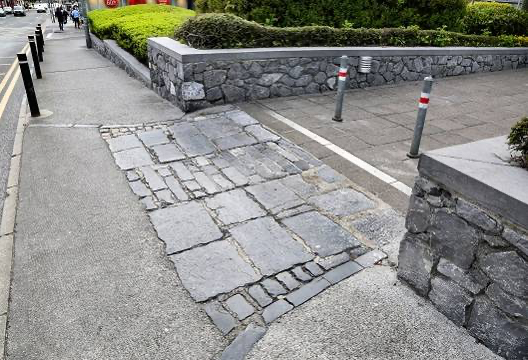
The first, in fact, is still retained on the footpath at the old entrance to the former County Infirmary, which closed in 1924, before the building was expanded into the County Buildings of today. Thankfully, a thin section of the former irregular limestone paving slabs, were left in situ, in front of the former gateway now surrounded by the concrete paving of today. One can only wonder at the number and type of horse-drawn ‘ambulances’ of other days which passed over these irregular sized limestone slabs.
Walking further up the hill, we come to today’s Western Hotel, the first of a fine row of joined buildings. These were constructed, it seems, about the same time as the former hospital to accommodate, as one might say, the initial ‘top brass’ of the hospital staff, and other important citizens of the time. The fine iron railings lining either side of the original rising entrance steps indicate grandeur, but there is something else, which makes the hotel stand out among the rest of the buildings.
Up to recent times, two original iron boot scrapers were still in situ, at the actual entrance on top of the steps. Time, however, has taken its toll, and the one on the right has fallen prey to the demon rust! Thankfully, the left-hand one is still intact, although the actual cleaning plate has given way to rust also.
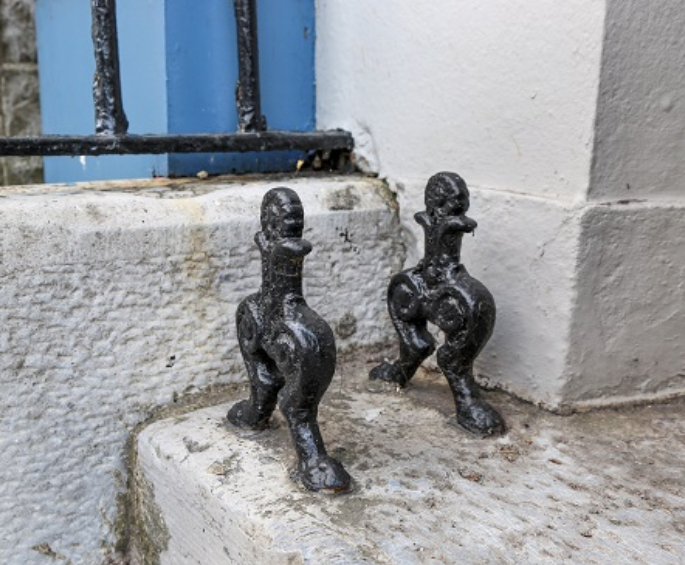
However, the two iron supports, carefully cleaned and painted in the usual black paint of the past, still greets the eye, one of the last pair of the many, which once dotted the well-off streets. All you have to do is to note, on television, the pair guarding the entrance to 10 Downing Street whenever the Prime Minister of England enters or leaves his or their home.
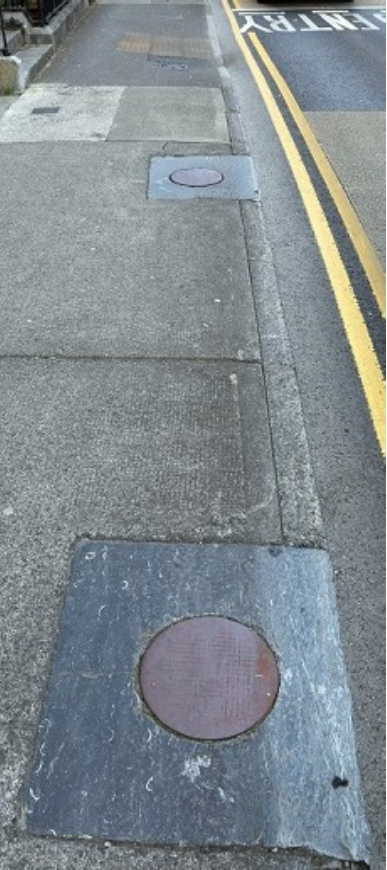
A few footsteps onwards, back here on Prospect Hill, and another pair of iron reminders from the past greets the eye. Surrounded by the concrete paving of today, two circular iron coal cellar lids lie redundant now, their job of allowing access for imported coal now long past. Time, in the form of countless footsteps, have erased writing or embellishments on their surface, but at least they remain, when hundreds of others have been removed with the advent of electricity.
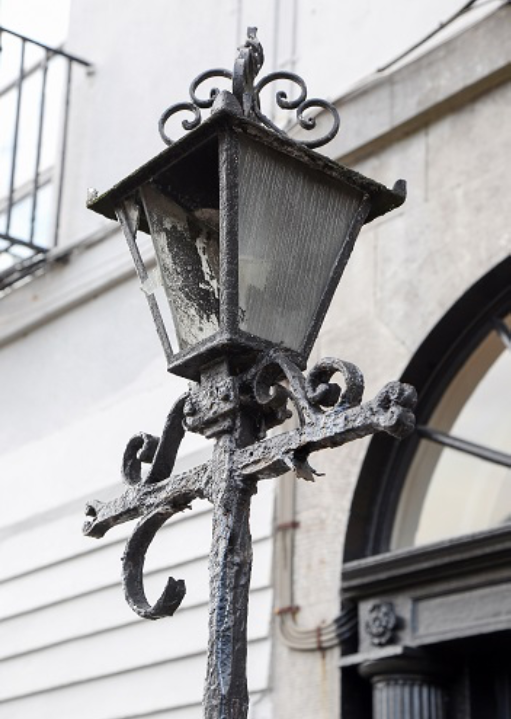
Some footsteps further on, we come to the business premises of Keane Mahony-Smith, at the end of this short row of impressive buildings. Again, this fine three storey building contains railed steps leading up to the entrance. While there are no iron foot-scrapers, there is, however, another fine iron reminder from past times. Rising proudly up from the corner of the entrance railings, stands one of the last, freestanding iron streetlamp posts, with its lamp holder still intact on top. Also still there is the horizontal iron crossbar on which the lamp-lighter placed his ladder while lighting the lamp. This is a fine archaeological treasure for all to gaze upon and admire.
That is not all, because engraved on the adjacent first stone step is another gem from the past. The three straight carved strokes, in a fan shape, of a benchmark is clear for all to see. This and thousands of other such carvings across the land indicated different heights over sea level, all scientifically co-ordinated with the initial one situated on the East Coast near Dublin. There were no computers back then in the early decades of the 19th century to help ordnance survey experts in their work.
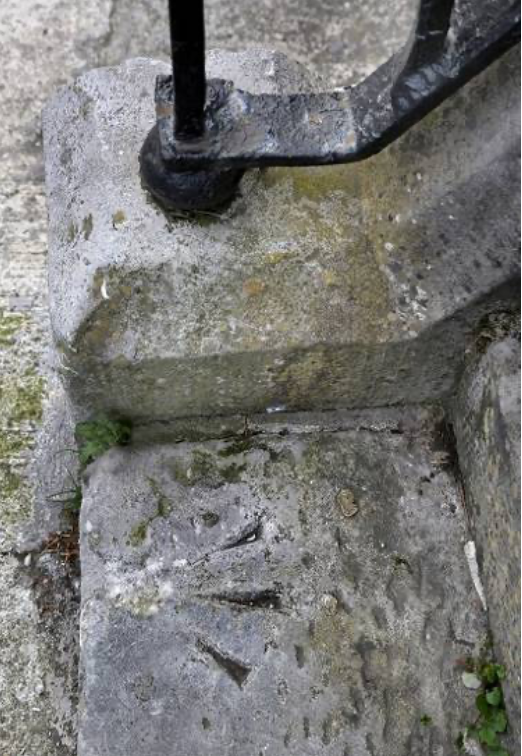
Many benchmarks exist throughout the city and county on walls and flagstones of every description, including one on the bottom cornerstone of Lynch’s Castle in Shop Street. To some people, however, these carvings were thought to be actual footprints of the devil and should be avoided at all costs. Archaeology, how are ya!