Human life without water would not survive, so from time immemorial we humans have treasured it. So where water bubbled up through the earth in the form of springs or wells, they became a special place. From the end of the Bronze Age, c. 2,000 B.C. onwards, when our ancestors settled down to farm the land, special attention was paid to wells. This was a theme, which continued through the subsequent Iron Age, and especially so, when Christianity came to Ireland in the 5th century. Not surprisingly, wells were Christianised and given saints’ names, such as St Patrick’s Well and St Bridget’s Well becoming the most common.
However, here in today’s St Patrick’s Parish, St Augustine’s Well beside Lough Atalia takes pride of place. Situated halfway along Lough Atalia Road, only a few metres down to the waters’ edge of Galway City’s special ‘salt lake’, the well has attracted numerous pilgrims, many seeking miraculous cures down through the years, if not centuries.
It all began when the Augustinian Order of Friars set up in 1500 A.D. their first monastic site at the end of the long hill, stretching from Moneenageisha, before coming to an end overlooking the tidal entrance to Lough Atalia, as well as the nearby swamp-land, now Galway docks. Encouraged by Margaret Athy, wife of the mayor of Galway, the Augustinian establishment grew into a large important Christian site, complete with a fine church building overlooking the bay and town. Sadly, this fact later led to its eventual downfall, with the friars moving within the town walls after the English Reformation, as well as various town sieges. The church and its immediate grounds were turned into a military fort, thus gaining the title of ‘Forthill’. When peace eventually returned, the site was turned into the cemetery we know today.
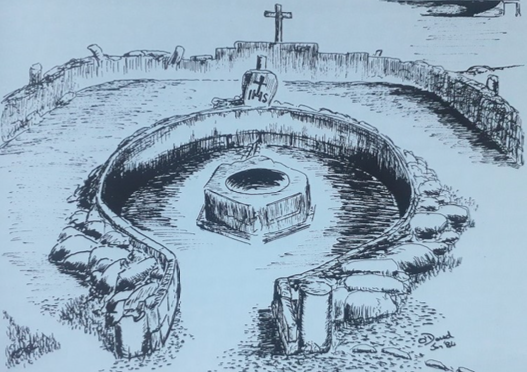
(St Augustine’s Well by the author of the article in 1984)
However, various sources suggest that four wells were situated within the original larger Lough Atalia land possessed by the Augustinians. In more recent times, during the laying of a foundation of a railway line extension, a circular stone-walled well was temporarily exposed. Meanwhile, various editions of ordnance survey maps show three other wells along the actual shoreline of Lough Atalia itself. One was depicted opposite the entrance to the Forthill Cemetery of today and the London Illustrated News of 16 September 1871 depicts shawled women praying beside it, with a train crossing the railway bridge in the background. That well is now covered over by a landfill opposite the Galway Bay Seafoods establishment.
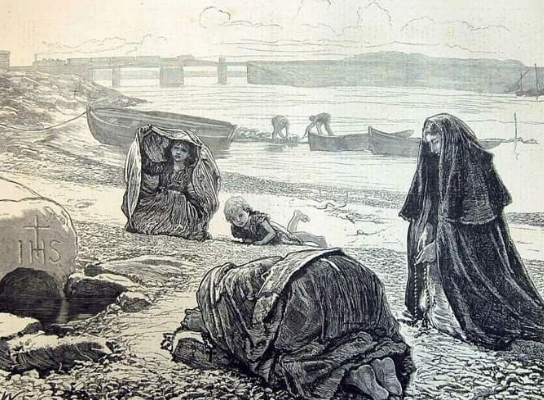
(London Illustrated News image of 16 September 1871)
This well is the western one of the trio shown in the ordnance maps. On the other side of the bridge, lies the current St Augustine’s Well, while the third has disappeared, perhaps under extended land or the waters of the Lough itself.
Thus, today’s St Augustine’s Well is the last of those in the Lough Atalia area, as distinct from others in the rest of the city and its environs. As with other holy wells in Ireland, cures for various ailments are associated with the Lough Atalia examples, especially the remaining one of today. Perhaps the earliest reference dates back to 11 June, 1673 when a Patrick Lynch was cured of a serious stomach ailment after using its waters. Since then, many accounts refer to cures for eye and ear defects as well as other ailments have been noted. Mention has been made of crutches being left behind, especially from country people who came from far and near to pray and sample the special curative waters of this well. Special days such as the last Sunday in July and August saw devotions held there, when crowds gathered, at the circular stone and cement lined well, topped off by a ‘HIS’ inscribed slab, all surrounded by a wider version at the water’s edge, topped off by a stone cross.
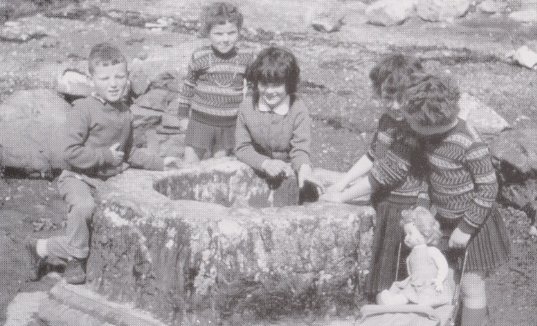
(Children playing at St Augustine’s Well, c. 1960s)
Sadly, much of this structured shrine was badly damaged by rising storm-tossed waves, leading, thankfully, to the Galway Civic Trust stepping in at the start of the new millennium, 2000 and restoring the fine site we see today. New steps were inserted leading down to the well, a new stone cross was added and appropriate seating was included also. As well, on the suggestion of a local man, the famous hurler, Seán Duggan of nearby College Road, an informative inscribed plaque was also added, giving appropriate information on this sacred site to local visitors and strangers alike.
For further information on this well, and also on those in the city and environs, see my article, complete with drawing, in Volume 60, 2008, of the Journal of the Galway Archaeological & Historical Society.
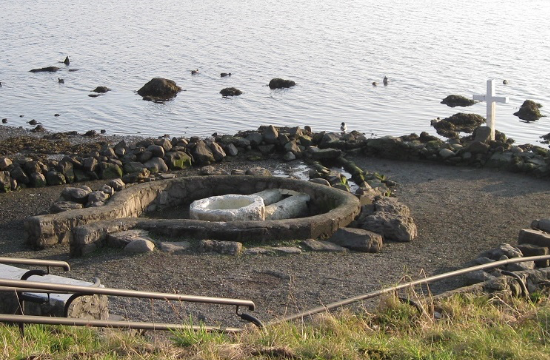
(St Augustine’s Well, 2018)