In 2022, as the pandemic receded, Jack Kavanagh headed west to celebrate summer alongside citizens and visitors on the lively streets of Galway.
Galway is once more in the land of the living
I’d spent ten days in a room in Dublin, coughing with Covid; so, I took the train to the City of the Tribes to feel alive again. To enjoy the western air, the music, stories; spend a day at the races, maybe, or just celebrate life. Where better to do that than Galway in July?
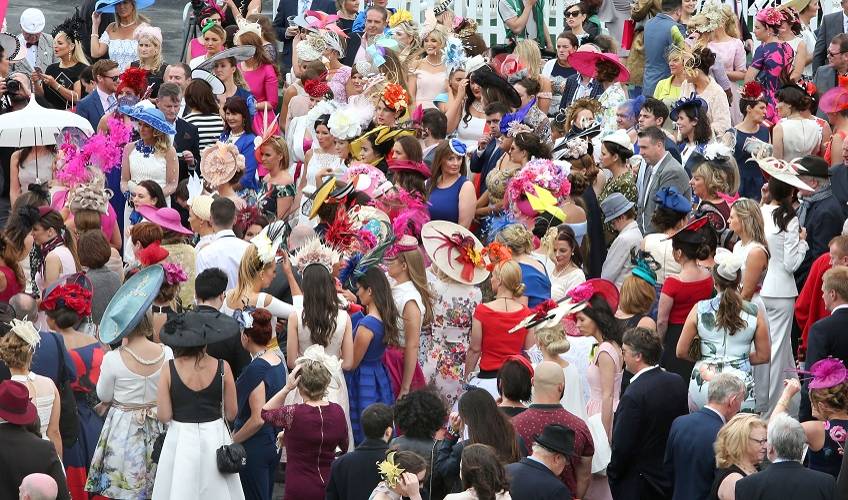
I stayed in the Claddagh, the fishing village just across the River Corrib. The place is forever stamped in global folklore with the heart and the crown of the Claddagh ring symbolising fidelity to the one for whom your pulse races. Like many a Galway treasure, the ring design came from afar, brought back by Richard Joyce after his capture by Algerians and apprenticeship to a Moorish goldsmith. Standing in line for fish’n’chips, I hear orders relayed between staff in Arabic, and a Spanish couple singing tipsily behind me. July has filled the old port city again with the heady creativity of the International Arts Festival and the high-rolling hedonism of the Galway Races.
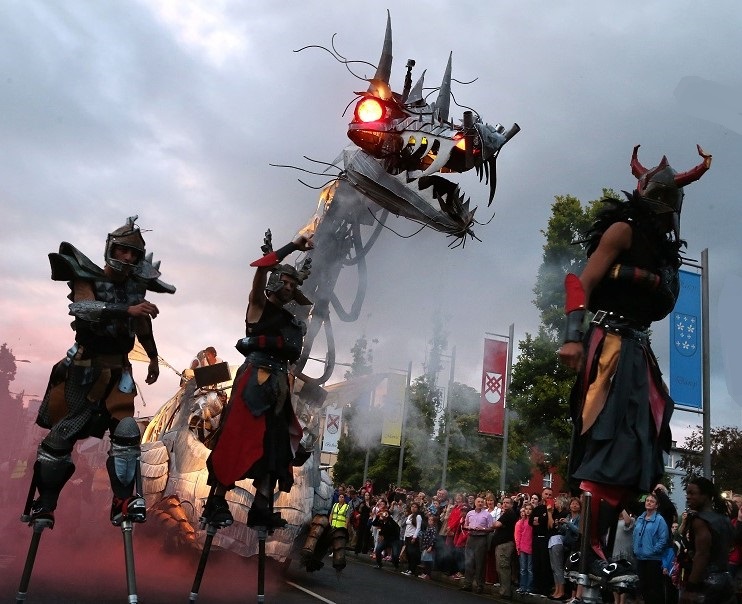
A ghost town for nearly two years, the streets now echo with the familiar summer drumbeat of street carnivals; the sarcastic laughter of seagulls harangues you from above; and the pubs are abuzz with the racing fancy’s whispered tips. Wander the streets and you witness the wonderful exoticism of parades dreamt up by arts troupes such as Macnas. This year, the Galway Community Circus has citizens walking on air: Their Lifeline spectacle teaches all-comers to venture along high-wires stretched over the River Corrib; the aim is to bolster mental health in these tough times via the hope, strength and resilience that the circus art imparts to those willing to take the first step toward the far shore.

I walk along the solid stones of Nimmo’s Pier and recall a day long, long ago that now feels like a distant dream: I stood here, decades earlier, in awe at the climax of a parade as an amphibious riot of green – and blue – and purple-scaled sea creatures danced their torchlight procession for an ancient Irish sea god and his new bride to the end of the pier. The festive fish and merry mermaids then threw their blazing torches into the brine as Manannán Mac Lir (Son of the Sea) dived headlong into the bay with his beloved, never to be seen again. The veil between reality and myth is breached regularly in Galway.
In 2022, a herd of huge red giraffes roam the streets in an animal operetta led by their beloved Diva. These monumental creatures, lit up by atmospheric flares, transform Galway’s Latin Quarter into a surrealistic streetscape that belongs to the realm of magic realism. Later, the Flaming Lips bring their own psychedelic rock circle back to the Big Top in Fisheries Field. Last time they played here, singer Wayne Coyne rode a LED-lit unicorn. Galway in July is often beyond belief; but only to visitors without the imagination to indulge in the magic all around them.
One man, whose magic touch has deserted him, alas – at least when it comes to backing non-mythological horses – is Paul Garavan. Paul is the latest clan member to run the legendary pub bearing their name. Tonight, the elegantly suited owner is just back from the Galway Races, where he might as well have bet on unicorns: ‘Every horse I backed was running backwards’, he sighs. As we sit sipping a smoky Connemara Peated Single Malt with historian Willie Henry in Garavans’ snug, Paul shares stories of the men who have supped here, including writers Samuel Beckett and Brendan Behan. He also recalls local legends such as long-time manager Johnny Ray and barman Nicholas Killoury. ‘Nicholas was a man of great faith’, says Paul, ‘who downed his dishcloth to pray at 6 p.m. each evening at the sound of the Angelus bells, regardless of the status of settling pints of stout’. Regulars knew well enough to get their order on before five minutes to six. – Well, Holy Mother of God.
Could this be where Beckett named his play about existential impatience, Waiting for Godot? ‘Nicholas shocked us all one day, when he asked permission to make a call to a woman in England, who turned out to be his wife’, says Paul, ‘We never even knew he was married! She had given him an ultimatum, apparently, to choose between her and his mother. Naturally, the Irish mammy prevailed’.
I’m thinking about that woman exiled to England when two Cockney-accented tourists stop me next morning on Wolfe Tone Bridge. They want their photo taken in front of the wind-blasted hawthorn tree; its branches blown eastward on the west side of the River Corrib. As I hand back their phone, I recall the astute observation of writer Edna O’Brien, one of Ireland’s most celebrated exiles in London: ‘When anyone asks me about the Irish character, I say look at the trees. Maimed, stark, and misshapen, but ferociously tenacious.
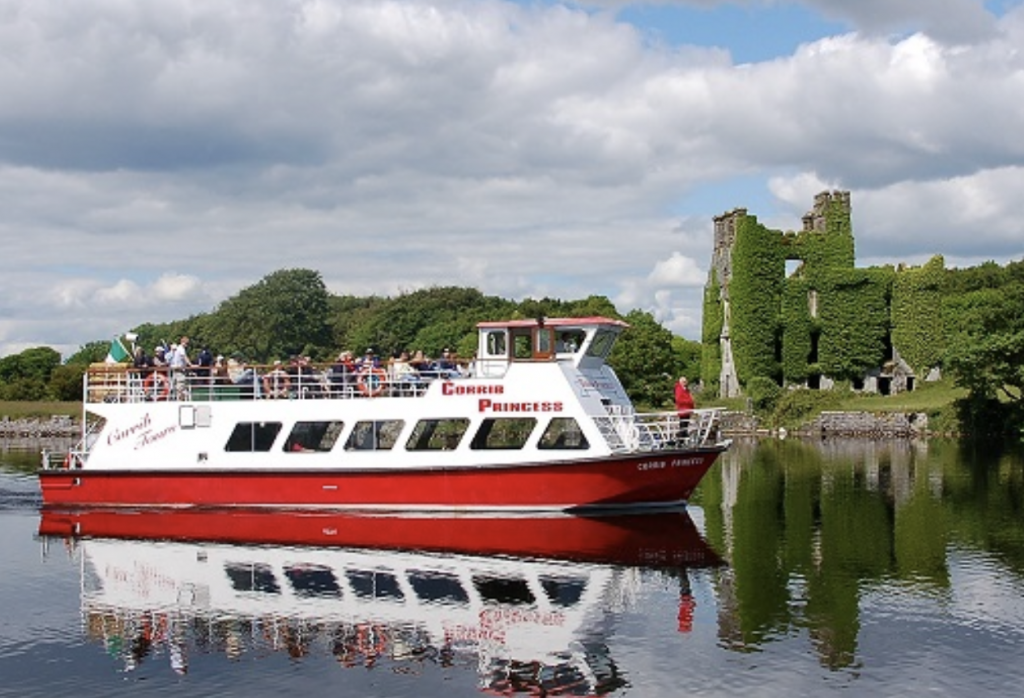
The ferocious O’Flaherty’s, of course, were among the most tenacious of all the Gaelic clans around medieval Galway, when conquest and colonisation came to Connacht. Aodán McDonagh, captain and owner of The Corrib Princess, mentions their stronghold, Aughnanure Castle, as he guides us on the journey up the River Corrib onto the great lake (Lough) of the same name. The six-store abode of the ‘ferocious O’Flahertys’ bristles with murder-holes, secret rooms, and bartizan side turrets, enclosed in a walled ward with its own picturesque lookout tower used to sight approaching boats.
The early Neolithic settlers made this same upriver passage. The Vikings too; their sunken wooden boats were found by a sea captain, Trevor Northage, who was mapping the lake’s fishing grounds several years ago. Today, only leisure crafts use this great waterway connecting Ireland’s second largest lake with Galway Bay and the Atlantic beyond. The Princess takes us past the remains of ancient ring forts, and two ruined castles, Terryland and Menlo, where people are picnicking.
Our voyage follows the same route the early Norman conquerors took when they first ventured warily into the heart of the Celtic darkness. This vast bogland was then a wooded, largely lawless wilderness; as the Normans colonised the Gaels, the rent demanded of one particularly ferocious O’Flaherty chieftain was delivered in the form of the head of the De Burgo son who had been sent to collect payment, returned in a sack.
Later, we sit discussing another gruesome legend that of ‘The Kings Head’ in the pub of the same name with owners Paul and Mary Grealish. I’m chuckling to myself: Galway people discuss local history as if it happened last week. Savouring a delicious salmon-salad lunch in this labyrinth building dating back to the 13th century, it’s easy to see why. There’s even a humorous plaque on the wall: ‘Pub of the Year 1651’.
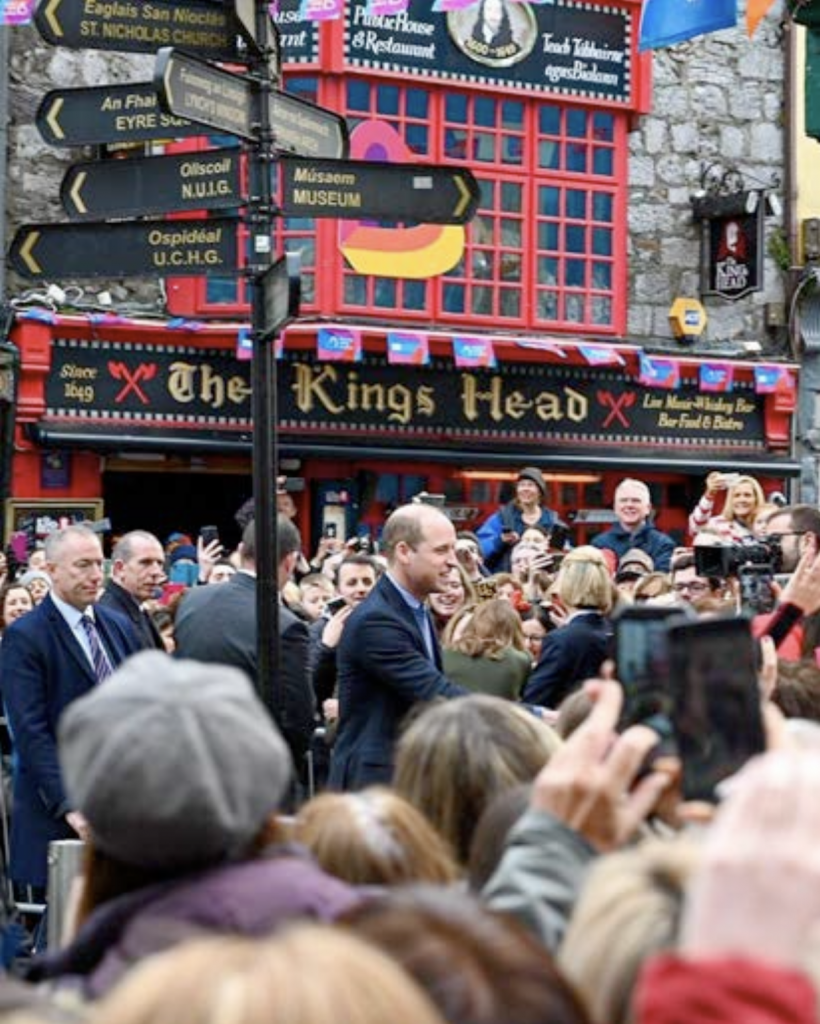
The King’s Head also hosts an adjoining seafood restaurant, a modern music stage (decorated with an ancient harp), and a comedy workshop at the top of its tower. The Grealish family bought the pub in 1989. By then, myths about a previous resident, Peter Stubbers, a colonel in Cromwell’s army, had long supplanted historical facts. Galway gossip easily embraces ye olden times too. So, the new owners commissioned renowned archaeologist Paul Gosling and historian Jackie Uí Chionna to verify the legends. According to the experts, Stubbers, the man who probably lopped off the head of England’s King Charles I, did indeed take residence here back in the mid 1600s as Galway’s first Protestant mayor, usurping the home of Thomas Lynch Fitz-Ambrose, the last of the city’s Gaelic tribal mayors.
Among many fascinating wall hangings – including a map of medieval Galway and a mirror advertising Persse’s Whiskey, once distilled on nearby Nuns Island – there’s a terrific photo by Declan Colohan of Prince William visiting The Kings Head in March 2020. The future king’s head dominates as he rises above the crowd; my own head was still foggy from the 21st century plague, so I foolishly forgot to ask Paul whether His Royal Highness ordered a pint of the pub’s own Blood Red Ale. Probably not; one must keep one’s head while on duty, after all.
Back in early Norman times, severed heads (on spikes) were known to decorate Claregalway Castle. The estate is now in its third decade of a majestic restoration under owner Eamonn O’Donoghue. The Tipperary man laughs at his magnificent obsession in restoring this Norman fortification to its former grandeur. The medieval walled citadel was designed initially to keep the likes of the ferocious O’Flahertys out. This renowned eye doctor clearly possesses great architectural and historical vision, but he scoffs at his endless castle-building as his “late-stage madness.”
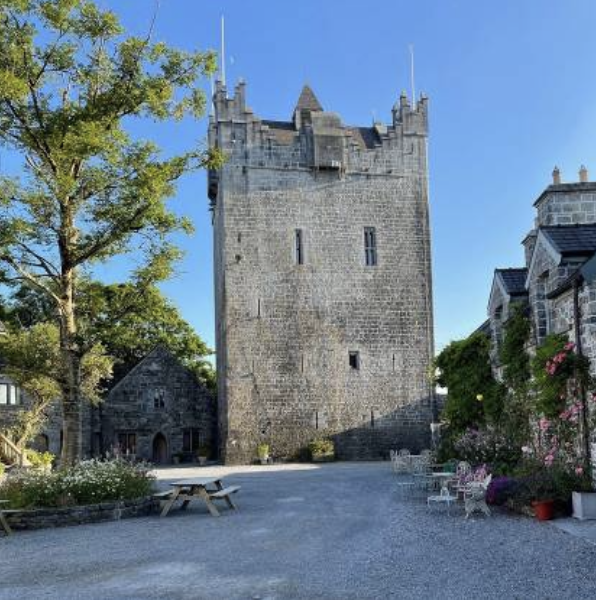
“Welcome to the tower of Ulick the Beheader,” he quips, “the quintessential West of Ireland psychopath”. The previous owner liked to display the anguished visages of vanquished attackers high above the outer walls as a warning to would-be attackers. We climb three flights of a stone spiral staircase and turn into the wonderfully recreated Long Hall of the tower house. The doorways are low, built to accommodate the moderately-sized medieval Gael, not his tall, well-fed modern descendant.
“Watch your head!” warns O’Donoghue. The tower at Claregalway and its Long Hall are astonishing architectural replicas. There are few buildings anywhere that allow you to viscerally step back in time – in Irish castles elsewhere, a velvet rope keeps you on the present-day path of the tourist, not the time traveller. Claregalway is different, a vibrant space, where you step out of your modern life and inhabit the ancient realm of a medieval Connaught citadel. The castle and its grounds are available as accommodation for private guests and for seminars; it also hosts music and horticultural festivals.
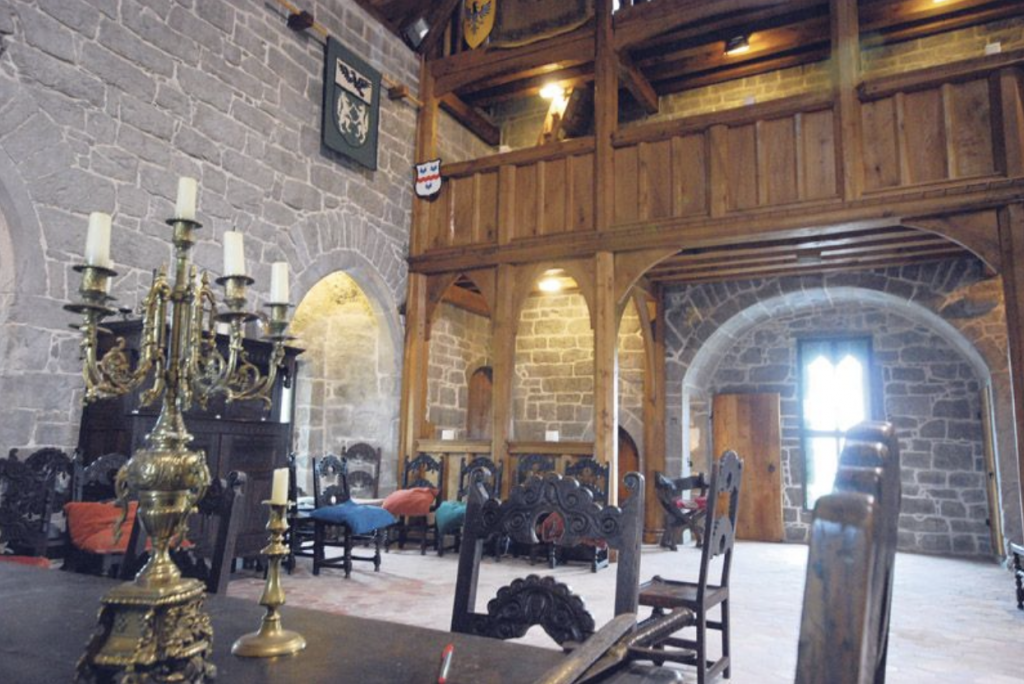
The owners recently showed a Galway hurling game on a big screen under the shade of a huge beech tree, as puppeteers entertained children nearby. The Long Hall also hosts Ireland’s oldest bed, a decorated dark oak frame dating from 1542. What dreams and nightmares must have swirled around its psychic space? The musicians who’ve entertained in the hall have shared the feelings evoked by this enchanted room with their host. “Many have mentioned the magic that happens when the sound of a harp or a bodhran or a fiddle resounds off these limestone walls,” says O’Donoghue. Acclaimed players, such as accordionist Sharon Shannon, have transported guests back to the nights of music, mead, and merriment in a Gaelic chieftain’s tower house. High on the tower’s rooftop, the doctor points out the special sighting of Claregalway Castle: The Franciscan Monastery dating from 1240 just to the north predates the citadel and in the distant northwest one can see two ancient fairy hills, believed to have mystical powers similar to those of the Gaelic world’s other energy vortices, such as the Hill of Tara.
The power of the Earth is all around here and O’Donoghue’s firm, Galway Stone Design, uses its most locally abundant resource to chisel history into his castle recreation. Many of the firm’s stonemasons are also carpenters, who restore furniture and galleries within the complex. The good doctor shows us examples of French, Italian, and other stone carving styles that decorate the doorways of the castle courtyard. “The only thing that grows abundantly in the ground in the west of Ireland”, says O’Donoghue, is stone, “We’re keeping the ancient crafts alive here.”
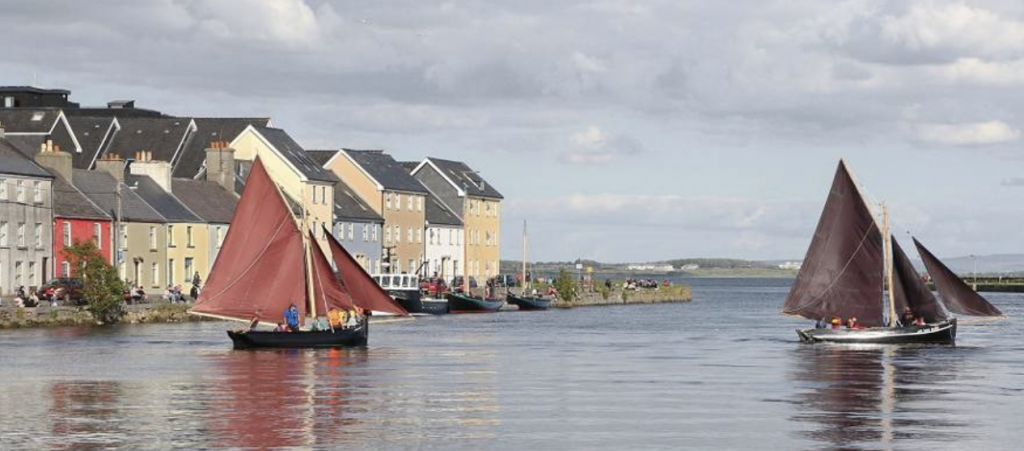
Another old tradition that has been revived around Connemara is the building and sailing of Galway hookers(traditional fishing and transport vessels long known as the workhorses of coastal Connemara and North Clare). Skipper Peter Connolly and his first mate Daragh Bailey bring their gorgeous hooker, Claddagh Lass, around from Ros an Mhíl, to pick us up at the city docks. Daragh describes a pod of dolphins that followed them over, but as we head out under the midday sun, all is still in the vast, green waters of Galway Bay. There is little wind, and, true to the crafts’ history, no outboard motor lies within the curved wooden hull of the hooker.
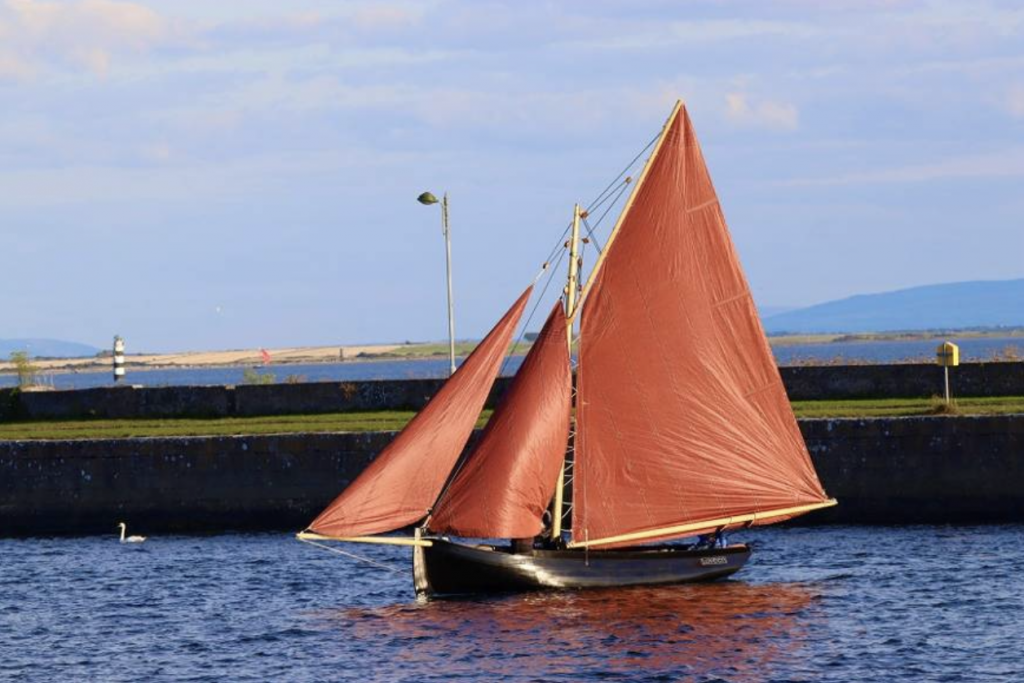
We’re joined by Dermot Connelly, a carpenter with roots in the Claddagh and a cousin of the skipper, who worked on the restoration of Galway hookers in the 1980s. Dermot’s father, Tom Connelly, was a renowned artist of the Claddagh and crafted many a fine painting and models of these ancient boats. In the last decades of the 20th century, the hooker was in danger of disappearing into the realm of a relic remembered only in such artworks. But the work of dedicated locals, including Peter Connolly, has seen a sea change in the fortunes of these traditional vessels. When Bádoirí an Cladaig (Claddagh Boatmen) along with boat builder Joe Joyce, launched Croí an Cladaig (Heart of the Claddagh) in 2014, it was the first hooker of its class built in Galway since the early 1920s. Now a multitude of red sails grace Galway Bay again. Today, Dermot Connelly has returned from his longtime home in Toronto to share his sailing heritage with his teenage son, Kevin. Dermot describes how the craftsmen would steam the long cuts of oak wood that make up the ribs to give the hooker its unique, full-bellied shape.
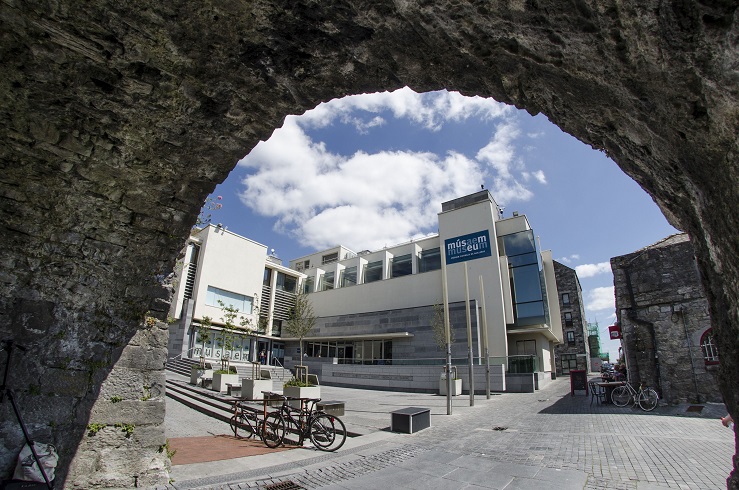
In the Galway City Museum, you can study a magnificent hooker up close along with a collection of curraghs (rowboats made of a framework of laths covered with tarred canvas). The hooker on view here, Máirtín Oliver, was crafted especially for the museum. These boats got their name from “hook and line” fishing, which used long lines of baited hooks to catch fish individually. Although hookers are traditional fishing boats, the largest of their four classes, the bádmór (big boat) and leathbhád (half boat) were also used for the transport of cargo. These would haul up to eight tons (7.25 metric tons) of turf, livestock, general supplies, lime, poitín (illegal whiskey), and seaweed (a valuable fertiliser) to and from Ireland’s western islands. The smaller gleoiteóg (neat vessel) and púcán (open boat) are more nimble, used by lobster and small-catch fishermen.
Sails are made of unbleached calico, a heavy textile that is soaked in a protective solution made from tree bark or from a tar-and-butter mix. This tradition of “barking the sails” – a process repeated yearly give the sails of Galway hookers their distinctive red or rusty brown hue. Hookers use three red sails – mainsail, foresail, and jib – to harness the wild Atlantic winds. To watch these sleek vessels under full sail is to witness Irish maritime history in motion. But in the absence of even a breeze today, our 34-foot (10 m) sails hung heavily.
“We float silently in Galway Bay”.Drifting dreamily in midday doldrums. Our skipper kicks off his elegant German work boots (worn in fond memory of his late brother) to clamber barefoot around the 31.6-foot (9.6 m) leathbhád (half-boat) craft. With his mischievous grin and mellifluous Galway accent, his windswept mane, and his salt-and-pepper moustache, Peter Connolly could be a seaman in the service of Grace O’Malley, Ireland’s legendary 16th century Pirate Queen. While we wait for wind, he entertains us with tales from this “town tormented by the sea” as the poet Mary Davenport O’Neill called Galway.
There’s one about the builders who got a three-month contract on Nuns Island and, due to difficult weather and challenging conditions, “finally completed the job 18 years later … and that’s a true story.” Peter chuckles: “The silent sisters were ideal clients – an enclosed order of nuns who couldn’t complain”. Willie and I had taken the River Walk past the island convent the day before. Here, a healthy population of women still live out lives of chastity, poverty, and silence, despite the drastically endangered numbers of vocations elsewhere in the somewhat collapsed Catholic state that is modern-day Ireland.
I spotted a courting couple lying in the shadow of an elm tree, right across from Nuns Island. A little further on, Willie shows me the locally knick-named ‘Chastity Bars’. These spiked iron bands were installed by a bishop to prevent lovers canoodling in the shelter from the elements afforded by the church’s exterior alcoves. But Galway is a city for the living: love and life and birds and bees hum through the air on these sultry, sensuous days of summer, regardless of the rigours of any restrictive religion, it seems.
I tell Willie the story told to me by a petite forty-something woman smoking a cheroot in Galway back in 1981, over the first bottle of wine I ever shared with an adult. In her youth, this woman had joined a convent in Andalusia. But a Dublin man nicknamed ‘Chubby Williams’ had other ideas: He traversed the Celtic Sea and the length of France, crossing the Pyrenees to beg her to reconsider. Standing in the dust outside imposing ancient wooden doors, he was told by a not-too-impressed Mother Superior to come back the next morning, when he would have 15 minutes, and 15 minutes only, to make his case to his beloved. And she told me this story in the kitchen of her country house in north Galway, when I stayed there as a guest of her son, one of the couple’s nine children. “Love prevailed,” Deirdre Williams told me recently. “You could say I found a different vocation,” the still-sprightly nonagenarian added.
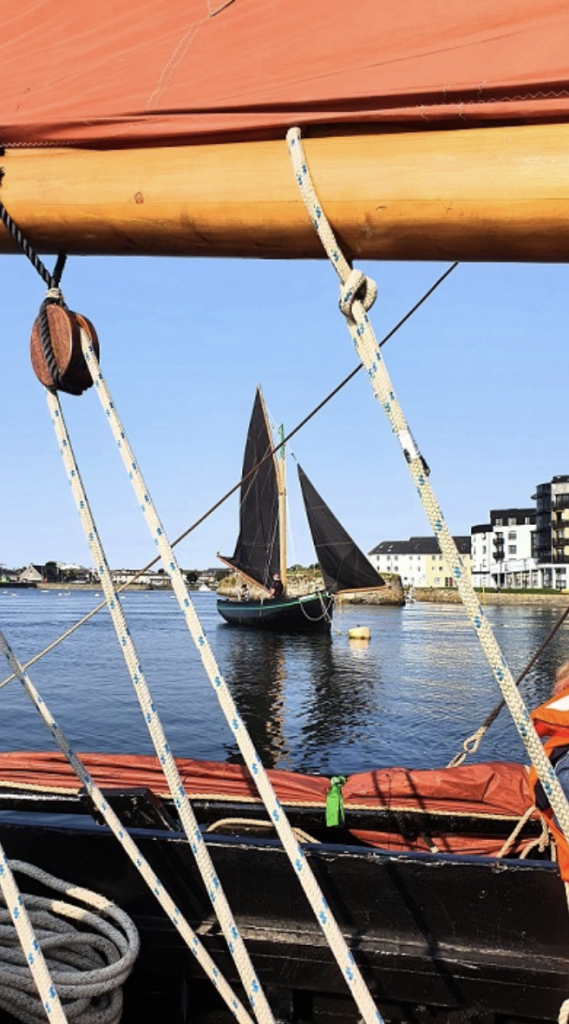
Back out on the bay, our skipper checks the cloudless, windless skies over Galway, and asks me what time my train for Dublin leaves. I’ve a wedding to go to in the capital that night, but I assure him I have all the time in the world. Dublin nuptials, deadlines, and even the raucous, thronged streets of race-week Galway seem a world away now. The red sails of the hooker flap gently. The sun bathes the shores of Connemara to the north. We are floating in western waters, happy to be alive. Glad to be adrift in the Galway summertime.