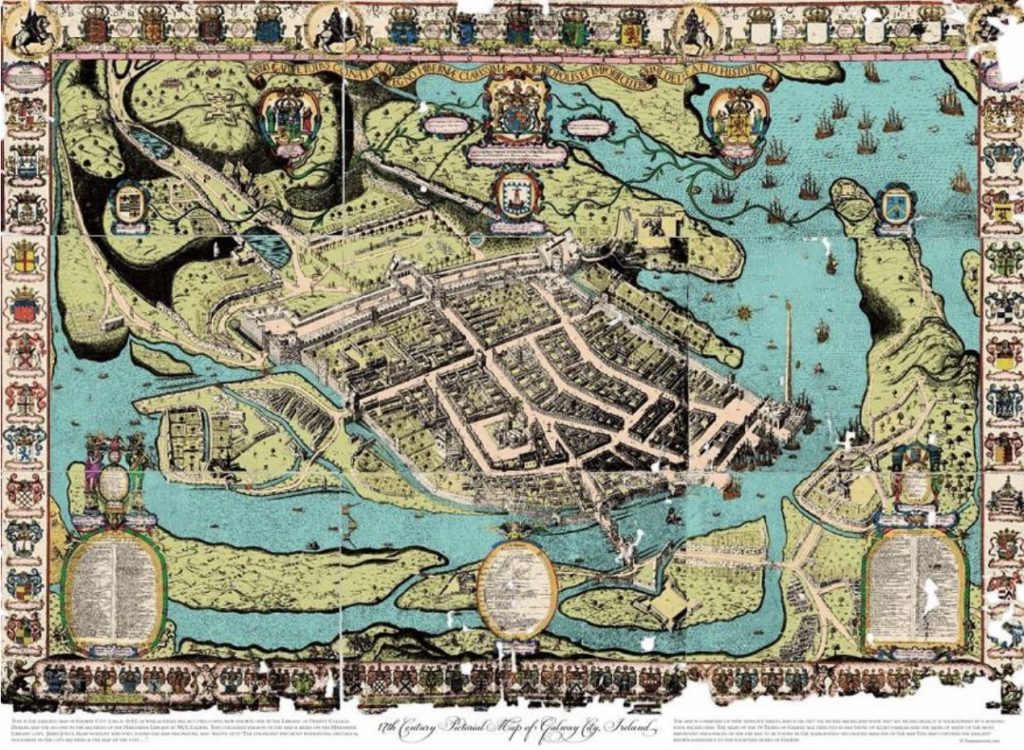
The original Lion’s Tower was built in the year 1278 as part of the first real permanent wall of defence constructed around the town of Galway. It was circular and situated on what we now know as Eglinton Street. It was close to the Middle Tower, which was a little closer to Williamsgate Street.
Between 1646 and 1651, significant alterations were made to the walls, with huge side ramparts being constructed along the eastern section for added protection. This included a very large northern rampart which dwarfed the former bastion around the Lion’s Tower. It is commemorated by a plaque which can be seen on the northwest corner of Tower Buildings.
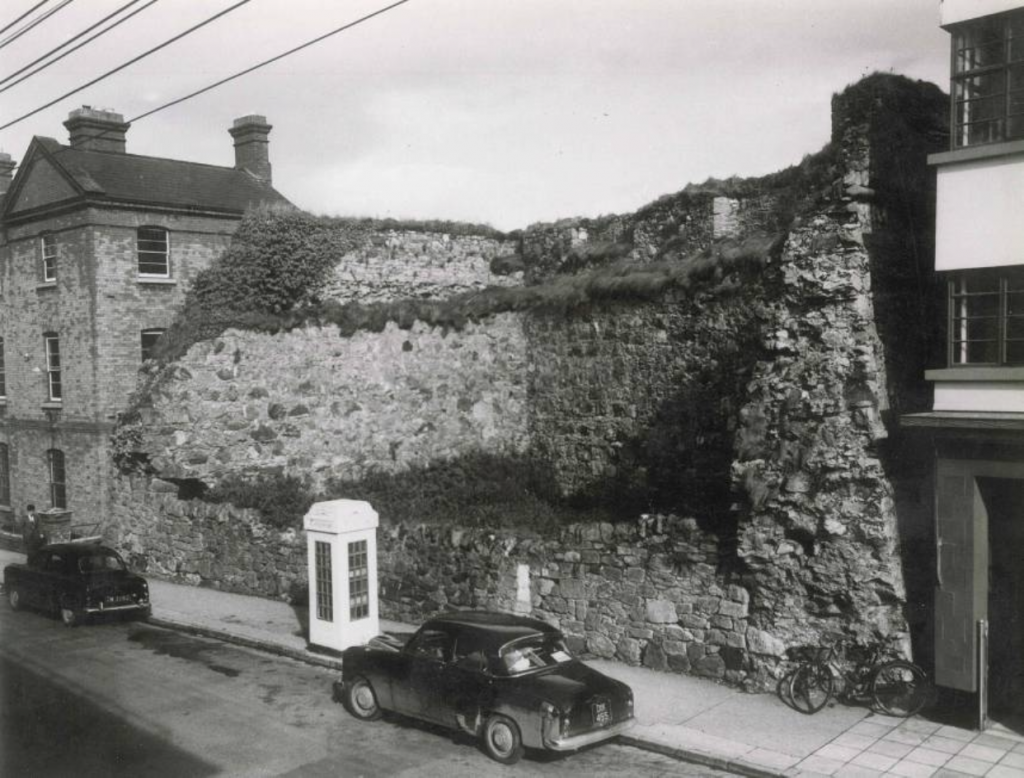
The tower was a major part of the city’s fortifications, a polygonal bastion which has a prominent sloping wall, above which the parapet rose vertically. The interior of the wall had shallow embrasures for cannon, and the general standard of workmanship was very high.
In the late 1840s, the idea of building a new road following the length of Francis Street to Williamsgate Street was being considered. It was proposed that for 200 pounds, a new street about 460 feet in length – through Mr. Bath’s grounds – would be a useful and desirable improvement, tending to afford building sites for an improved class of houses, either as shops or as private dwellings, as well as enhancing considerably the value of the property through which it would run. In its present state it was of little value.
It was feared that if the line of the street was not laid out to the best advantage, it might have been occupied by houses of an inferior description. In the event, the street was straight, but its construction did not entail the removal of the western part of the Lion’s Tower.
At the official opening of the street in August 1852 by the Lord Lieutenant of Ireland, the Earl of Eglinton, the name was officially changed to Eglinton Street.
The remains of the Lion’s Tower were demolished in 1970, causing a lot of protest and excitement at the time. The line of grass along the interior of the walls was where the cannon would have been placed. Our photograph, which is courtesy of the Royal Society of Antiquaries of Ireland, shows that while the inner section of the tower had deteriorated, the outer wall was still intact and gave one an idea of how impressive the original medieval wall must have been.