The popular statue of writers Oscar Wilde (Irish) and Eduard Vilde (Estonian) is a permanent fixture in William Street. Both sculptures are seated, leaving a space between them for any weary person to sit down. It has proven a great asset for locals and visitors alike to sit there and have their photograph taken.
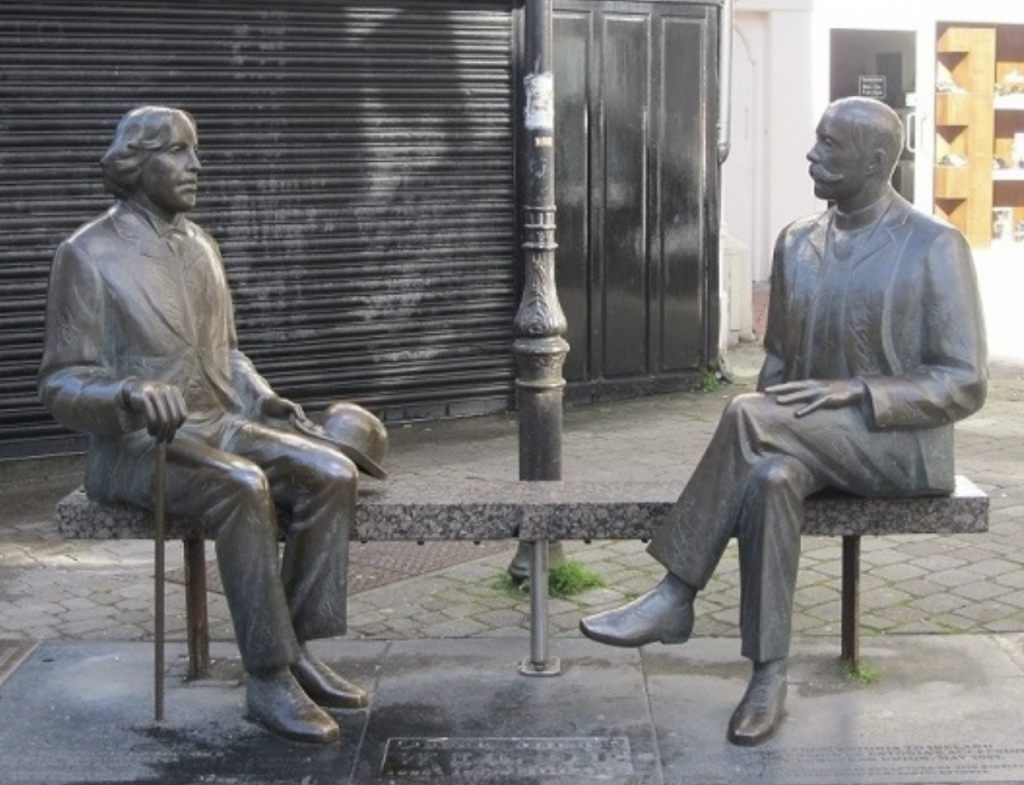
The sculpture was a gift from the City of Tartu in Estonia and presented to Galway on 24 April 2004. It was officially unveiled by Councillor Terry O’Flaherty, Mayor of Galway. Also present were a host of Estonian dignitaries, including his Excellency Simmu Tiik (Ambassador to Ireland); journalists, businessmen, Government Ministers, members of the European Parliament and many more turned out for the special occasion. It is a replica of a sculpture located outside the Wilde Irish Pub in Tartu, Estonia. These men were contemporary writers, and the statues represent a possible meeting between them in 1892. The people of Estonia were very enthusiastic to have a replica made of the sculpture and presented to the people of Ireland. The plan was to have the sculptures unveiled prior to the ‘Day of Welcomes’ which took place on 1 May that year. The Day of Welcomes was a special date as it was part of the Cultural Programme for the Irish European Union Presidency in 2004. A miniature bronze cast of the sculpture was presented to President Mary McAleese during her visit to the country that year – 2001.
Eduard Vilde was born on 4 March 1865. He was a writer and pioneer of critical realism in Estonian literature, and a diplomat. Vilde was the author of classics such as The War in Mahtra and The Milkman from Mäeküla. He was one of the most revered figures in Estonian literature during his lifetime. He is also generally credited as being the first professional writer in Estonia. Vilde died on 6 December 1933. Oscar Wilde was born on 16 October 1854 in Dublin. Wilde married a wealthy Englishwoman named Constance Lloyd on 29 May 1884. They had two sons: Cyril and Vyvyan. He was a hugely successful writer with such works as The Picture of Dorian Gray and The Importance of Being Earnest. It was while enjoying his literary success, that Wilde commenced a gay relationship with a young man named Lord Alfred Douglas. The young man’s father, the Marquis of Queensberry, was shocked by the affair and Wilde ended up facing court proceedings on a charge of ‘Gross Indecency’. On 25 May 1895, Wilde was convicted and sentenced to two years in prison. Oscar Wilde died in Paris of meningitis on 30 November 1900.