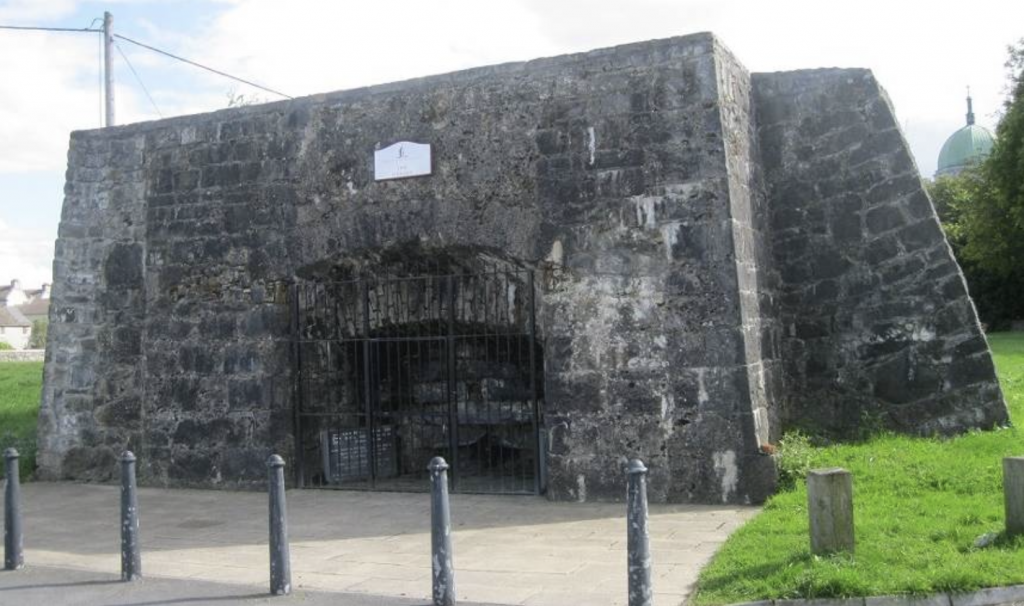
There is a large Lime Kiln situated in Fishery Field on the west bank of the River Corrib. The Puirin (Opening) is located in the north wall of the Kiln. There was a ramp on the east side which led to the house that was once on the top of the structure. There are buttresses attached to the south and west walls. A simple procedure was followed to produce lime. A layer of turf was placed at the bottom of the kiln over which a layer of broken limestone was placed to a thickness of about 20cm. Then another layer of turf was followed by limestone, and this process continued until the Kiln was full. The bottom layer of turf was then set alight through the puirin. Once the turf caught fire, it gradually spread throughout the entire Kiln. Additional layers of turf and limestone were added as the contents began to sink, this continued until the Kiln was full of lumps of lime. On average, the process took three or four days to complete. The lime was used for various purposes: making mortar, white-washing houses, and fertiliser for gardens and potato ridges. It is recorded on the 1833 Ordnance Survey map as a factory, for producing lime.