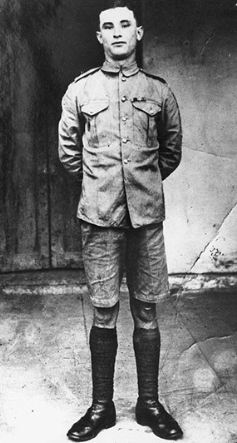
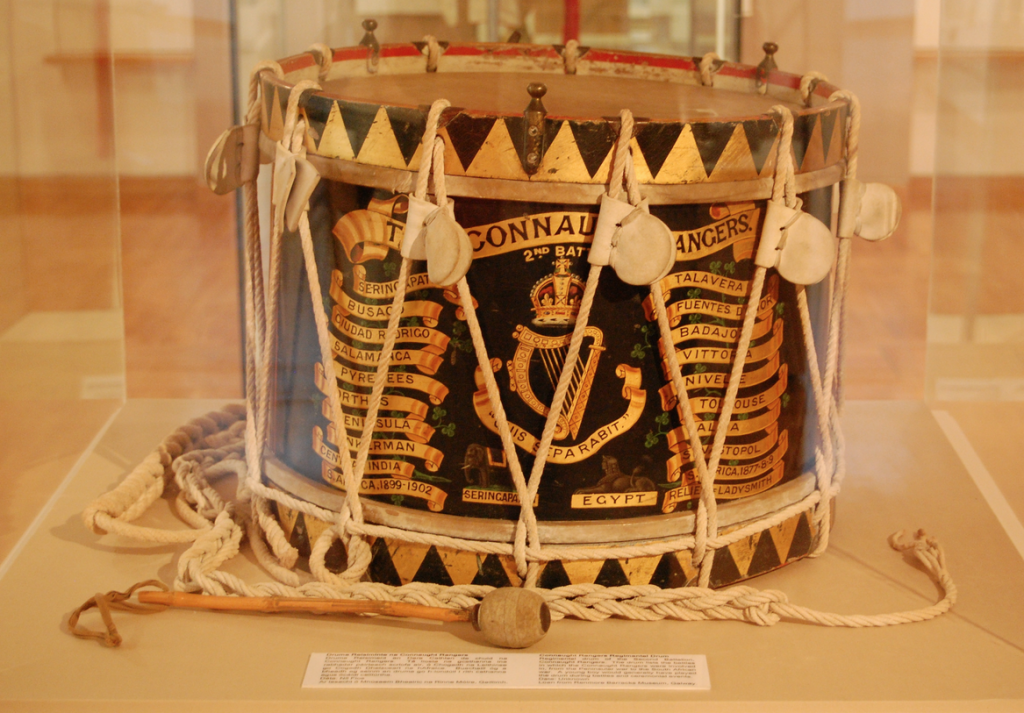
On 12 June 1922, the Connaught Rangers were disbanded along with five other Southern Irish Regiments of the British Army. The ceremony of ‘laying-up’ the colours took place in St George’s Hall, Windsor Castle in the presence of King George V. The Irish Free State had been formed and this saw the withdrawal of the British Army from Ireland. Many of the Rangers, officers and men, joined the new Irish National Army and they brought a lot of military experience to the force. Lieutenant-Colonel Henry Jourdain was the last Officer Commanding the Connaught Rangers. According to one source; he declined an offer from Michael Collins to become Commander-in-Chief of the newly formed Irish National Army in 1922.

One could say that the Connaught Rangers had their origins in the French Revolution. The revolution saw the execution of King Louis XVI on 21 January 1793. There was a fear among many French revolutionaries regarding interference from Britain. The French Revolutionary Government then declared war on Great Britain and Holland. The British army at the time consisted of just 44,000 troops of all ranks. There was an urgent need for Britain to defend the Empire and so a major recruiting campaign began. This included Ireland and on 25 September 1793, the 88th Connaught Rangers were formed by Colonel John Thomas de Burgh (Galway), the Earl of Clanrickarde. The 88th and 94th subsequently became the First and Second Battalions of the Rangers under later military reforms. The regiment became renowned for fearlessness, ferocity and courage in battle, which earned them the nickname, ‘The Devil’s Own’. One General described them as ‘The greatest pack of blackguards in the British Army’.

The Rangers recruited men mainly from around Connacht including Galway City and county. A large percentage of the officers were of Irish and Anglo-Irish origin. The Connacht Ranger dress uniforms were red with yellow facings and their emblem was a harp, topped with a crown. The motto was ‘Who shall separate us’. They first saw action in 1794 during the disastrous Flanders campaign against Napoleon. Despite their inexperience, they fought well; but hundreds perished in the forced winter retreat that followed. The following spring, they were ordered to return to England, where they were joined by new recruits from Ireland. The regiment was then drafted into Sir Ralph Abercrombie’s equally disastrous expedition to the West Indies. After leaving Portsmouth in December 1795, the troop ships ran into severe gales. The vessel carrying the Rangers was blown right through the Straits of Gibraltar and into the Mediterranean Sea, where the ship was destroyed with only a few men surviving.

The war in Europe continued and by 1808, France had achieved domination over much of the continent. Napoleon moved troops through Spain on the pretext of invading Portugal, but instead he dominated the Spanish. The Rangers found themselves caught up in the war. One of their commanders was the famous General Sir Thomas Picton (later killed at Waterloo). The Rangers formed one of his foremost battalions in the war and became renowned for their courage in battle. According to one source, the Duke of Wellington showed the highest confidence in the Rangers, when he remarked, ‘I do not know what effect they will have on the enemy, but they certainly frighten me!’ The Rangers also took a leading role in the successful storming of Ciudad Rodrigo and Badajoz, towns being held by the French. One of their greatest moments was at the battle of Salamanca, where the Rangers again played a vital part in routing the French. The proof of their outstanding courage was soon apparent, as they came away with one of the most prestigious and celebrated war trophies ever captured in battle, the famous ‘Jingling Johnny’.
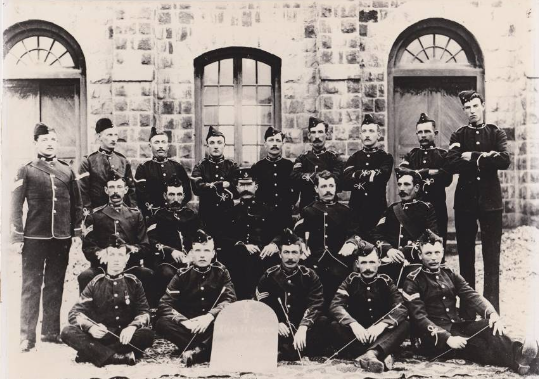
The Rangers continued to see action throughout the nineteenth century. Their tours of duty included Malta, the Ionian Islands, West Indies, Nova Scotia and India. They were also deployed for action in the Crimean War (1854-56). They continued to excel in courage and were noted for their daring in some of the most brutal engagements of the war; including action at the battles of Alma (1854); Inkerman (1854) and the Siege of Sevastopol (1854-55). They also took part in the Second Boer War in South Africa in 1899-1900.
The Rangers saw regular duty in India. Renmore Barracks became the Connaught Rangers Depot soon after it opened in 1880. It was from there that many young men from Galway enlisted during the Great War of 1914-18. Lieutenant-Colonel Jourdain, Officer Commanding, was noted as a very courageous leader by his men. The Rangers proved themselves again throughout this war in some of the bloodiest battles of the conflict; the Somme, Ypres and Gallipoli. Incidentally, the song, ‘It’s A Long Way to Tipperary’ was made famous by the Connaught Rangers. They sang it as they marched out of Boulogne in August 1914. It was practically unknown at the time, but a reporter heard them singing, and it soon became the allies’ signature tune.
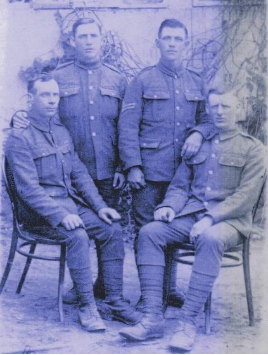
standing on the right
After the war the Connaught Rangers were sent back to India. It was there that the famous mutiny took place. It began on Sunday night 27 June 1920 in Wellington Barracks, Jullundur, Punjab after a group of Rangers were discussing the appalling state of affairs at home. They decided to refuse to obey orders as a protest against the British military committing atrocities in Ireland. They were quickly joined by several hundred other Rangers including Private James Daly. Some of the Rangers attempted to seize weapons from the munitions store. The soldiers guarding the store opened fire killing two of the attackers and seriously wounding another soldier. The military authorities crushed the mutiny. The British were seriously concerned and sixty-one Rangers were taken before a military court-martial and fourteen were initially sentenced to death. All the death sentences were reduced, except Daly, his conviction was upheld. He faced the firing squad at sun-rise in Dagshai Barracks on 2 November 1920. The Indian Mutiny was the final action of the Connaught Rangers, and the irony was that it was their bid to support Irish Freedom.