The Gaelic Athletic Association was founded in November 1884 and the Gaelic League followed in 1893. Branches were formed quickly and spread throughout the Country. The aim of the Gaelic League was to promote and foster all aspects of Gaelic culture – games, language, traditions and beliefs. In Dublin, the Keating’s Football and Hurling Club had a very active men’s committee and with the ladies who supported the teams decided to establish a game for girls, which was based on hurling and the rules of hurling. Tadg O’Donoghue, a well-known Gaelic scholar, invented the name for the new game. It was called Camoguidheacht, and the stick was called a camóg. This was based on the Gaelic word for hurley – camán and Camóg (óg) was a young hurley, thus Camoguidheacht was born.
In 1903, Camogie was formed in the Keating’s Club in Dublin and in 1904 officers were appointed and 1905 rules and a constitution were printed for this new game. Practice matches were already being played despite prejudice against women in sport. A second club was formed, and this Cuchulainn’s Club played against Keating’s in 1904 and was supported and promoted by the local Gaelic League. The game attracted a lot of attention and further games took place. By 1906 the interest was widespread and included Galway. In June 1906 the Galway Observer included an article introducing this ‘new game’ for girls. It described it as a gentle kind of hurling! At the time of writing the new club had already about thirty members and its formation and organisation were attributed to Miss Una McDonagh who was captain. A Miss Cremin was treasurer and a Miss Gibbons was secretary.
The only condition for membership was ‘membership of the Gaelic League’ and practices were being held twice a week in a field given by Martin McDonagh (no relation of the captain). Many years later, Una McDonagh described to me (her granddaughter), going to Mr. McDonagh to ask for use of the field for camogie. He, according to her, almost fell off his chair laughing at the idea of women playing such a game. Not alone at the whole idea, but also the fact that they wore long skirts and frilly blouses with long sleeves. Despite this reaction he allowed them to use his field!
At this time, in early 1906, teams were formed in Ballygar, Mountbellew and Oughterard. The Galway Observer of 2 June 1906 gave an account of a game between Athlone Gaelic League and the Galway City team:
On 23 June 1906 in the heaviest downpour of rain we have had this year, the Galway Gaelic League met the girls of the Athlone Gaelic League in a friendly match of camogauigeacht. They played at Shantalla in the presence of a large crowd which would have been many times larger had not the awful thunderstorm raging when the game began. But the roaring of the heavens could not deter those plucky ladies and sportsmen alike, they played the match to a finale. It was very courageous to play at all on such an evening; more courageous was it for our Galway girls to try their strength with but two months knowledge of the game. Yet they played wonderfully, and the spectators generously acknowledged their cleverness. They were the heavier team, it is true, but this was rather a disadvantage on a day like last Sunday. For novices their play was a revelation.
Without at all wishing to single out individuals for particular mention we cannot, however, help saying that the Captain, Miss Una McDonagh, Miss Spelman, Miss Gibbons and Miss Doyle are worthy of the highest praise. As already mentioned, the work of the home team was fine, but these four ladies gave a most excellent display. We feel sure that with a little more practice the Galway team need not fear to meet any in the country. And honour, where honour is due, we cannot speak too highly of the Athlone team. We congratulate them and but for the certainty of a rainy day we would hope they might meet our girls in friendly encounters often again.
During the early days of Camogie there was opposition from society in general towards women partaking in physical sports, some of this was voiced as interfering with their ability to have children, be mothers, and be good homemakers. In addition, British rule in Ireland didn’t allow crowds to gather and matches were often stopped. Crowds were baton charged (1918 at Kilbeacanty) a fixture at Gurteen between ‘Gurteen and Skehana’ was prevented by the police.
In 1911, Cait O’Donoghue, who was national organiser of the Camogie Association contacted her Gaelic League colleagues in the Universities with a view to encouraging the formation of Camogie clubs there. She sought the support of Dr. Douglas Hyde, who was in favour of the ladies of the National University playing this game. This helped counteract some of the opposition to women participating in sport. A noted Gaelic scholar, Dr. Agnes O’Farrelly, who published under the name of ‘Una Uladh’ was an executive member of the Gaelic League and prevailed on her friend William Gibson, Lord Ashbourne, to donate a trophy for the impending inter-university camogie competition. He was a Trinity graduate and became President of the Gaelic League. He bestowed the Ashbourne Cup to encourage the game and advance social life amongst the ladies of the National University. His name added prestige to the future competition.
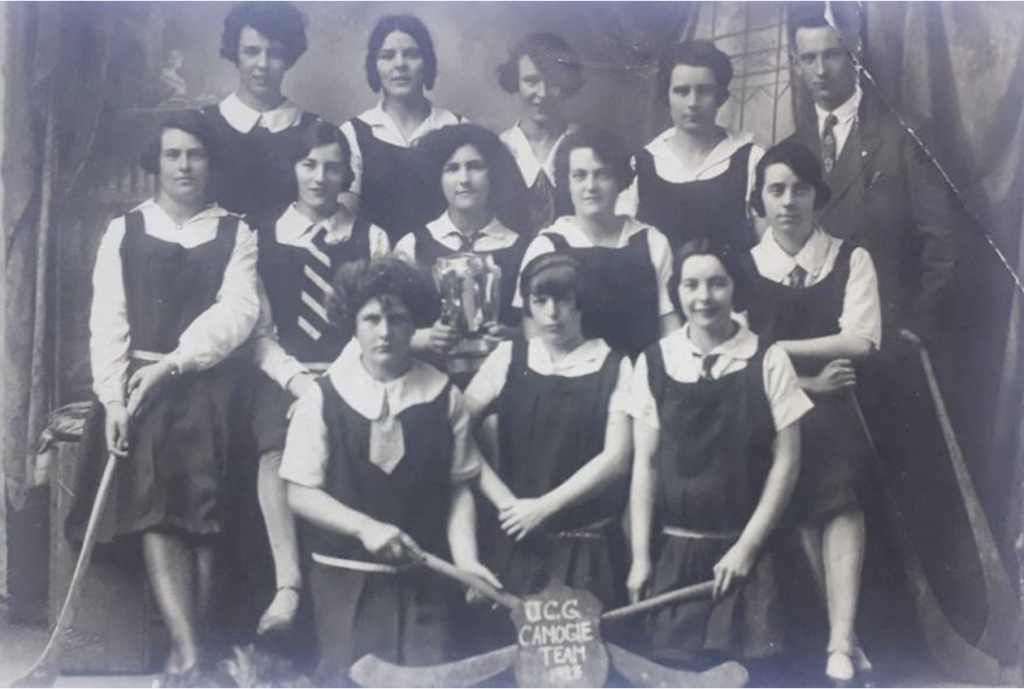
Initially, University College Galway (UCG) didn’t submit a team in 1915 as there weren’t enough females attending college who were interested. A central council ruling was made which enabled UCC and UCG to draft in players (maximum of 3) from amongst non-university players to form teams. Vi Bodkin, who had forgotten about the ruling, was worried about the players she included in UCG teams as Secretary of University Camogie Club; her daughter told me that Vi needed constant reassurance as she neared the end of her life that she did nothing wrong. In 1917, UCG won the Ashbourne Cup and again in 1920, and several years since then.
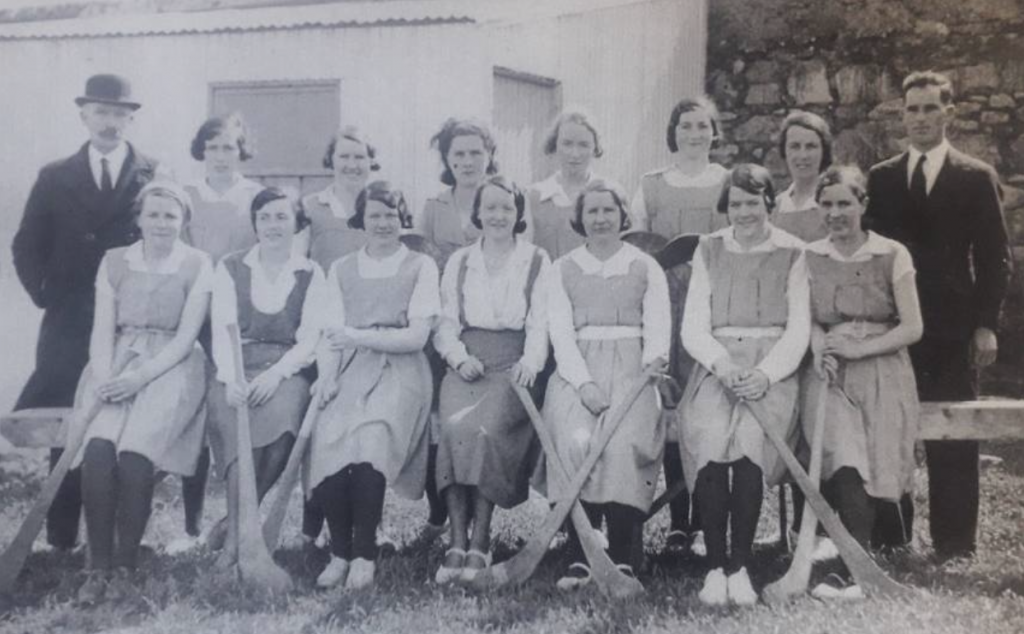
Between 1904 and 1922 teams were formed in Ballygar, Galway, Oughterard, Athenry, UCG, Galway Cumann na mBan, Killoniron, Kilnadeema, Rose Convent (Dominican School), Galway Town, Corrib Stars, Technical Institute, Tuam, Mountbellew, Ballinasloe, Caltra, Moylough, Newcastle, Portumna, Skehanagh, Ballinamore, Gurteen, Derrymullen. These teams using Ladies hurling or in later times Camogie titles played throughout the County at Feiseanna, Aerioht or at venues associated with hurling or football matches.
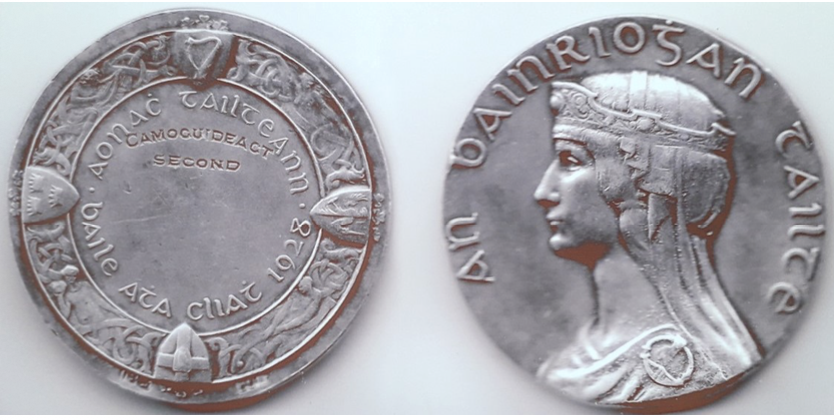
In 1927, there were four teams in Galway City and a competition was organised for a set of medals. Matches were played in Renmore army grounds, South Park and the Sportsground, College Road. The clubs were UCG, Galway Town, Dominican Convent Taylors Hill and the Technical Institute Dominick Street. A meeting was held in the Technical Institute on 4 June 1928. The aim was to form a committee to organise a team to represent Connacht at the Tailteann Games. William Mannion, schoolteacher of Bawnmore, Claregalway, presided. Sean O’Duffy, national organiser of the Camogie Association, attended. He outlined the history of the Association from 1904 and the procedures adopted in the playing of the game generally. He said Connacht was ready for the Tailteann Games and the enthusiasm shown on the day was a signal to the other Provinces to wake up, as it looked as if the West was really awake. Committee Elected: Chairperson S.T. O’Callaghan, Principal of the Technical Institute; Vice-Chair Mick King, Manager of Liptons, Shop Street; Secretary, Tom Farrell, County Footballer; Treasurer Miss Vi Bodkin, UCG.
Several matches were played in preparation for the Tailteann Games. These included a match between a Galway and Dublin selection; Galway won 4-3 to 1-0. Sean O’Duffy was the referee. The games took place in Croke Park on 26 August 1928. Galway, representing Connacht, were drawn against Leinster. There was no entry from Ulster or Munster. Connacht played Dublin (Leinster) in the final, which Leinster won 5-1 to 2-0.
The recently formed County Board organised a competition on a league basis, and by the late 1920s it was firmly established. Currandrum emerged as the strongest team, winning in 1929, 1930 and 1932. They had seven sets of sisters and four others making up the teams. In 1928, UCG defeated the Dominican Convent in the semi-final of the County League but were beaten by the Technical Institute in the final in January 1925, a result 4-1 to 1-1. A player emerged from the games played in 1928 who would have a big influence on Camogie over the next seventeen years – Peg Morris. She played for Tuam, but then represented Headford.
The Tailteann Games of 1932 resulted in victory for Leinster over Connacht. Several names appeared during the games that would regularly appear and form the basis of Galway teams of the future – including Monica Duggan, Josie Melvin, Nora Conroy, Nora Kavanagh, Nora Geary, Una Riordain, Sabina Belton, Madge Tonery, K. Cosgrove and the Elwood sisters. In 1932 Galway took part in the newly organised All Ireland competition and reached the final stages. Galway defeated Louth in the semi-final but lost to Dublin in the final; 3-2 to 0-2. The final was played in July 1933 in Galway Sportsground, and it was the first and only All-Ireland played outside Dublin. This was just but a brief overview of the early history of camogie in Galway.