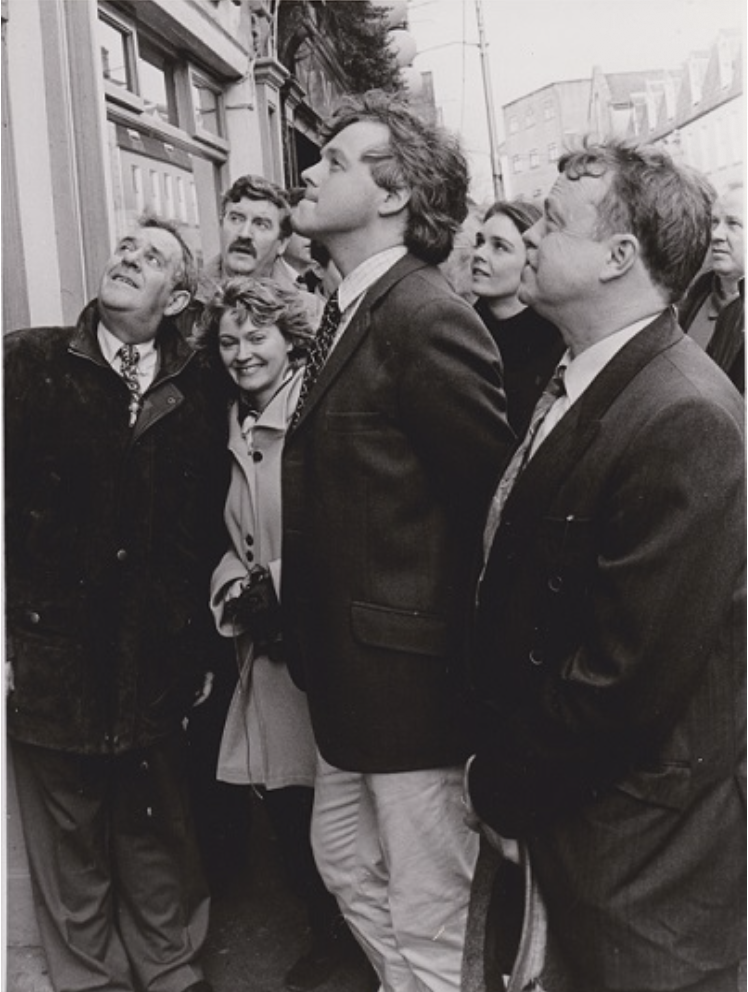
Robert O’Hara Burke was the famous Australian explorer. He was the son of James Hardiman Burke and Anne O’Hara of St Clerans, near Craughwell, County Galway. His father served as Mayor of Galway seven times during the 1820s. The family also owned a townhouse in Dominick Street. According to some sources, Robert O’Hara Burke was born there in 1821. He was baptised in St Nicholas’ Collegiate Church on 30 July 1822. Burke left Ireland when he was fourteen years old and enlisted in the Woolwich Military Academy. He later travelled to Austria and became a Hussar in the Imperial Austrian Army. He returned to Ireland in 1848 and joined the Royal Irish Constabulary. Burke resigned in 1852 and travelled to Australia, where he joined the police force in Victoria.
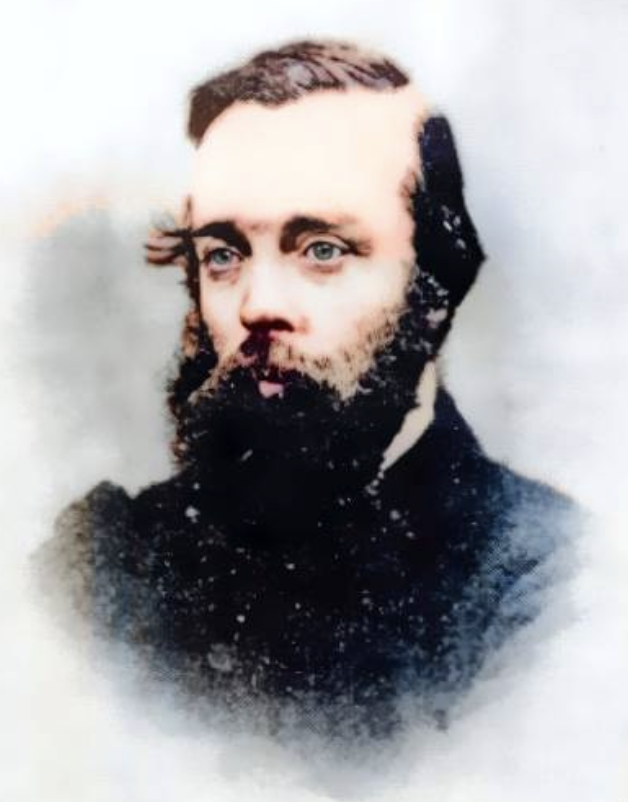
He was later appointed leader of the famous Victorian Exploring Expedition that left Melbourne on 20 August 1860. This was the largest expedition ever assembled in Australia. The purpose of the expedition was to cross the continent. His second in command was William John Wills, and it was this man who recorded their experiences, giving a graphic insight into the expedition. The journey would take them from Melbourne to the Gulf of Carpentaria. They established their main camp at Cooper’s Creek and after leaving William Brahe in charge, Burke set out with three others to reach the gulf (Wills, Charles Gray, and John King). He believed that the journey would be accomplished in three months. Although they reached the gulf on 11 February 1861, it had taken longer than expected. The hardship proved too much for Charles Gray, who died on April 17th. With the sun beating down on them, they managed to bury him in a shallow grave, but lost a day’s march in doing so.
Meanwhile, back on the hills above the Cooper’s Creek camp, a lone horseman, William Brahe, watched every morning for Burke and his party to emerge from the shimmering waste. Nobody came, and except for the Aborigines who visited them from time to time, they were alone in the wilderness. On Sunday morning April 21st Brahe told the men they could wait no longer and decided to leave for Melbourne. He still hoped that Burke would make it back to Cooper’s Creek. He arranged for provisions to be placed in a cache. After placing a note in a bottle explaining their position, he had the cache buried near a Coolibah tree. He marked the spot by carving on the tree the most famous notation in the history of exploration in Australia:
D I G
3 FT. N.W.
APR. 21, 1861
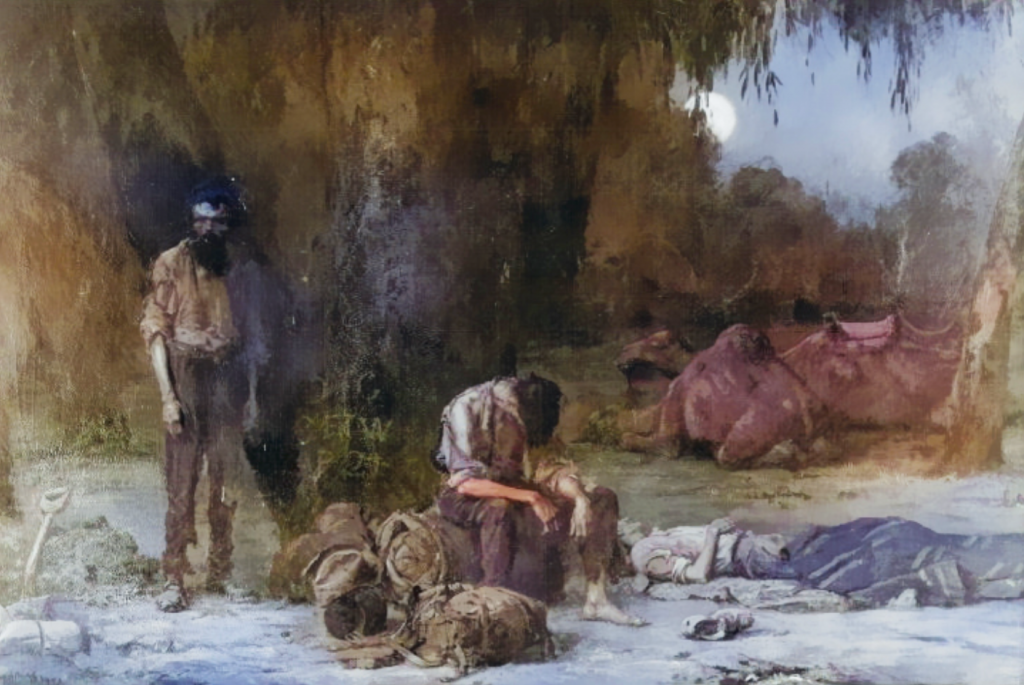
Just over nine hours later, at about 7.30 in the evening, Burke, Wills and King staggered into the camp after force marching the last 30 miles that day. It was a staggering achievement for men in such weakened condition. Their supreme effort was in vain, they were greeted only by the silence of the camp; they had missed their salvation. John Longstaff’s painting captured the scene in graphic detail. In this painting, Burke stands close to the dig tree, looking almost like a ghost looking silently out at the world in disbelief. Wills sits slumped on the camel pack and King, overcome with physical exhaustion, lies on the ground.
They made a number of attempts to leave Cooper’s Creek over the following months, but it proved impossible for them. Wills died in June, followed by Burke in July 1861. King was rescued by the Aborigines. He was cared for and looked after by them until he was eventually found by a rescue party in September and taken back to Melbourne. The story of Burke and Wills is one of the most recorded in Australia.